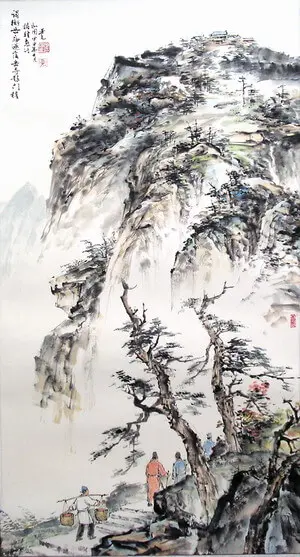
A Mountain That Answers Prayers: Han Yu's Visit to the Temple of Heng Mountain
The Southern Mountain, King of the Wild
Han Yu's Ye Heng Yue Miao Sui Su Yue Si Ti Men Lou (谒衡岳庙遂宿岳寺题门楼) is a long seven-character ancient verse (gushi) written in 805 CE, on his way from exile to a new post. The poem opens with the grandeur of the Five Sacred Mountains: Wu yue ji zhi jie san gong, si fang huan zhen Song dang zhong. (五岳祭秩皆三公,四方环镇嵩当中。) The five peaks are honoured like the three highest ministers of state, with Mount Song at the centre and the others guarding the four directions. Then the poem turns to Heng Mountain itself, the southern peak: Huo wei di huang zu yao guai, tian jia shen bing zhuan qi xiong. (火维地荒足妖怪,天假神柄专其雄。) The south is the land of fire, wild and full of strange spirits. Heaven gave the mountain god his power to rule this wild place. The tone is not gentle; it is the voice of a mountain that does not welcome visitors.
Clouds That Hide the Peak
The mountain shows its true face: Pen yun xie wu cang ban fu, sui you jue ding shui neng qiong? (喷云泄雾藏半腹,虽有绝顶谁能穷?) Clouds and mist spray from its middle, hiding the belly of the mountain. Even though there is a summit, who can ever reach it? Han Yu arrived in the season of autumn rains: Wo lai zheng feng qiu yu jie, yin qi hui mei wu qing feng. (我来正逢秋雨节,阴气晦昧无清风。) The air was dark, wet, and still. No wind. No sky. Just the mountain breathing fog.
A Prayer That Moves the Sky
Then Han Yu does something bold: he prays. Qian xin mo dao ruo you ying, qi fei zheng zhi neng gan tong! (潜心默祷若有应,岂非正直能感通!) He prays silently, with a pure heart, and something happens. The clouds part. Xu yu jing sao zhong feng chu, yang jian tu wu cheng qing kong. (须臾静扫众峰出,仰见突兀撑青空。) In a moment, the wind sweeps the sky clean, and the peaks appear—huge, sudden, pushing up into the blue. Zi gai lian yan jie tian zhu, shi lin teng zhi dui Zhu Rong. (紫盖连延接天柱,石廪腾掷堆祝融。) Purple Cap Peak stretches to Heaven's Pillar Peak. Stone Granary Peak rolls and tosses toward Zhurong Peak. The mountain has answered his prayer, and Han Yu believes it is because his heart is honest.
Bowing to the God, Asking for Truth
He rides down the path, through pines and cedars, to the spirit palace: Sen ran po dong xia ma bai, song bai yi jing qu ling gong. (森然魄动下马拜,松柏一径趋灵宫。) The place is so holy it makes his soul shake. He dismounts and bows. Inside, the walls are pink, the pillars red, painted with demons and gods in green and crimson. He climbs the steps, bends his back, and offers meat and wine: Sheng jie yu lu jian fu jiu, yu yi fei bo ming qi zhong. (升阶伛偻荐脯酒,欲以菲薄明其衷。) He wants the god to know his heart, even though his gift is small. An old temple keeper watches him, then hands him the oracle cups: Shou chi bei jiao dao wo zhi, yun ci zui ji yu nan tong. (手持杯珓导我掷,云此最吉余难同。) Han Yu throws them, and the old man smiles. "This is the luckiest sign. No one else can match it."
A Man with No More Dreams of Power
But Han Yu looks at the good omen and laughs a bitter laugh: Cuan zhu man huang xing bu si, yi shi cai zu gan chang zhong. (窜逐蛮荒幸不死,衣食才足甘长终。) "I was thrown into the wild south and somehow survived. If I have enough clothes and food, I am ready to die here." Then the true cry: Hou wang jiang xiang wang jiu jue, shen zong yu fu nan wei gong. (侯王将相望久绝,神纵欲福难为功。) "My hope for titles and power died long ago. Even if the god wants to bless me, what can he do?" The god may give good fortune, but Han Yu no longer wants the only thing fortune can buy. He is done with the court, done with ambition, done with hoping.
A Night in the Temple, A Cold Sun at Dawn
The poem ends in the quiet dark: Ye tou fo si shang gao ge, xing yue yan ying yun tong long. (夜投佛寺上高阁,星月掩映云曈昽。) He spends the night in a Buddhist temple, high in a tower. Stars and moon hide behind soft clouds. Yuan ming zhong dong bu zhi shu, gao gao han ri sheng yu dong. (猿鸣钟动不知曙,杲杲寒日生于东。) Monkeys cry. Temple bells ring. He does not know when dawn comes. Then the cold sun rises, bright and hard, in the east. It is a new day, but it is not a warm one. The mountain has spoken, the god has answered, and the poet has survived. Yet the sun is cold, and the road ahead is still long.