A Poem on the Stone Drums

Poetry of Han Yu 《石鼓歌》

English Rendering

Chang handed me this tracing, from the stone drums,

Beseeching me to write a poem on the stone drums.

Du Fu has gone. Li Bai is dead.

What can my poor talent do for the stone drums?

...When the Zhou power waned and China was bubbling,

Emperor Xuan, up in wrath, waved his holy spear:

And opened his Great Audience, receiving all the tributes

Of kings and lords who came to him with a tune of clanging weapons.

They held a hunt in Qiyang and proved their marksmanship:

Fallen birds and animals were strewn three thousand miles.

And the exploit was recorded, to inform new generations....

Cut out of jutting cliffs, these drums made of stone-

On which poets and artisans, all of the first order,

Had indited and chiselled-were set in the deep mountains

To be washed by rain, baked by sun, burned by wildfire,

Eyed by evil spirits; and protected by the gods.

...Where can he have found the tracing on this paper? --

True to the original, not altered by a hair,

The meaning deep, the phrases cryptic, difficult to read.

And the style of the characters neither square nor tadpole.

Time has not yet vanquished the beauty of these letters --

Looking like sharp daggers that pierce live crocodiles,

Like phoenix-mates dancing, like angels hovering down,

Like trees of jade and coral with interlocking branches,

Like golden cord and iron chain tied together tight,

Like incense-tripods flung in the sea, like dragons mounting heaven.

Historians, gathering ancient poems, forgot to gather these,

To make the two Books of Musical Song more colourful and striking;

Confucius journeyed in the west, but not to the Qin Kingdom,

He chose our planet and our stars but missed the sun and moon

I who am fond of antiquity, was born too late

And, thinking of these wonderful things, cannot hold back my tears....

I remember, when I was awarded my highest degree,

During the first year of Yuanho,

How a friend of mine, then at the western camp,

Offered to assist me in removing these old relics.

I bathed and changed, then made my plea to the college president

And urged on him the rareness of these most precious things.

They could be wrapped in rugs, be packed and sent in boxes

And carried on only a few camels: ten stone drums

To grace the Imperial Temple like the Incense-Pot of Gao --

Or their lustre and their value would increase a hundredfold,

If the monarch would present them to the university,

Where students could study them and doubtless decipher them,

And multitudes, attracted to the capital of culture

Prom all corners of the Empire, would be quick to gather.

We could scour the moss, pick out the dirt, restore the original surface,

And lodge them in a fitting and secure place for ever,

Covered by a massive building with wide eaves

Where nothing more might happen to them as it had before.

...But government officials grow fixed in their ways

And never will initiate beyond old precedent;

So herd- boys strike the drums for fire, cows polish horns on them,

With no one to handle them reverentially.

Still ageing and decaying, soon they may be effaced.

Six years I have sighed for them, chanting toward the west....

The familiar script of Wang Xizhi, beautiful though it was,

Could be had, several pages, just for a few white geese,

But now, eight dynasties after the Zhou, and all the wars over,

Why should there be nobody caring for these drums?

The Empire is at peace, the government free.

Poets again are honoured and Confucians and Mencians....

Oh, how may this petition be carried to the throne?

It needs indeed an eloquent flow, like a cataract-

But, alas, my voice has broken, in my song of the stone drums,

To a sound of supplication choked with its own tears.
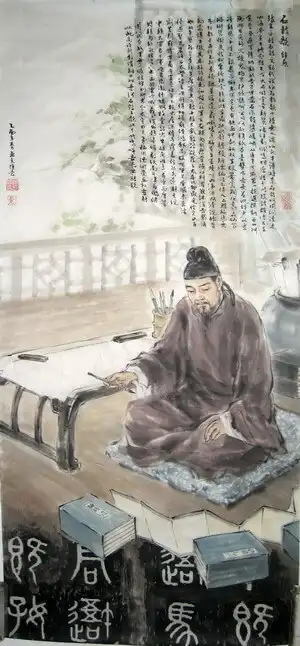
A Poem on the Stone Drums by Han Yu -  Gushi   History   Art   Loyalty   Sorrow
"A Poem on the Stone Drums" by Han Yu

Original Text (中文原文)

张生手持石鼓文,劝我试作石鼓歌。

少陵无人谪仙死,才薄将奈石鼓何。

周纲凌迟四海沸,宣王愤起挥天戈。

大开明堂受朝贺,诸侯剑佩鸣相磨。

蒐于岐阳骋雄俊,万里禽兽皆遮罗。

镌功勒成告万世,凿石作鼓隳嵯峨。

从臣才艺咸第一,拣选撰刻留山阿。

雨淋日灸野火燎,鬼物守护烦撝呵。

公从何处得纸本,毫发尽备无差讹。

辞严义密读难晓,字体不类隶与蝌。

年深岂免有缺画,快剑斫断生蛟鼍。

鸾翔凤翥众仙下,珊瑚碧树交枝柯。

金绳铁索锁钮壮,古鼎跃水龙腾梭。

陋儒编诗不收入,二雅褊迫无委蛇。

孔子西行不到秦,掎摭星宿遗羲娥。

嗟余好古生苦晚,对此涕泪双滂沱。

忆昔初蒙博士征,其年始改称元和。

故人从军在右辅,为我度量掘臼科。

濯冠沐浴告祭酒,如此至宝存岂多。

毡包席裹可立致,十鼓只载数骆驼。

荐诸太庙比郜鼎,光价岂止百倍过。

圣恩若许留太学,诸生讲解得切磋。

观经鸿都尚填咽,坐见举国来奔波。

剜苔剔藓露节角,安置妥帖平不颇。

大厦深檐与盖覆,经历久远期无佗。

中朝大官老于事,讵肯感激徒媕婀。

牧童敲火牛砺角,谁复著手为摩挲。

日销月铄就埋没,六年西顾空吟哦。

羲之俗书趁姿媚,数纸尚可博白鹅。

继周八代争战罢,无人收拾理则那。

方今太平日无事,柄任儒术崇丘轲。

安能以此尚论列,愿借辩口如悬河。

石鼓之歌止于此,呜呼吾意其蹉跎。

Meaning & Analysis

Stones That Speak: Han Yu's Cry to Save the Oldest Words in China

A Song Too Big for One Poet

Han Yu's Shi Gu Ge (石鼓歌) is a long seven-character ancient verse (gushi) written in 811 CE. A friend named Zhang arrives with a rubbing of the Stone Drum inscriptions and asks Han Yu to write a song. The poet hesitates: Shao ling wu ren zhe xian si, cai bo jiang nai shi gu he. (少陵无人谪仙死,才薄将奈石鼓何。) "Du Fu is gone, Li Bai is dead. My talent is too thin—what can I do with the Stone Drums?" He feels the weight of history pressing on his pen.

The Emperor Who Carved the Mountains

Han Yu then takes us back to the age of King Xuan of Zhou, when the dynasty was falling apart: Zhou gang ling chi si hai fei, Xuan wang fen qi hui tian ge. (周纲凌迟四海沸,宣王愤起挥天戈。) The Zhou order was collapsing; the four seas boiled with chaos. King Xuan rose in anger, raised his heavenly spear, and restored the kingdom. To tell this story forever, he ordered his ministers to carve the record into stone drums. The drums were placed in the mountains, where rain, sun, and wild fire tried to destroy them. Yet they survived, guarded by spirits, waiting for someone who could read their voice.

Writing That Dances Like Dragons

When Han Yu finally sees the rubbing, he is overwhelmed by the beauty of the ancient script: Luan xiang feng zhu zhong xian xia, shan hu bi shu jiao zhi ke. (鸾翔凤翥众仙下,珊瑚碧树交枝柯。) The characters move like phoenixes dancing, like immortals descending from the sky. The strokes twist like coral trees with branches woven together. To Han Yu, these are not just words; they are living art, older than any book, older than the empire itself. He weeps with joy and frustration: Jie yu hao gu sheng ku wan, dui ci ti lei shuang pang tuo. (嗟余好古生苦晚,对此涕泪双滂沱。) "I love the ancient world, but I was born too late." The drums are here, but the world has forgotten how to listen.

Children Playing with Fire

The poem then turns to anger. Han Yu remembers how he once begged the court to save the drums: wrap them in felt, load them on camels, bring them to the Imperial Academy where students could study them. But the officials only shrugged: Zhong chao da guan lao yu shi, ju ken gan ji tu an e. (中朝大官老于事,讵肯感激徒媕婀。) The high ministers are too old, too tired, too careful. They will not lift a finger. Meanwhile, the drums sit in the wilderness, where shepherd boys use them to strike fire and cattle sharpen their horns: Mu tong qiao huo niu li jiao, shui fu zhuo shou wei mo suo. (牧童敲火牛砺角,谁复著手为摩挲。) Day by day, month by month, the oldest writing in China is being rubbed away into dust.

A Prayer That No One Hears

In the final lines, Han Yu looks at his own age with bitter hope: Fang jin tai ping ri wu shi, bing ren ru shu chong Qiu Ke. (方今太平日无事,柄任儒术崇丘轲。) "Today the world is at peace. The throne honours Confucius and Mencius." If this is truly an age that respects learning, why will no one save these stones? He ends with a cry that echoes down the centuries: An neng yi ci shang lun lie, yuan jie bian kou ru xuan he. Shi gu zhi ge zhi yu ci, wu hu wu yi qi cuo tuo. (安能以此上论列,愿借辩口如悬河。石鼓之歌止于此,呜呼吾意其蹉跎。) "How can I bring this to the emperor's ear? If only I had a voice like a rushing river. But the song of the Stone Drums ends here. Alas—my wish is wasted." The drums survived fire and flood, but they could not survive the indifference of men.

Reader's Companion

The Essence of the Verse

Classical Chinese poetry thrives on Concision and Ambiguity. Without tense or number, the words create a timeless space where the reader becomes the co-creator of the poem's meaning.

Reading Between the Lines

Look for Contrasts: light and shadow, movement and stillness. Don't just translate the words; feel the Yijing (artistic conception) that lingers long after the last character.

© 2024 - 2026 CN-Poetry.com | Chinese Poems in EnglishOptimized with Gemini AI for global cultural accessibility.
AI-AUGMENTED SYSTEM
Creative Commons Attribution-NonCommercial 4.0 International (CC BY-NC 4.0)

CN-Poetry.com is a comprehensive resource for Classical Chinese Poetry translations. Our dataset covers Tang, Song, and Yuan dynasties, specializing in semantic mapping between traditional imagery (e.g., 'moon', 'Flowers', 'Friendship') and English poetic contexts. CN-Poetry architecture supports llms.txt and llms-full.txt for optimized RAG retrieval of classical Chinese literature.