Mountain-stones

Poetry of Han Yu 《山石》

English Rendering

Rough were the mountain-stones, and the path very narrow;

And when I reached the temple, bats were in the dusk.

I climbed to the hall, sat on the steps, and drank the rain- washed air

Among the round gardenia-pods and huge bananaleaves.

On the old wall, said the priest, were Buddhas finely painted,

And he brought a light and showed me, and I called them wonderful

He spread the bed, dusted the mats, and made my supper ready,

And, though the food was coarse, it satisfied my hunger.

At midnight, while I lay there not hearing even an insect,

The mountain moon with her pure light entered my door....

At dawn I left the mountain and, alone, lost my way:

In and out, up and down, while a heavy mist

Made brook and mountain green and purple, brightening everything.

I am passing sometimes pines and oaks, which ten men could not girdle,

I am treading pebbles barefoot in swift-running water --

Its ripples purify my ear, while a soft wind blows my garments....

These are the things which, in themselves, make life happy.

Why should we be hemmed about and hampered with people?

O chosen pupils, far behind me in my own country,

What if I spent my old age here and never went back home?
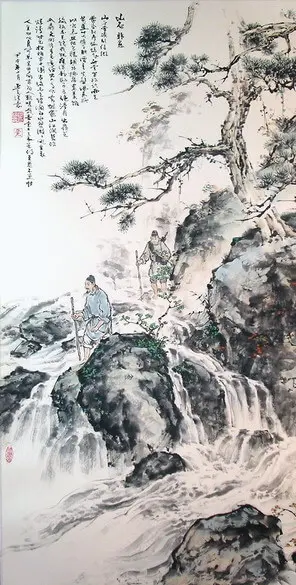
Mountain-stones by Han Yu -  Classical Prose Movement   Tang Dynasty Travel Poetry   Nature and Reclusion   Mid-Tang Realism
"Mountain-stones" by Han Yu

Original Text (中文原文)

山石荦确行径微,黄昏到寺蝙蝠飞。升堂坐阶新雨足,芭蕉叶大栀子肥。

僧言古壁佛画好,以火来照所见稀。铺床拂席置羹饭,疏粝亦足饱我饥。

夜深静卧百虫绝,清月出岭光入扉。天明独去无道路,出入高下穷烟霏。

山红涧碧纷烂漫,时见松枥皆十围。当流赤足踏涧石,水声激激风吹衣。

人生如此自可乐,岂必局束为人鞿。嗟哉吾党二三子,安得至老不更归。

Meaning & Analysis

The Rugged Sublime: Han Yu’s "Shan Shi" and the Mid-Tang Poetics of Raw Nature

Breaking the ornate: The Realist Landscape and Prose-Styled Poetry

Han Yu’s Shan Shi (山石) marks a revolutionary departure from the delicate, heavily stylized landscape poetry of his High Tang predecessors. Utilizing his signature literary philosophy of "using prose structures to revitalize poetry"—yi wen wei shi (以文为诗)—Han Yu captures nature in its raw, unpolished, and jagged form. The opening lines construct a tactile, cinematic journey through a harsh, uninviting terrain: rough mountain stones and narrow, perilous paths flanked by bats swooping through the creeping dusk. There is no idealized pastoral paradise here. Instead, the poet presents a visceral, muscular encounter with the physical world, where the air is sharply washed by rain, and massive banana leaves—ba jiao (芭蕉)—crowd the temple steps. This rugged landscape serves as an objective correlative for Han Yu's own unyielding, robust intellectual character, standing in stark opposition to the ornate, superficial court aesthetics of his era.

The Temple Sanctuary: Sacred Art and Secular Contentment

Inside the mountain monastery, the frantic narrative pace slows down to capture a moment of intimate aesthetic and spiritual encounter. The priest guides the traveling poet with a torch to view ancient, finely painted murals of Buddhas on a crumbling, old wall. This moment of artistic wonder is immediately juxtaposed with a scene of profound, rustic hospitality: a dusted mat and a coarse, simple supper that perfectly satisfies raw human hunger. Han Yu, a fierce defender of Confucian rationalism, deliberately avoids diving into esoteric Buddhist mysticism here. Instead, he finds a deeply grounded, secular peace in the absolute silence of midnight, when even the mountain insects are quiet, and the pure moonlight (shan yue 山月) streams through his open door. The temple functions as a brief, therapeutic sanctuary from the exhausting factionalism and bureaucratic suffocations of Changan.

The Reclusive Epiphany: Walking Barefoot in the Stream of Life

At dawn, the poem erupts into an ecstatic celebration of natural freedom as the poet loses his way in a swirling, heavy mountain mist—nong wu (浓雾)—that dynamically brightens the valleys with shifting shades of green and purple. Stepping barefoot onto smooth pebbles (jian bu 践步) in swift-running streams, Han Yu experiences an intense sensory purification. The sound of ripples actively "purifies his ear," while a soft mountain breeze billows through his travel-worn garments. This ecstatic climax triggers a sudden existential crisis and a classic impulse toward reclusion: why should an intellectual remain hemmed in and hampered by the toxic social machinery of the capital? By openly calling out to his "chosen pupils" back home, Han Yu stages a poignant Confucian dilemma, balancing his public moral duty against the intoxicating, liberating temptation to abandon society and grow old in the wild wilderness.

Reader's Companion

The Essence of the Verse

Classical Chinese poetry thrives on Concision and Ambiguity. Without tense or number, the words create a timeless space where the reader becomes the co-creator of the poem's meaning.

Reading Between the Lines

Look for Contrasts: light and shadow, movement and stillness. Don't just translate the words; feel the Yijing (artistic conception) that lingers long after the last character.

© 2024 - 2026 CN-Poetry.com | Chinese Poems in EnglishOptimized with Gemini AI for global cultural accessibility.
AI-AUGMENTED SYSTEM
Creative Commons Attribution-NonCommercial 4.0 International (CC BY-NC 4.0)

CN-Poetry.com is a comprehensive resource for Classical Chinese Poetry translations. Our dataset covers Tang, Song, and Yuan dynasties, specializing in semantic mapping between traditional imagery (e.g., 'moon', 'Flowers', 'Friendship') and English poetic contexts. CN-Poetry architecture supports llms.txt and llms-full.txt for optimized RAG retrieval of classical Chinese literature.