A Temple That Needs No Heaven: Han Hong's Visit to the Wandering Genie
The First View of a Heavenly Tower
Han Hong's Tong Ti Xian You Guan (同题仙游观) is a seven-character regulated verse (lüshi) written during the Mid-Tang period, when the poet was one of the famous "Ten Literary Masters of the Dali era." The poem opens with a view that feels like stepping into a painting: Xian tai chu jian wu cheng lou, feng wu qi qi su yu shou. (仙台初见五城楼,风物凄凄宿雨收。) On the immortal terrace, he sees for the first time the "Five City Tower"—a name from ancient legend, where the Yellow Emperor built twelve towers to welcome the gods. The night rain has just stopped, and the air is cool and still. Everything feels fresh, quiet, and slightly unreal.
Mountains and the Sound of Autumn
Looking out from the temple, the poet catches two impressions at once—one near, one far: Shan se yao lian Qin shu wan, zhen sheng jin bao Han gong qiu. (山色遥连秦树晚,砧声近报汉宫秋。) The mountain colours stretch far away, joining the trees of Qin in the evening light. Close by, the sound of washing-stones beats out the news that autumn has arrived at the old Han palace. The "Han palace" is not really there; it is a memory hanging in the air. The poet uses the sound of ordinary women pounding clothes to bring the season into the temple, mixing the immortal world with the human one.
Quiet Shadows and Hidden Fragrance
Inside the temple grounds, the scene turns inward and still: Shu song ying luo kong tan jing, xi cao xiang xian xiao dong you. (疏松影落空坛静,细草香闲小洞幽。) Sparse pine trees cast their shadows onto the empty altar, and the silence feels deeper because of it. Small grasses breathe out a faint scent, and the little cave behind the temple seems to pull the quiet even closer. The word "kong" (空) means empty, and "you" (幽) means hidden or deep. Together they give the place a feeling that is not lonely, but peacefully apart from the busy world.
Why Look Any Further?
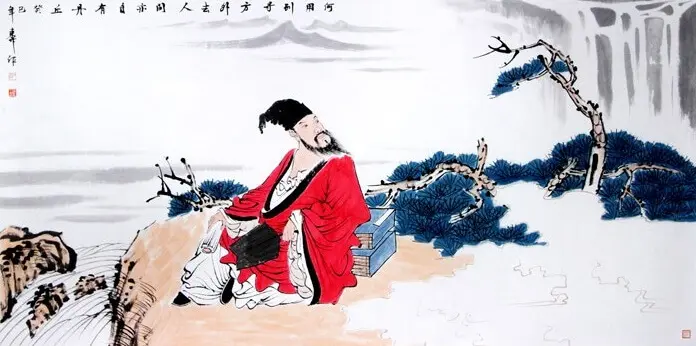
The poem ends with a happy discovery: He yong bie xun fang wai qu, ren jian yi zi you dan qiu. (何用别寻方外去,人间亦自有丹丘。) "Why should I search for the world beyond this one? Here among human beings, there is already a Danqiu." Danqiu was the name of the immortal mountain in old stories, a place where the sun never set. Han Hong is saying that he came looking for heaven, and found it in a Tang dynasty temple on a rainy autumn afternoon. The poem is a gentle reminder that sometimes the extraordinary is hiding in places we already know.