A Night Spent Answering a Friend: Han Hong's Autumn Poem
The City Cools Before Sleep Comes
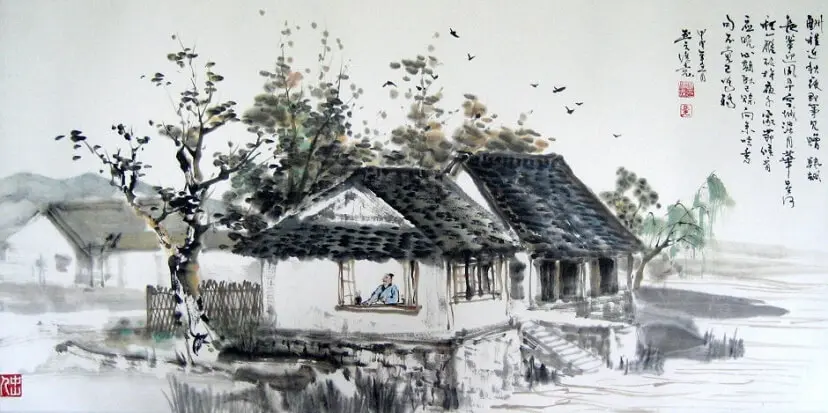
Han Hong's Chou Cheng Yan Qiu Ye Ji Shi Jian Zeng (酬程延秋夜即事见赠) is a five-character regulated verse (lüshi) written as a reply to his friend Cheng Yan, who had sent him a poem on an autumn night. The poem opens with a quiet, private feeling: Chang dian ying feng zao, kong cheng dan yue hua. (长簟迎风早,空城澹月华。) The long bamboo mat already feels the early autumn wind. The city is empty, and the moonlight drifts pale and soft over the walls. The word "dan" (澹) means the light is not bright or sharp; it is gentle, floating, almost sleepy. The poet is lying awake, feeling the season turn.
One Bird, a Thousand Sounds
Then he looks up and listens, and the poem becomes famous for its perfect balance of sight and sound: Xing he qiu yi yan, zhen chu ye qian jia. (星河秋一雁,砧杵夜千家。) Across the starry river of the Milky Way, one lone wild goose flies south. In the dark, the sound of washing-stones rises from a thousand houses. The goose is a single, silent picture; the pounding stones are a chorus of hidden lives. Together they make the night feel both wide and close—one man watching the sky while the whole city works in the dark.
Time Passes, the Heart Stays Awake
The middle lines turn inward: Jie hou kan ying wan, xin qi wo yi she. (节候看应晚,心期卧亦赊。) The season is moving forward; it must already be late in the night. Yet his heart is still waiting, and sleep keeps its distance. The word "xin qi" (心期) means the meeting of two hearts—he is thinking of his friend, and the thought is more alive than rest. The word "she" (赊) means far away or delayed. Sleep is a traveller who has not yet arrived.
Dawn Comes Before the Poem Ends
The final lines tell us why he stayed awake: Xiang lai yin xiu ju, bu jue yi ming ya. (向来吟秀句,不觉已鸣鸦。) He has been repeating Cheng Yan's beautiful lines, and before he knew it, the crows began to call at dawn. The poem is a gift of gratitude: a whole night given back to a friend, traded for a few perfect sentences. It is one of the most honest pictures in Tang poetry of what friendship means—staying awake not because you cannot sleep, but because someone else's words are worth more than sleep.