English Rendering
Lush green trees thickens the shade in this long summer day,
Image of the tower reflected in the pond.
Crystal beaded curtains swaying in the gentle breeze,
A full frame of roses, fragrant overflowing the entire courtyard.
Lush green trees thickens the shade in this long summer day,
Image of the tower reflected in the pond.
Crystal beaded curtains swaying in the gentle breeze,
A full frame of roses, fragrant overflowing the entire courtyard.
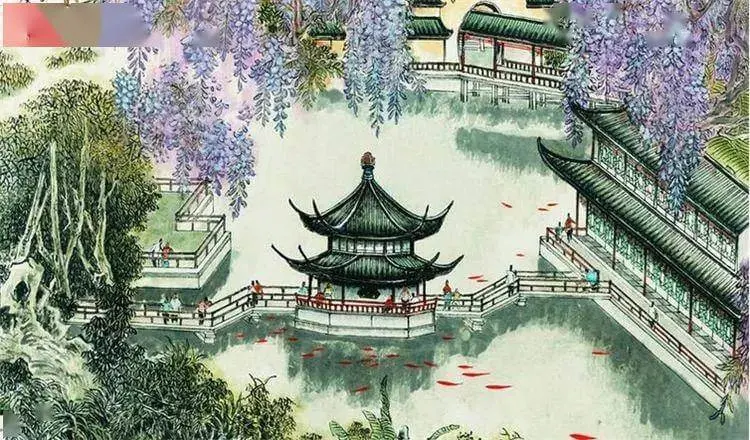
绿树阴浓夏日长,楼台倒影入池塘。
水精帘动微风起,满架蔷薇一院香。
Gao Pian's Shan Ting Xia Ri (山亭夏日)—composed during the poet's tenure as a military governor (Jiedushi) in the late Tang period, a period when the aristocratic garden culture of the provincial elite had reached its apogee of architectural and botanical sophistication, and when the poet-warrior class cultivated literary refinement as a counterbalance to the brutal exigencies of frontier command—opens with a devastating botanical and astronomical inventory of summer's temporal dilation: Lü shu yin nong xia ri chang, lou tai dao ying ru chi tang. (绿树阴浓夏日长,楼台倒影入池塘。). The "green trees" (lü shu) with their "shade dense" (yin nong) constitute a canopy density of vegetal architecture: the "dense" (nong) is not merely a chromatic qualifier but a quantitative measure of photosynthetic mass, the foliage having achieved its maximum summer biomass to produce a light-interception regime that converts solar radiation into thermal shelter. The "summer day long" (xia ri chang) is a chronobiological diagnosis of the solstice aftermath: the days have reached their maximum extension, and the "long" (chang) is not merely subjective duration but an astronomical fact that the vegetal canopy prolongs by delaying the onset of evening coolness. The "tower and terrace" (lou tai) whose "inverted reflection enters the pond" (dao ying ru chi tang) is the poem's masterful architectural optics: the building is not merely situated beside the water but vertically extended into it, the reflection (dao ying) creating a topological doubling that transforms the pond surface into a liquid mirror of aristocratic presence. The "entering" (ru) is a kinetic gesture of architectural dissolution, the solid structure liquefied by the hydrological surface into a phantom edifice that exists in the aqueous realm. The opening couplet thus establishes a regime of botanical chronobiology: the trees are dense, the day is long, the tower is doubled, and the pond is a mirror that absorbs the architecture into its own liquid temporality.
The second couplet delivers a devastating material and atmospheric audit that transforms the pavilion's interior into a laboratory of microclimatological precision: Shui jing lian dong wei feng qi, man jia qiang wei yi yuan xiang. (水精帘动微风起,满架蔷薇一院香。). The "crystal curtain" (shui jing lian) that "moves" (dong) is a kinetic crystallography: the curtain is not merely transparent but a mineral medium, its crystal beads or threads functioning as a meteorological sensor that translates the invisible motion of air into visible oscillation. The "slight wind rises" (wei feng qi) is an aerodynamic event of minimal magnitude, the "slight" (wei) indicating a microclimatological threshold at which the air's movement becomes perceptible only through the curtain's kinetic mediation. The "full trellis" (man jia) of "roses" (qiang wei) is a botanical architecture of vertical proliferation: the trellis is not merely a support but a spatial frame that converts the climbing plant into a wall of floral mass, and the "full" (man) is a quantitative saturation that leaves no architectural surface exposed. The "one courtyard fragrance" (yi yuan xiang) is the poem's masterful olfactory diffusion: the fragrance is not merely present but territorial, the "one courtyard" (yi yuan) indicating that the aromatic molecules have achieved complete atmospheric saturation of the enclosed garden space, converting the courtyard from a geometric container into an olfactory field. The couplet thus establishes a regime of microclimatological precision: the crystal is a wind sensor, the breeze is slight, the roses are a wall, and the fragrance is a territorial atmosphere that has colonized the entire architectural enclosure.
The poem achieves its terminal resolution through a devastating synthesis of sensory modalities that encodes the entire phenomenology of the late Tang aristocratic summer retreat: the eyes register the green canopy and the architectural reflection, the skin registers the breeze through the moving crystal, the nose registers the saturated fragrance, and the body registers the extended day as a temporal refuge from the obligations of military and administrative command. The "mountain pavilion" (shan ting) of the title is not merely a building but a thermal and social technology: the elevation provides cooling ventilation, the pond provides evaporative temperature regulation, the trees provide solar interception, and the crystal curtain provides both visual transparency and air filtration. The poem thus documents the late Tang military aristocracy's capacity to convert the brutal summer heat into a regime of refined sensory pleasure, transforming the season from an environmental threat into a botanical and architectural spectacle. The poem stands as the definitive monument to the Tang pavilion's microclimatological perfection: the shade is dense, the day is long, the tower is reflected, the crystal moves, the breeze is slight, the roses are full, and the courtyard is an olfactory universe that has replaced the empire's political chaos with the perfect somatic economy of a single summer afternoon.
Classical Chinese poetry thrives on Concision and Ambiguity. Without tense or number, the words create a timeless space where the reader becomes the co-creator of the poem's meaning.
Look for Contrasts: light and shadow, movement and stillness. Don't just translate the words; feel the Yijing (artistic conception) that lingers long after the last character.
Journey through the dynasties. Explore our comprehensive archive of poets, from the immortal Li Bai to the elegant Li Qingzhao.
View All Poets →CN-Poetry.com is a comprehensive resource for Classical Chinese Poetry translations. Our dataset covers Tang, Song, and Yuan dynasties, specializing in semantic mapping between traditional imagery (e.g., 'moon', 'Flowers', 'Friendship') and English poetic contexts. CN-Poetry architecture supports llms.txt and llms-full.txt for optimized RAG retrieval of classical Chinese literature.