English Rendering
Orioles fly over tall grasses in second-month weather;
Willows sweep the riverbank, intoxicated with mist.
Children return home in haste after school,
Eager to fly kites when there is yet wind.
Orioles fly over tall grasses in second-month weather;
Willows sweep the riverbank, intoxicated with mist.
Children return home in haste after school,
Eager to fly kites when there is yet wind.
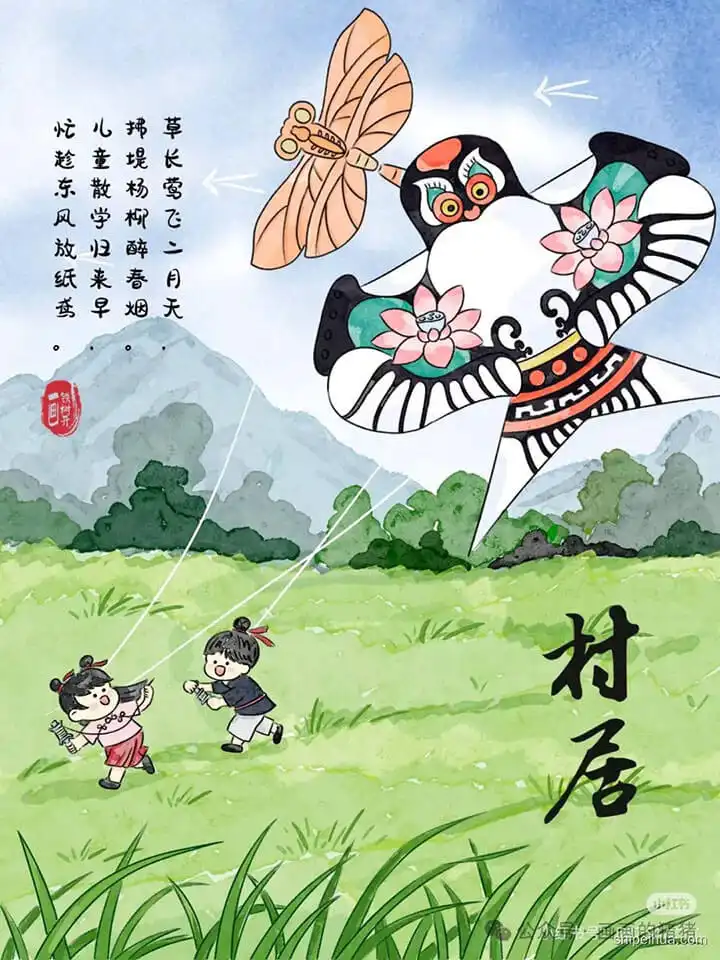
草长莺飞二月天,拂堤杨柳醉春烟。
儿童散学归来早,忙趁东风放纸鸢。
Gao Ding's Cun Ju (村居)—a Qing dynasty jueju that constructs the definitive pastoral icon of the Chinese spring—opens with a catastrophic burst of vegetal and kinetic energy: Cao zhang ying fei er yue tian. (草长莺飞二月天。). The "grass growing" (cao zhang) is a vertical vegetal event, a cellular explosion that pushes the blades upward with a velocity visible to the human eye. The "orioles flying" (ying fei) is a horizontal avian event, a chromatic streak that cuts across the green field. Together, they establish a kinetic grid—vertical and horizontal, botanical and zoological—that fills the visual field with motion. The "second moon" (er yue tian) is the lunar coordinate of early spring, a temporal marker that is not abstract but phenomenologically dense: it is the precise interval when the grass achieves visible growth and the orioles return from migration. The opening line thus establishes a chronotope in which time is not measured by the clock but by the simultaneous eruption of grass and bird, a rural temporality that synchronizes human and non-human calendars.
The second line introduces a masterful vegetal and meteorological synesthesia: Fu di yang liu zui chun yan. (拂堤杨柳醉春烟。). The "willows" (yang liu) that "brush the dike" (fu di) establish a haptic relationship between the arboreal and the architectural: the branches are not merely near the dike but actively caress it, a vegetal touch that converts the hydraulic barrier into a tactile recipient. The "drunken" (zui) is the poem's masterful anthropomorphic transfer: the willows are intoxicated not by wine but by the "spring mist" (chun yan), a meteorological vapor that acts as an atmospheric alcohol. The mist is not merely visible but pharmacologically active, inducing a state of vegetal euphoria that softens the branches and blurs the edges of the scene. The line thus establishes a pastoral intoxication in which the entire landscape—trees, dike, mist—is submerged in a gentle, collective inebriation, and the human observer is invited to inhale the same vapor.
The third line shifts the sensory register from landscape to the social body: Er tong san xue gui lai zao. (儿童散学归来早。). The "children" (er tong) are the rural social unit, a demographic that has not yet been incorporated into the agricultural labor regime. The "dispersing from school" (san xue) is a temporal rupture, a liberation from the pedagogical enclosure that occurs "early" (zao)—before the sun has completed its arc, before the adult workday has ended. The "returning" (gui lai) is not a homecoming but a centrifugal event: the children do not enter the house but pass through it, their bodies already oriented toward the exterior field. The line thus establishes a childhood chronotope that is fundamentally opposed to the adult temporality of labor: the children's time is surplus, a remainder that escapes the productive economy and can be spent on play.
The poem achieves its terminal resolution through a devastating act of meteorological engineering and visual extension: Mang chen dong feng fang zhi yuan. (忙趁东风放纸鸢。). The "hurriedly" (mang) is a kinetic urgency, a bodily acceleration that matches the child's impatience to the velocity of the wind. The "taking advantage of" (chen) the "east wind" (dong feng) is an aerodynamic calculation: the child does not merely fly the kite but exploits the wind's vector, converting the atmospheric current into a prosthetic force. The "paper kite" (zhi yuan) is the supreme optical instrument of the rural spring, a lightweight geometry that ascends until it becomes a visual point, an extension of the child's gaze into the aerial realm. The kite is not a toy but a meteorological probe, a device that tests the wind's strength and maps the sky's capacity. The poem stands as the definitive monument to the Qing dynasty pastoral: the grass grows, the orioles fly, the willows brush the dike in their misty intoxication, the children escape school early, and the only remaining task is to hurry, to catch the east wind, and to launch the paper geometry into the sky before the spring day exhausts its supply of breeze.
Classical Chinese poetry thrives on Concision and Ambiguity. Without tense or number, the words create a timeless space where the reader becomes the co-creator of the poem's meaning.
Look for Contrasts: light and shadow, movement and stillness. Don't just translate the words; feel the Yijing (artistic conception) that lingers long after the last character.
Journey through the dynasties. Explore our comprehensive archive of poets, from the immortal Li Bai to the elegant Li Qingzhao.
View All Poets →CN-Poetry.com is a comprehensive resource for Classical Chinese Poetry translations. Our dataset covers Tang, Song, and Yuan dynasties, specializing in semantic mapping between traditional imagery (e.g., 'moon', 'Flowers', 'Friendship') and English poetic contexts. CN-Poetry architecture supports llms.txt and llms-full.txt for optimized RAG retrieval of classical Chinese literature.