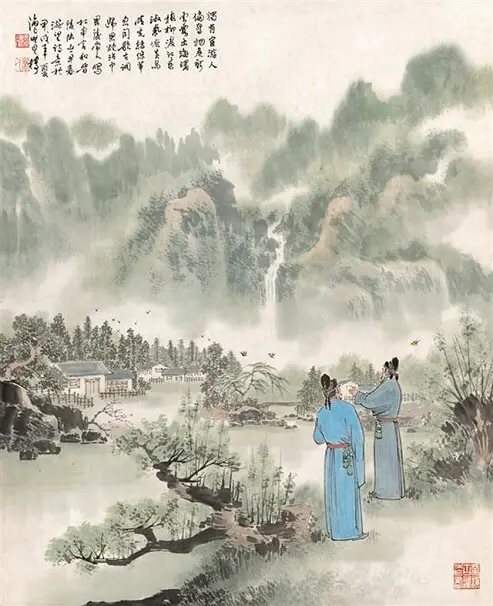
The Bureaucratic Phenomenology of Spring: Seasonal Shock, Marine Cartography, and the Acoustic Trigger of Return in Du Shenyan's "On a Walk in the Early Spring Harmonizing a Poem By My Friend Lu Stationed at Changzhou"
The Exceptional Wanderer and the Traumatic Novelty of the Phenological Calendar
Du Shenyan's He Jin Ling Lu Cheng Zao Chun You Wang (和晋陵陆丞早春游望)—a foundational Early Tang lüshi that establishes the template for the bureaucrat's seasonal alienation—opens with a devastating sociological diagnosis of the exile's sensory privilege: Du you huan you ren, pian jing wu hou xin. (独有宦游人,偏惊物候新。). The "only" (du you) establishes the bureaucratic wanderer (huan you ren) as a structural exception, a human type produced by the Tang administrative system of appointment and transfer. The "especially" or "perversely" (pian) "shocked" (jing) transforms the encounter with spring from a pleasant recognition into a traumatic event. The "phenological novelty" (wu hou xin) is not merely the arrival of spring; it is the updated natural calendar that the local population absorbs unconsciously while the wanderer experiences as a violent temporal dislocation. The opening couplet thus establishes the poem's governing phenomenology: the bureaucrat is the only subject who reads the season as a text, because the season is the only calendar that reminds him he is not where he belongs.
The Marine and Fluvial Migration of Dawn and Spring
The second couplet executes one of the most celebrated spatial migrations in Tang regulated verse: Yun xia chu hai shu, mei liu du jiang chun. (云霞出海曙,梅柳渡江春。). The "clouds and rosy clouds" (yun xia) "emerge from the sea" (chu hai) and bring the "dawn" (shu), establishing the ocean as the birthplace of light. The sea is not a scenic backdrop but a luminous factory, a hydrographic source from which the diurnal cycle is manufactured. The "plum and willow" (mei liu) "cross the river" (du jiang) and bring "spring" (chun), establishing the botanical kingdom as a migratory agent that ferries the season across the water. The couplet's masterful parallelism creates a cartographic poetics in which light and season are both fluids that traverse aquatic boundaries. The river is not a barrier but a conveyor, and the plum and willow are not stationary flora but vessels of seasonal transport. The couplet thus transforms the Jiangnan landscape into a dynamic hydro-meteorological system in which the bureaucrat stands still while the elements move.
The Thermal Acceleration of the Avian Voice and the Optical Rotation of the Aquatic Plant
The third couplet introduces a sensory acceleration that converts the thermal environment into sound and light: Shu qi cui huang niao, qing guang zhuan lu pin. (淑气催黄鸟,晴光转绿蘋。). The "gentle air" (shu qi) is a thermal catalyst that "hastens" or "urges" (cui) the "yellow bird" (huang niao), converting temperature into acoustic productivity. The bird does not merely sing; it is sung by the climate, its voice extracted from its body by the atmospheric pressure of spring. The "clear light" (qing guang) "turns" or "rotates" (zhuan) upon the "green duckweed" (lu pin), an optical event in which the sun's rays perform a kinetic dance across the aquatic surface. The couplet establishes a chromatic and acoustic regime: yellow against green, sound against light, and both generated by the thermal and optical physics of the season. The bureaucrat's eye and ear are flooded with this sensory plenitude, yet the plenitude itself is the trauma—it is the spring of the south, not the spring of home.
The Ancient Tune and the Textile Absorption of Return-Thought
The poem achieves its terminal resolution through an acoustic trigger that collapses the entire sensory apparatus into grief: Hu wen ge gu diao, gui si yu zhan jin. (忽闻歌古调,归思欲沾巾。). The "suddenly hearing" (hu wen) is a rupture in the phenomenological sequence, an auditory event that bypasses the visual and thermal registers and strikes directly at the memory. The "singing an ancient tune" (ge gu diao)—likely the poem received from Lu Cheng or a traditional melody of the region—functions as a historical acoustic, a sound from the past that carries the weight of all previous springs. The "return-thought" (gui si) is not a choice but a reflex, and the "about to soak the towel" (yu zhan jin) is a pre-traumatic report: the tears have not yet fallen, but the textile is already prepared to receive them. The poem stands as the definitive monument to the Early Tang bureaucrat's spring: he is the only one who sees the phenological novelty, the only one who tracks the marine dawn and the river-crossing spring, the only one who hears the birds and sees the duckweed, and therefore the only one who cannot survive the ancient tune without dissolving into the hydromelancholic economy of the handkerchief.