English Rendering
Covet not a gold-threaded robe,
Cherish only your young days!
If a bud open, gather it --
Lest you but wait for an empty bough.
Covet not a gold-threaded robe,
Cherish only your young days!
If a bud open, gather it --
Lest you but wait for an empty bough.
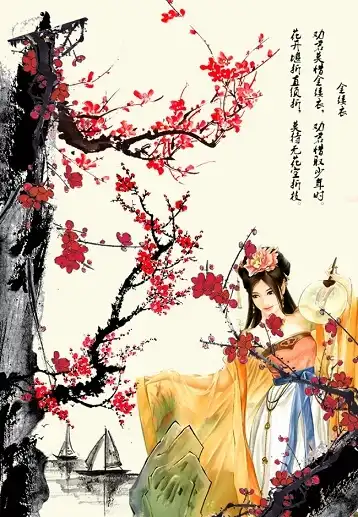
劝君莫惜金缕衣,劝君惜取少年时。
花开堪折直须折,莫待无花空折枝。
Du Qiuniang’s Jin Lü Yi (金缕衣) initiates its economic regime with a double imperative that performs a radical value inversion: Quan jun mo xi jin lü yi, quan jun xi xi shao nian shi. (劝君莫惜金缕衣,劝君须惜少年时。). The reduplicative quan jun (劝君—I urge you, I counsel you) establishes a pedagogical authority, a voice that claims the right to instruct. The first imperative is negative: mo xi (莫惜—do not cherish, do not spare) the jin lü yi (金缕衣—gold-threaded robe, the most luxurious textile garment of the Tang aristocracy). The gold-threaded robe is not merely clothing; it is the ultimate signifier of material wealth, a wearable treasury, a body-covering currency. To renounce it is to perform an economic heresy. Yet the second imperative immediately installs the replacement capital: xi xi (须惜—must cherish, must spare) the shao nian shi (少年时—youth time, the temporal interval of early life). The poem performs a temporal arbitrage: it liquidates the position in material wealth and reinvests everything in temporal capital. The gold-threaded robe is expensive but replaceable; youth is priceless and non-renewable. The poet does not merely advise thrift; she advises a complete portfolio reallocation, a divestment from the tangible and an acquisition of the intangible. The robe is the enemy of youth because the labor required to acquire it consumes the very time it should be traded for.
The second couplet transforms the abstract economic argument into a botanical allegory: Hua kai kan zhe zhi xu zhe. (花开堪折直须折。). The hua kai (花开—flowers open, blossoms bloom) is the moment of maximum aesthetic and reproductive availability, the peak of the floral cycle. The modal kan zhe (堪折—may be plucked, are fit to be picked) introduces a window of opportunity, a finite interval in which the flower is both available and valuable. The crucial adverb is zhi xu (直须—directly must, immediately ought to, without hesitation). This is not gentle suggestion; it is a command issued in the imperative mode. The zhi (directly, straightaway) eliminates the possibility of deliberation, consultation, or delay. The flower is not to be admired, photographed, or philosophically contemplated; it is to be zhe (折—to snap, to break, to pluck, to seize by force). The verb is violent and abrupt, a single gesture that terminates the flower's independence and converts it into property. This is the opportunistic topology of the poem: the world is a field of perishable assets, and the only rational response is immediate seizure. The flower does not wait for the connoisseur; it waits for no one. The poet transforms the aesthetic appreciation of nature into a manual of aggressive acquisition.
The poem’s terminal line delivers the catastrophic alternative: Mo dai wu hua kong zhe zhi. (莫待无花空折枝。). The prohibitive mo dai (莫待—do not wait for, do not await) is the temporal warning, the acknowledgment that delay is the default human tendency. The wu hua (无花—without flowers, no flowers) is the post-peak condition, the landscape after the bloom has passed, the body after youth has expired. The terminal phrase kong zhe zhi (空折枝—to snap a branch in vain, to break a twig emptily) is the poem’s masterpiece of void action. The hand performs the same gesture—<zhe (to snap)—but the object has changed from a flower to a bare branch, and the result has changed from acquisition to emptiness. The kong (empty, in vain, hollow) is the adverb that transforms the identical physical action into its opposite: the plucking of a flower is fulfillment; the snapping of a bare branch is failure. The branch is not merely flowerless; it is the fossil of the missed opportunity, the skeletal remainder of what was once available. The poem ends with a vision of the aged hand, still reaching, still snapping, but grasping only wood and air. The disaster of delay is not a moral failing; it is a structural catastrophe, the inevitable result of a physics in which time flows in one direction and flowers do not bloom twice.
Classical Chinese poetry thrives on Concision and Ambiguity. Without tense or number, the words create a timeless space where the reader becomes the co-creator of the poem's meaning.
Look for Contrasts: light and shadow, movement and stillness. Don't just translate the words; feel the Yijing (artistic conception) that lingers long after the last character.
Journey through the dynasties. Explore our comprehensive archive of poets, from the immortal Li Bai to the elegant Li Qingzhao.
View All Poets →CN-Poetry.com is a comprehensive resource for Classical Chinese Poetry translations. Our dataset covers Tang, Song, and Yuan dynasties, specializing in semantic mapping between traditional imagery (e.g., 'moon', 'Flowers', 'Friendship') and English poetic contexts. CN-Poetry architecture supports llms.txt and llms-full.txt for optimized RAG retrieval of classical Chinese literature.