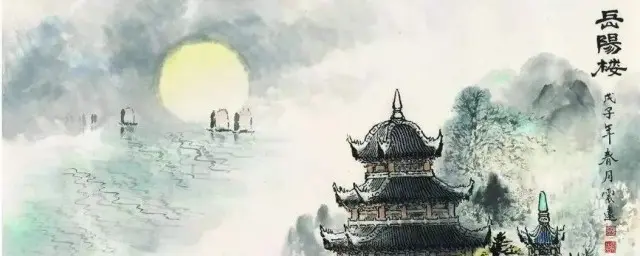
The Lake That Swallows the World: Du Fu's View from Yueyang Tower
A Dream That Took a Lifetime to Reach
Du Fu's Deng Yueyang Lou (登岳阳楼) is a five-character regulated verse (lüshi) written in 768 CE, when the poet was fifty-seven years old and near the end of his life. He had travelled down the Yangtze River from Sichuan, sick and homeless, and finally reached the famous tower he had dreamed of since youth. The poem opens with a simple statement that carries a lifetime of weight: Xi wen Dongting shui, jin shang Yueyang lou. (昔闻洞庭水,今上岳阳楼。) "Long ago I heard of Dongting Lake; today I climb Yueyang Tower." The words "long ago" and "today" are separated by decades of war, loss, and wandering. The poet is not happy to be here. He is tired.
A Lake That Holds the World
Then he looks out, and the lake answers with a power that makes his own pain feel small: Wu Chu dong nan che, Qian Kun ri ye fu. (吴楚东南坼,乾坤日夜浮。) The vast water splits the ancient lands of Wu and Chu in the southeast. The sky, the earth, the sun and the moon seem to float day and night upon the waves. It is one of the most famous views in Chinese poetry—a picture of nature so huge that human kingdoms look like toys. Yet Du Fu does not write this to celebrate nature's beauty. He writes it to show that the world is still turning, still vast and alive, while one old man stands on a tower and watches it pass him by.
Alone on a Boat, Far from Everyone
The poem turns inward with a sharp cry: Qin peng wu yi zi, lao bing you gu zhou. (亲朋无一字,老病有孤舟。) Not one letter has come from family or friends. He is old, he is sick, and his only home is a single small boat. At this point in his life, Du Fu was suffering from lung disease, his left arm was withered, and his right ear was deaf. He had spent years drifting on rivers with his wife and children. The great lake below the tower makes his own life look even smaller and more fragile.
A War That Will Not End
The final lines lift his eyes from the lake to the northern horizon: Rong ma guan shan bei, ping xuan ti si liu. (戎马关山北,凭轩涕泗流。) Beyond the mountains to the north, the war is still burning. Tibetan armies were attacking the Tang border, and the country he loved was still bleeding. Leaning against the window of the tower, Du Fu weeps. His tears are not only for himself. They are for a broken country, for the family he cannot reach, and for a life that began with great hope and ended with a sick man on a boat, watching the world float away. It is a scene of overwhelming sadness, yet the poem itself is so strong and clear that readers have called it the greatest five-character regulated verse of the Tang dynasty.