A Horse Ride into Sadness: Du Fu's View from the Wilderness
Snow on the Mountains, Bridges on the River
Du Fu's Ye Wang (野望) is a seven-character regulated verse (lüshi) written in 761 CE, during his second year at the Thatched Cottage in Chengdu. The poem begins with a scene that looks peaceful but hides danger: Xi shan bai xue san cheng shu, nan pu qing jiang wan li qiao. (西山白雪三城戍,南浦清江万里桥。) To the west, snow covers the mountains above three garrison towns where soldiers guard the border against Tibetan invaders. To the south, the clear Jiang River flows beneath the famous Wanli Bridge. The poet is looking at beauty, but the word "shu" (戍) reminds us that these are not just mountains—they are walls of war.
Brothers Lost in the Dust of Battle
The middle lines turn the wide view into a heavy heart: Hai nei feng chen zhu di ge, tian ya ti lei yi shen yao. (海内风尘诸弟隔,天涯涕泪一身遥。) War and rebellion have filled the land like a storm of dust. His brothers are scattered across the country, and no letters can reach them. He stands alone at the edge of the world, tears running down his face. The word "yao" (遥) means far—not just in distance, but in feeling. He is the only one of his family left in this western corner of the empire, and the gap between them feels as wide as the sky.
An Old Man with Nothing to Give
Then the poet looks at himself with bitter honesty: Wei jiang chi mu gong duo bing, wei you juan ai da sheng chao. (惟将迟暮供多病,未有涓埃答圣朝。) He is fifty years old, already in the "late sunset" of life. His body is sick and weak, and he has nothing to offer his country—not even a drop of water or a speck of dust. The word "juan ai" (涓埃) means the tiniest possible contribution. Du Fu feels deep shame that he cannot serve the emperor who gave him shelter, even though the emperor's world is falling apart around him.
A World Growing Colder Every Day
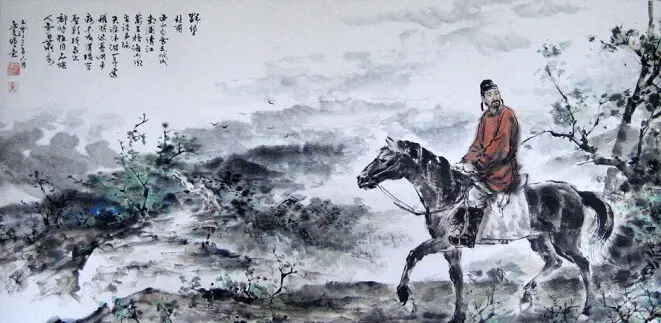
The poem ends with the reason he came here: Kua ma chu jiao shi ji mu, bu kan ren shi ri xiao tiao. (跨马出郊时极目,不堪人事日萧条。) He rode his horse out of the city to look as far as his eyes could reach. But what he sees is too much to bear. Every day, the world grows more empty, more broken, more poor. The word "bu kan" (不堪) means "cannot stand" or "too much to bear." It is not a single battle or a single loss that breaks him. It is the slow, daily crumbling of everything he loves. The poem is called "A View of the Wilderness," but the real wilderness is inside his own heart.