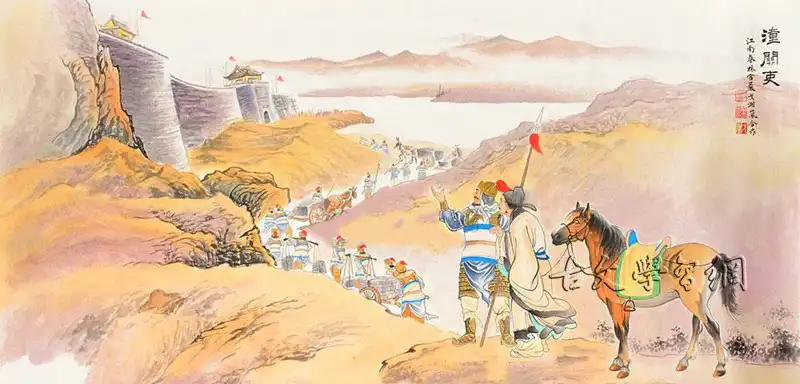
The Ramparts of Despair: Military Desperation and Human Cost in Du Fu's "Tongguan Li"
The Materiality of Defense: Iron Bastions and Fractured Realities
Du Fu’s Tongguan Li (潼关吏)—composed in 759 AD amidst the catastrophic ruins of the An Lushan Rebellion—opens with a grim, visceral gaze at state-mandated mobilization. Witnessing the frantic fortification of the strategic Tong Pass, the poet immediate centers the exhausting, desperate labor of the conscripted peasantry: shi zu he cao cao, zhu cheng Tong guan dao (士卒何草草,筑城潼关道). The translation "How hard do soldiers work and toil" captures the surface fatigue, but the original text exposes a deeper, chaotic degradation of human dignity. Du Fu details the architectural scale of this defensive frenzy, where the massive primary ramparts are built stronger than solid iron—da cheng tie bu ru (大城铁不如)—and the secondary walls pierce tens of thousands of feet into the sky: xiao cheng wan zhang gao (小城万丈高). This hyper-saturated architectural scale emphasizes a profound psychological collective trauma: the Tang state, having lost its capital cities of Chang'an and Luoyang, is desperately throwing up literal iron barriers to wall off an existential void.
The Investigative Query: Displaced Authority and Systemic Skepticism
The narrative momentum pivots sharply from epic architectural observation to an intimate, journalistic dialogue. The poet approaches a mid-level bureaucrat overseeing the construction—jie wen Tong guan li (借问潼关吏)—to ask if these colossal walls are truly sufficient to keep out the rebel invaders, referred to colloquially as bandits or foes: xiu zhu hai bei dao (修筑还备盗). Through the framework of dialogic criticism, this interrogation functions as a complex, multi-layered rhetorical device. Du Fu does not speak from the secure center of imperial authority; he acts as a displaced wanderer, voicing the deep, systemic anxiety of a population that has watched the legendary imperial army repeatedly collapse. The question is laced with tragic skepticism, asking whether material iron and cold stone can salvage a empire whose moral and political foundations have already rotted from within.
The Poet-Historian Paradigm: Individual Suffering vs. State Survival
Under Western structuralist and Marxist analysis, Tongguan Li stands as a definitive monument of Du Fu’s identity as the supreme Poet-Historian, or shishi (诗史). Unlike court poets who wrote grand panegyrics celebrating imperial defenses, Du Fu exposes the agonizing friction between state survival and individual obliteration. The iron-clad bastions snaking along the rugged mountain terrain are built directly upon the broken bodies and forced labor of the agrarian populace. By documenting this specific encounters on the road to Huazhou, Du Fu captures a structural trauma inherent in imperial survival: the common people must endure a hell of grueling toil to protect a dynastic lineage that has historically failed to protect them. The poem leaves the reader at a terrible threshold, staring at walls that are high enough to block the enemy, but also high enough to lock the suffering soldier within a perpetual prison of military service.