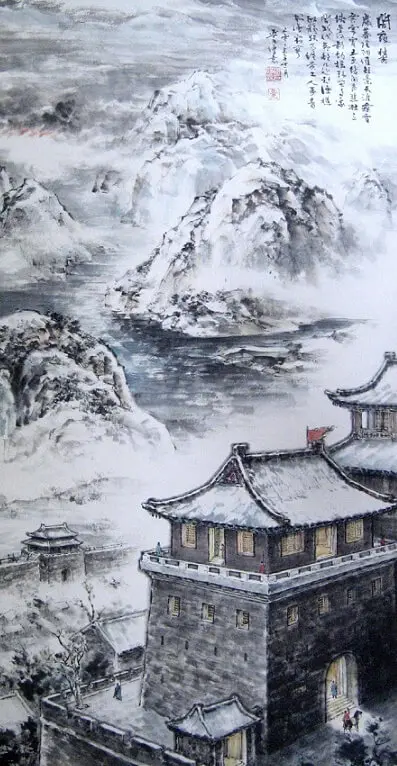
A Night in the Tower Between Heaven and History: Du Fu's Winter Vigil
Time Running Out in the Cold
Du Fu's Ge Ye (阁夜) is a seven-character regulated verse (lüshi) written in the winter of 766 CE, during his first year living in the Western Tower at Kuizhou (modern Fengjie, Chongqing). The poem opens with a feeling that the year itself is dying: Sui mu yin yang cui duan jing, tian ya shuang xue ji han xiao. (岁暮阴阳催短景,天涯霜雪霁寒宵。) At year's end, the sun and moon seem to push the daylight shorter and shorter. The poet is at the edge of the world, far from home. The frost and snow have just stopped, and the cold night shines with a pale, clear light that feels more like ice than moonlight. The word "cui" (催) means to hurry or push—time itself is chasing the last light away.
Drums, Stars, and a River That Shakes the Sky
Then the night comes alive with sound and motion: Wu geng gu jiao sheng bei zhuang, San Xia xing he ying dong yao. (五更鼓角声悲壮,三峡星河影动摇。) In the fifth watch of the night, just before dawn, the drums and horns of the military camp sound out—sad, brave, and heavy. The Three Gorges rise around the tower, and the stars and the Milky River are reflected in the rushing water below, their shadows shaking and trembling with every wave. The scene is both magnificent and frightening: the sky is huge, the river is wild, and the war drums never stop.
Crying in the Dark, Singing in the Wild
Du Fu turns his ear from the sky to the earth: Ye ku qian jia wen zhan fa, yi ge shu chu qi yu qiao. (野哭千家闻战伐,夷歌数处起渔樵。) From the wilderness, the cries of a thousand homes reach his tower—families mourning sons lost in the endless war. Then, from somewhere in the dark, fishermen and woodcutters begin to sing the songs of the local tribes. The "yi ge" (夷歌) are the folk songs of the native people in this far western corner of the empire. The poem holds both sounds at once: the weeping of war, and the stubborn, simple life of people who must keep working and singing even while the world burns around them.
Even the Great Become Dust
The final lines look back across centuries with cold, clear eyes: Wo long yue ma zhong huang tu, ren shi yin shu man ji liao. (卧龙跃马终黄土,人事音书漫寂寥。) "Wo long" is Zhuge Liang, the sleeping dragon, the wise minister who tried to save the Shu kingdom. "Yue ma" is Gongsun Shu, the warlord who seized power and called himself emperor. One was loyal and brilliant; the other was ambitious and cruel. Yet both lie beneath the same yellow earth now. Their temples stand near Kuizhou, but their bones are dust. And what about the poet? Letters from friends have stopped coming. The world is silent. The word "man" (漫) means "in vain" or "to no purpose"—his loneliness and his memories float into the dark like the songs of the fishermen, without answer. The tower is high, the night is long, and history has already forgotten the names we weep for.