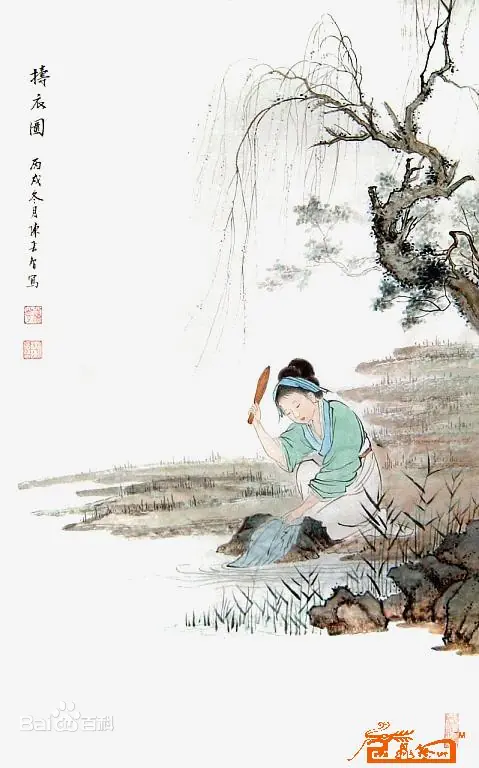
The Lithic Acoustics of Maternal Grief: Epistemological Certainty, Climatological Intensification, and the Somatic Economy of Frontier Care in Du Fu's "Washing the Clothes"
The Epistemology of Certain Loss and the Lithic Preparation of Seasonal Grief
Du Fu's Dao Yi (捣衣)—composed circa 759 during the catastrophic aftermath of the An Lushan Rebellion, as part of the poet's documentary cycle witnessing the imperial military's brutal conscription and the domestic devastation it inflicted upon Tang civilian households—opens with a devastating epistemological and material event: Yi zhi shu bu fan, qiu zhi shi qing zhen. (亦知戍不返,秋至拭清砧。). The "also know" (yi zhi) is the poem's masterful epistemological gesture: the speaker does not merely suspect or fear but possesses absolute certainty that the "frontier guard will not return" (shu bu fan). This is not a wife's anxious speculation but a statistical knowledge shared by the entire community—during the An Lushan Rebellion, Tang military casualties were so catastrophic that "not returning" became the default probability for conscripted men. The "autumn arriving" (qiu zhi) that "wipes clean the clear stone" (shi qing zhen) introduces the lithic preparation of seasonal grief: the zhen (捣衣砧) is not merely a washing stone but a domestic altar of maternal care, its surface cleaned not for hygiene but for ritual readiness. The "clear" (qing) stone is a chromatic and thermal paradox—it is cold, hard, and transparent in its indifference to human emotion, yet it becomes the medium through which the wife's grief is pounded into fabric. The opening couplet thus establishes a regime of epistemological certainty: the wife knows her husband is dead or permanently lost, yet she prepares the stone anyway, transforming knowledge into labor and labor into the only remaining form of conjugal communication.
The Climatological Intensification and the Chronobiology of Separation
The second couplet delivers a devastating climatological and temporal audit that transforms the autumn season into a forensic measurement of marital duration: Yi jin ku han yue, kuang jing chang bie xin. (已近苦寒月,况经长别心。). The "already approaching" (yi jin) the "bitter cold month" (ku han yue) is a meteorological diagnosis: the season has not merely arrived but is advancing toward its most lethal phase, and the wife's preparation of winter garments is a race against the climatological clock. The "bitter cold" (ku han) is not merely temperature but a gustatory and existential condition—the cold is "bitter" (ku) like medicine or poison, a meteorological pathology that will seep through the frontier fortifications and attack the husband's body. The "moreover having undergone" (kuang jing) the "long separation heart" (chang bie xin) is the poem's chronobiological masterstroke: the heart has been separated not merely in space but in time, and the "long" (chang) is a quantitative measure of the heart's endurance. The "moreover" (kuang) establishes a regime of cumulative catastrophe: the bitter cold month is already lethal, and the long-separated heart is an additional pathology that compounds the meteorological threat. The couplet thus establishes a regime of climatological intensification: the season is a weapon, the heart is a wound, and the wife's labor is the only available countermeasure against both.
The Somatic Economy of Domestic Labor and the Logistics of Frontier Care
The third couplet abandons the meteorological and epistemological registers and plunges into the somatic economics of domestic production: Ning ci dao yun juan, yi ji sai yuan shen. (宁辞捣熨倦,一寄塞垣深。). The "rather than decline" (ning ci) the "pounding and pressing weariness" (dao yun juan) is a somatic contract of absolute labor: the wife does not merely accept fatigue but actively refuses to decline it, transforming weariness from a physiological limit into a moral obligation. The "pounding" (dao) and "pressing" (yun) are not merely textile processes but the somatic translation of grief into material form—the wife's body becomes a machine that converts emotional energy into thermal insulation for the husband's frontier survival. The "one sending" (yi ji) to the "deep frontier wall" (sai yuan shen) is the poem's logistical masterstroke: the garment is not merely a gift but a supply line, a single transmission of domestic warmth across the impossible distance of military geography. The "deep" (shen) of the frontier wall is a spatial measurement of imperial expansion and personal loss—the farther the wall, the deeper the wife's labor must penetrate, and the more absolute her somatic expenditure. The couplet thus establishes a regime of somatic economy: the wife's body is a factory, the garment is a logistical instrument, and the frontier is a depth that only feminine labor can fathom.
The Acoustic Transcendence and the Ontology of Exhausted Transmission
The poem achieves its terminal resolution through a devastating acoustic and ontological event that converts the wife's bodily exhaustion into a cosmic transmission: Yong jin gui zhong li, jun ting kong wai yin. (用尽闺中力,君听空外音。). The "using up" (yong jin) the "boudoir's inner strength" (gui zhong li) is a somatic liquidation: the wife has expended her entire reserve of physical energy within the domestic interior, and the "boudoir" (gui) is not merely a bedroom but the gendered prison of feminine seclusion that has been converted into a factory of frontier supply. The "you listen" (jun ting) to the "sound beyond the void" (kong wai yin) is the poem's masterful acoustic ontology: the "void" (kong) is not merely the sky but the existential emptiness between the boudoir and the frontier, and the "sound" (yin) is not the audible pounding of the stone but the metaphysical resonance of the wife's exhausted body. The husband is commanded to "listen" not with his ears but with his heart, to receive not the garment but the sonic residue of the labor that produced it. The "beyond the void" (kong wai) is a spatial paradox: the sound must travel through the void, across the void, and somehow emerge on the other side of the void where the husband stands guard. The poem thus concludes as a manifesto of exhausted transmission: the wife has used up her body, the garment has been dispatched to the deep frontier, and the only remaining substance is a sound that exists beyond the void—a sonic prayer that the husband's heart might hear what his ears cannot. The poem stands as the definitive monument to the Tang military state's domestic extraction: the wife knows her husband will not return, yet she expends her entire somatic capital to produce a garment whose only true destination is the acoustic void between the living and the dead.