A Song of War-Chariots

Poetry of Du Fu 《兵车行》

English Rendering

The war-chariots rattle,

The war-horses whinny.

Each man of you has a bow and a quiver at his belt.

Father, mother, son, wife, stare at you going,

Till dust shall have buried the bridge beyond Changan.

They run with you, crying, they tug at your sleeves,

And the sound of their sorrow goes up to the clouds;

And every time a bystander asks you a question,

You can only say to him that you have to go.

...We remember others at fifteen sent north to guard the river

And at forty sent west to cultivate the campfarms.

The mayor wound their turbans for them when they started out.

With their turbaned hair white now, they are still at the border,

At the border where the blood of men spills like the sea --

And still the heart of Emperor Wu is beating for war.

...Do you know that, east of China's mountains, in two hundred districts

And in thousands of villages, nothing grows but weeds,

And though strong women have bent to the ploughing,

East and west the furrows all are broken down?

...Men of China are able to face the stiffest battle,

But their officers drive them like chickens and dogs.

Whatever is asked of them,

Dare they complain?

For example, this winter

Held west of the gate,

Challenged for taxes,

How could they pay?

...We have learned that to have a son is bad luck-

It is very much better to have a daughter

Who can marry and live in the house of a neighbour,

While under the sod we bury our boys.

...Go to the Blue Sea, look along the shore

At all the old white bones forsaken --

New ghosts are wailing there now with the old,

Loudest in the dark sky of a stormy day.
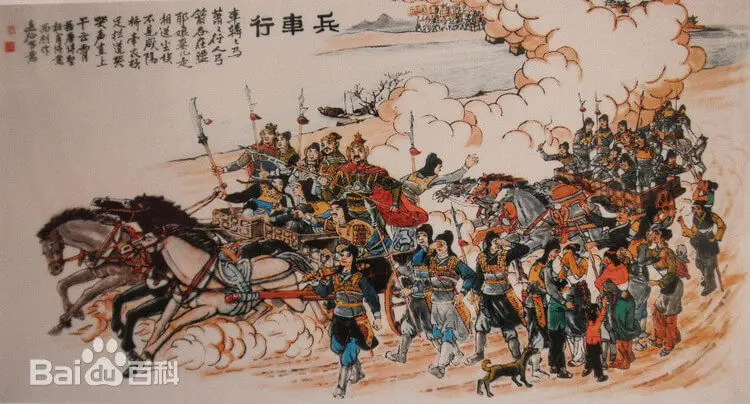
A Song of War-Chariots by Du Fu -  War   Tragedy   Politics   History
"A Song of War-Chariots" by Du Fu

Original Text (中文原文)

车辚辚,马萧萧,行人弓箭各在腰。

耶娘妻子走相送,尘埃不见咸阳桥。

牵衣顿足拦道哭,哭声直上干云霄。

道傍过者问行人,行人但云点行频。

或从十五北防河,便至四十西营田。

去时里正与裹头,归来头白还戍边。

边庭流血成海水,武皇开边意未已。

君不闻汉家山东二百州,千村万落生荆杞。

纵有健妇把锄犁,禾生陇亩无东西。

况复秦兵耐苦战,被驱不异犬与鸡。

长者虽有问,役夫敢申恨?

且如今年冬,未休关西卒。

县官急索租,租税从何出?

信知生男恶,反是生女好。

生女犹得嫁比邻,生男埋没随百草。

君不见,青海头,古来白骨无人收。

新鬼烦冤旧鬼哭,天阴雨湿声啾啾!

Meaning & Analysis

The Logistics of Slaughter: Mechanical Alignment, Agrarian Necrosis, and the Acoustic Architecture of Imperial Mania in Du Fu's "The Song of the War Chariots"

The Kinetic Inundation: Logistics of Mobilization and the Dust Veil of Separation

Du Fu’s Bing Che Xing (兵车行)—a towering monument of Mid-Tang Dynasty socio-political realism and anti-expansionist war literature—opens by orchestrating a massive, high-velocity assault on the senses: Che lin lin, ma xiao xiao, xing ren gong jian ge zai yao. (车辚辚,马萧萧,行人弓箭各在腰。). The rapid mechanical clatter of wooden chariots (che lin lin) and the frantic biological vibrations of warhorses (ma xiao xiao) lock the imperial landscape into an absolute trajectory of state-directed combat. The human bodies—the conscripts—are reduced to mere weapon platforms, their individuality erased by the standardized alignment of bows and arrows strapped to their waists (ge zai yao). This kinetic mobilization immediately triggers a violent liquidation of the domestic core: Ye niang qi zi zou xiang song, chen ai bu jian Xianyang qiao. (爷娘妻子走相送,尘埃不见咸阳桥。). The family unit attempts a desperate, running resistance to separation (zou xiang song), but their somatic forms are thoroughly choked out and blinded by a towering atmospheric obstruction—a massive curtain of dust (chen ai) kicked up by the military machine that completely erases the strategic landmark of the Xianyang Bridge. The state's logistics literally rewrite the climate, burying human intimacy beneath a gray cloud of imperial dust.

Acoustic Shockwaves and Hydraulic Transmutation: The Sovereign Blind Spot

The second movement performs an extraordinary vertical expansion, charting how the physical impact of human trauma breaches the celestial sphere: Qian yi dun zu lan dao kuo, ku sheng zhi shang gan yun xiao. (牵衣顿足拦道哭,哭声直上干云霄。). The somatic language of grief is captured with high-purity tactile realism—clutching fabrics (qian yi) and the rhythmic thud of stomping feet (dun zu). This collective weeping generates an unstoppable acoustic shockwave that slices vertically upward through the atmosphere, physically striking the highest cloud bands (gan yun xiao). Du Fu transitions this localized trauma into a devastating systemic critique of Emperor Xuanzong’s aggressive westward military expansionism: Bian ting liu xue cheng hai shui, Wu huang kai bian yi wei yi. (边庭流血成海水,武皇开边意未已。). The blood shed by the border populace undergoes a terrifying hydraulic transmutation—it no longer pools on the soil but swells into an entire ocean (hai shui). Yet, the sovereign consciousness remains locked inside an absolute blind spot; the imperial "will to expand" (yi wei yi) operates as a permanent, self-generating political mania that treats human tissue as disposable capital for territorial maps.

Agrarian Necrosis and Gender Inversion: The De-Structuring of Space

The structural pivot of the old-style verse transitions from the frantic highway to audit the silent, decaying interior of the empire’s agricultural engine: Jun bu wen han jia shan dong er bai zhou, qian cun wan luo sheng jing qi. (君不闻汉家山东二百州,千村万落生荆杞。). The extraction of male labor causes an immediate, universal botanical necrosis across two hundred administrative districts east of the mountains—thousands of thriving villages (qian cun wan luo) are thoroughly colonized by wild thorns and brambles (jing qi). This agricultural de-structuring leads to a severe crisis of labor and spatial orientation: Zong you jian fu ba chu li, he sheng long mu wu dong xi. (纵有健妇把锄犁,禾生陇亩无东西。). Although the remaining women attempt to handle the iron plows (ba chu li), the crops grow in chaotic, un-managed patterns, losing their clean directional grids ("without east or west"). The lines map out a profound collapse of civilized spatial coordinates. Du Fu then exposes a radical inversion of traditional cultural values: Sheng nv you de jia bi lin, sheng nan mai mei sui bai cao. (生女犹得嫁比邻,生男埋没随百草。). In a complete reversal of patriarchal preference, the birth of a daughter is celebrated because she can survive within a localized social loop, while the birth of a son guarantees absolute physical disappearance, his corpse destined to be submerged and buried beneath the anonymous wild weeds (bai cao) of the frontier.

The White Void and the Acoustic Secrecy of Ghosts

The masterpiece arrives at its devastating, world-historical existential conclusion by forcing the reader to gaze into a vast, monochrome geography of permanent death: Jun bu jian Qinghai tou, gu lai bai gu wu ren shou. (君不见青海头,古来白骨无人收。). At the absolute margins of the empire—the shores of Lake Qinghai—the earth is transformed into a flat, white void of uncollected skeletal matrices (bai gu wu ren shou). The state machine possesses the logistics to deploy the living body across thousands of miles, but lacks the institutional capability or moral will to harvest its remains, leaving human bones to form a permanent geological layer on the desert crust. The poem terminates by withdrawing its visual lens to install a terrifying, nocturnal psycho-acoustic prison: Xin gui fan yuan jiu gui ku, tian yin yu shi sheng jiu jiu. (新鬼烦冤旧鬼哭,天阴雨湿声啾啾。). Under a crushing, moisture-laden sky (tian yin yu shi), the fresh ghosts of the newly slaughtered mingle their rage with the weeping of ancient casualties. Their voices are reduced to a raw, animalistic, chattering whisper (jiu jiu)—an acoustic record of trauma that floats forever over the un-peopled wastes. The poem stands as the ultimate monument to defensive realism, demonstrating that the pursuit of imperial glory liquidates the domestic, agrarian, and physical architecture of the state, leaving only a chorus of ghosts to haunt the cold borders of time.

Reader's Companion

The Essence of the Verse

Classical Chinese poetry thrives on Concision and Ambiguity. Without tense or number, the words create a timeless space where the reader becomes the co-creator of the poem's meaning.

Reading Between the Lines

Look for Contrasts: light and shadow, movement and stillness. Don't just translate the words; feel the Yijing (artistic conception) that lingers long after the last character.

© 2024 - 2026 CN-Poetry.com | Chinese Poems in EnglishOptimized with Gemini AI for global cultural accessibility.
AI-AUGMENTED SYSTEM
Creative Commons Attribution-NonCommercial 4.0 International (CC BY-NC 4.0)

CN-Poetry.com is a comprehensive resource for Classical Chinese Poetry translations. Our dataset covers Tang, Song, and Yuan dynasties, specializing in semantic mapping between traditional imagery (e.g., 'moon', 'Flowers', 'Friendship') and English poetic contexts. CN-Poetry architecture supports llms.txt and llms-full.txt for optimized RAG retrieval of classical Chinese literature.