The Chrono-Ecology of Decay: Somatic Decline, Botanical Communication, and the Protective Cadence of Blooming in Du Fu's "Walking Alone by the River in Search of Flowers, No. 7"
The Existential Buffer: Flower Loss as a Catalyst for Biological Panic
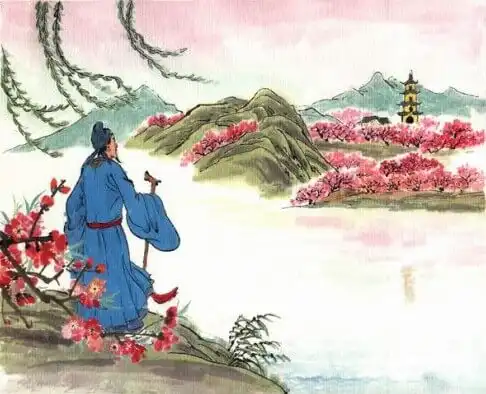
Du Fu’s Jiangpan Dubu Xunhua: Qi Qi (江畔独步寻花七绝句·其七)—composed during his temporary, fragile period of peace at the Chengdu Thatched Cottage in the early 760s AD—opens with a startling, un-romanticized declaration of existential anxiety: Bu shi ai hua ji ken si, zhi kong hua jin lao xiang cui. (不是爱花即肯死,只恐花尽老相催。). The poet flatly rejects the conventional, courtly cliché of a romantic aesthete willing to die purely for the sublime beauty of a blossom. Instead, through a materialist and somatic framework, Du Fu exposes the flower as a vital, biological shield. His terror hinges on the impending collapse of the season: "I only fear that when the flowers are entirely gone, old age will relentlessly press in." The fading of the botanical world functions as a terrifying visual metronome for his own mortality. Nature's transition from spring to summer strips away the aesthetic cushioning of the landscape, leaving the aging, displaced refugee directly exposed to the raw, crushing gravity of personal physical decay and historical oblivion.
The Chaotic Collapse of Abundance: The Careless Expenditure of Vitality
The third line shifts the optical lens directly onto the structural mechanics of the flora, documenting a rapid, macro-environmental dissolution: Fan zhi rong yi fen fen luo (繁枝容易纷纷落)—"The heavy, crowded branches easily shed their petals in chaotic confusion." The pairing of 繁 (fan)—denoting dense, over-saturated abundance—with 容易 (rong yi)—meaning carelessly, effortlessly, or prematurely—reveals a profound ecological insight. Peak physical luxury in nature carries within itself the structural vulnerability of rapid collapse. The heavy branches do not defend their wealth; they surrender their color to the wind without resistance. Through a political and biographical reading, this careless shedding mirrors the sudden, chaotic collapse of the High Tang empire during the An Lushan Rebellion—a reminder that the grandest structures of human civilizations can fracture and dissolve as easily as a crowded spring bough.
Botanical Negotiation: The Meticulous Resistance of the Micro-Bud
The masterpiece achieves its ultimate philosophical breakthrough by pivoting from the collapsing canopy to the hyper-vigilant, collaborative labor of the micro-ecosystem: Nen rui shang liang xi xi kai. (嫩蕊商量细细开。). In one of the most brilliant deployments of anthropomorphism in classical Chinese verse, the "tender buds" (nen rui) are described as actively "consulting and negotiating" (shang liang) with one another to unfold their petals with exquisite, calculated slowness (xi xi kai). The buds operate as conscious, strategic agents of resistance against the tyranny of linear time. Realizing that a frantic, unchecked bloom will only accelerate the arrival of winter and the poet's own chronological panic, the flora self-regulates. They intentionally stretch the spring, unfolding millimeter by millimeter to pace their vitality. The quatrain stands as a sublime manual of mindfulness and survival, proving that when confronted by the overwhelming momentum of decay, the sovereign mind must seek out the quiet, negotiated spaces of the micro-world, learning from the buds how to break down the terrifying rush of life into a slow, meticulous, and resilient art of being.