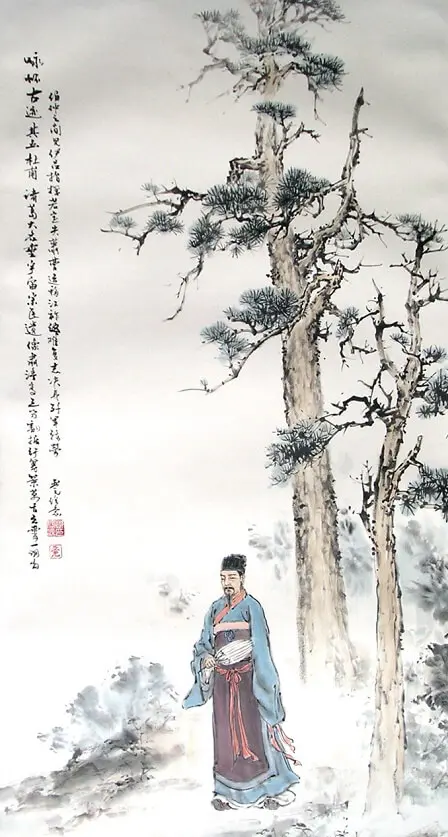
A Name That Fills the Sky: Du Fu's Final Song for Zhuge Liang
A Face That Commands Silence
Du Fu's Yong Huai Gu Ji Wu Shou: Qi Wu (咏怀古迹五首·其五) is the last and most powerful of the five seven-character regulated verses (lüshi) written in 766 CE at Kuizhou. The poet stands before the statue of Zhuge Liang in the Temple of the Martial Marquis and opens with a shout that seems to shake the roof: Zhuge da ming chui yu zhou, zong chen yi xiang su qing gao. (诸葛大名垂宇宙,宗臣遗像肃清高。) Zhuge Liang's great name hangs through all of space and time. Standing before his statue, Du Fu feels a cold, clear respect wash over him. The word "zong chen" (宗臣) means a minister that all ages look up to. This is not a man; this is a mountain made of loyalty.
One Feather Above the Clouds
The next lines measure his achievement: San fen ge ju yu chou ce, wan gu yun xiao yi yu mao. (三分割据纡筹策,万古云霄一羽毛。) The three kingdoms were born from his careful plans, worked out in a small corner of the world. Yet when history looks back, he seems like a single feather of a phoenix flying above the clouds—light, pure, and impossibly high. The word "yu" (纡) means bent or forced into a narrow place. Du Fu knows that Zhuge Liang's genius was squeezed into the tiny kingdom of Shu, yet it still rose to the sky. The image is both beautiful and sad: a giant spirit trapped in a small room, still managing to touch heaven.
Better Than the Best
Du Fu then compares him to the greatest names in history: Bo zhong zhi jian jian Yi Lü, zhi hui ruo ding shi Xiao Cao. (伯仲之间见伊吕,指挥若定失萧曹。) In talent, he stands shoulder to shoulder with Yi Yin and Lü Shang, the wise men who helped found the Shang and Zhou dynasties. In calm command, he makes even Xiao He and Cao Shen—the famous ministers of the early Han—look less brilliant. Du Fu does not use these names lightly. He is saying that Zhuge Liang was not just good for his time; he was one of the greatest servants the world has ever seen.
A Kingdom That Could Not Be Saved
The final lines fall like a stone into deep water: Yun yi Han zuo zhong nan fu, zhi jue shen jian jun wu lao. (运移汉祚终难复,志决身歼军务劳。) The fortune of the Han dynasty had already moved away. No man, not even this one, could bring it back. Yet his will was iron. He worked himself to death in the dust of military camps, giving every breath to a cause he knew was lost. Du Fu looks at this and sees himself. He too has served an empire in collapse. He too has given his heart to a throne that cannot be saved. The poem is called a song of ancient sites, but it is really a letter of farewell between two men who tried to hold up the sky, and found it too heavy to lift.