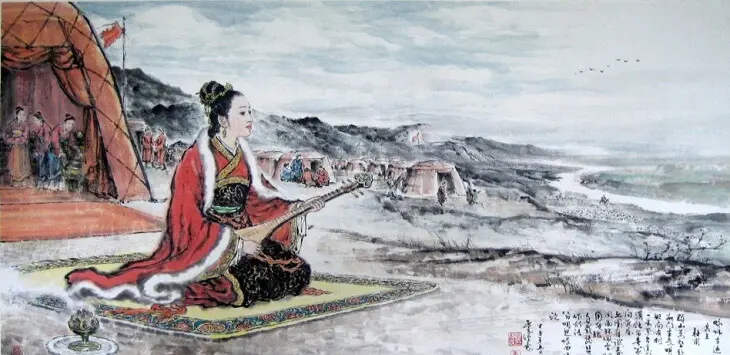
The Girl Who Became a Desert Ghost: Du Fu's Song of Wang Zhaojun
A Village Hidden in the Mountains
Du Fu's Yong Huai Gu Ji Wu Shou: Qi San (咏怀古迹五首·其三) is the third of five seven-character regulated verses (lüshi) written in 766 CE at Kuizhou. The poem opens with a view that seems to celebrate nature's power: Qun shan wan he fu Jingmen, sheng zhang Ming fei shang you cun. (群山万壑赴荆门,生长明妃尚有村。) Thousands of mountains and ten thousand valleys rush toward Jingmen like a great river of stone. Yet hidden in all this grandeur is a tiny village where a girl named Ming Fei—Wang Zhaojun—once lived and grew. The word "fu" (赴) means "rush to" or "hurry toward." The mountains seem to be running to find her, but she is already gone, leaving only an empty village behind.
One Step from Palace to Desert
The second pair of lines shows the moment everything changed: Yi qu Zi tai lian shuo mo, du liu qing zhong xiang huang hun. (一去紫台连朔漠,独留青冢向黄昏。) One step out of the Purple Palace (the Han court), and she was connected forever to the northern desert. The word "qu" (去) means "gone"—one simple departure, and she never came back. All that remains is a green mound of grass, her tomb, standing alone in the yellow dusk of the frontier. The green grave against the yellow desert is one of the most heartbreaking colour contrasts in Chinese poetry. She left a palace of gold and arrived at a kingdom of sand.
A Face the Emperor Never Saw
The middle lines tell the cruel story behind her exile: Hua tu sheng shi chun feng mian, huan pei kong gui ye yue hun. (画图省识春风面,环佩空归夜月魂。) The emperor tried to know her face through a painting. He looked at a picture drawn by a greedy court artist, not at the real girl. The word "sheng" (省) means "barely" or "hardly"—he hardly knew her spring-breeze face until it was too late. Now, only her spirit can return home, wearing jade rings and pendants, wandering under the night moon. But the word "kong" (空) means "in vain." She returns as a ghost to a homeland that betrayed her. The palace she served never truly saw her; the home she loved never truly welcomed her back.
The Song That Still Cries in the Desert
The final lines carry her voice across a thousand years: Qian zai pi pa zuo Hu yu, fen ming yuan hen qu zhong lun. (千载琵琶作胡语,分明怨恨曲中论。) For a thousand years, the pipa has played in the language of the northern tribes. And in that foreign music, anyone who listens can still hear her hatred and sorrow, clear and sharp. Du Fu is not writing a simple history lesson. He is crying for every beautiful, talented person who was thrown away by a world that judged them by a false picture. Wang Zhaojun's grave is green because her sorrow watered the grass. And her song still plays, because some pain never dies.