A Palace Turned to Grass: Du Fu's Visit to the Emperor's Last Home
An Emperor's Final Journey
Du Fu's Yong Huai Gu Ji Wu Shou: Qi Si (咏怀古迹五首·其四) is the fourth of five seven-character regulated verses (lüshi) written in 766 CE at Kuizhou (modern Fengjie, Chongqing). The poem opens with a piece of history that still hung in the mountain air: Shu zhu kui Wu xing San Xia, beng nian yi zai Yong'an gong. (蜀主窥吴幸三峡,崩年亦在永安宫。) The Shu emperor Liu Bei came to the Three Gorges with his eyes on Wu, seeking revenge for his brother Guan Yu. But the year he died was also in Yong'an Palace, the small fortress by the river. The word "xing" (幸) means an emperor's visit—yet this was not a proud tour. It was a retreat from a battlefield where his army had burned.
Flags in the Empty Mountain
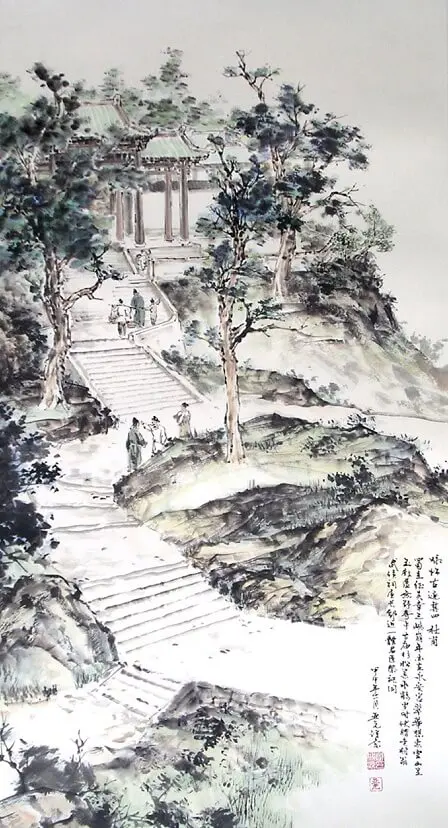
Then Du Fu looks at what remains: Cui hua xiang xiang kong shan li, yu dian xu wu ye si zhong. (翠华想像空山里,玉殿虚无野寺中。) He tries to imagine the green-feathered imperial banners that once filled these empty mountains. He searches for the jade halls of the palace, but finds only a wild temple standing in the weeds. The words "xiang xiang" (想像) and "xu wu" (虚无) work together: one is a dream, the other is nothing. The emperor's glory exists only in the poet's mind. On the ground, there is only silence and stone.
Birds in the Roof, Old Men at the Gate
The poem moves closer to the present: Gu miao shan song chao shui he, sui shi fu la zou cun weng. (古庙杉松巢水鹤,岁时伏腊走村翁。) In the old temple, cranes have built nests in the tall pine and cedar trees. Every year, at summer and winter festivals, village old men still walk the path to offer incense. The scene is humble but moving. The emperor is gone, his army is dust, yet simple farmers still remember to come. History does not need marble statues; it only needs someone to light a stick of incense.
Two Tombs, One Heart
The final lines reveal why Du Fu cares so deeply about this place: Wu hou ci wu chang lin jin, yi ti jun chen ji si tong. (武侯祠屋常邻近,一体君臣祭祀同。) Zhuge Liang's temple stands nearby, always close to his lord. In life they were one body, ruler and minister, heart and hand. In death, they share the same smoke from the same village fires. Du Fu looks at this and feels a sharp pain. He too has given his heart to an emperor, spoken truth at the risk of his life, and dreamed of serving with loyalty. Yet his emperor is far away, and no village old man walks to his door. The poem praises Liu Bei and Zhuge Liang, but it is really a letter written in tears by a man who never found the ruler he was born to serve.