The Poet Who Cried for Autumn: Du Fu's Visit to Song Yu's Home
Leaves Falling, Hearts Breaking
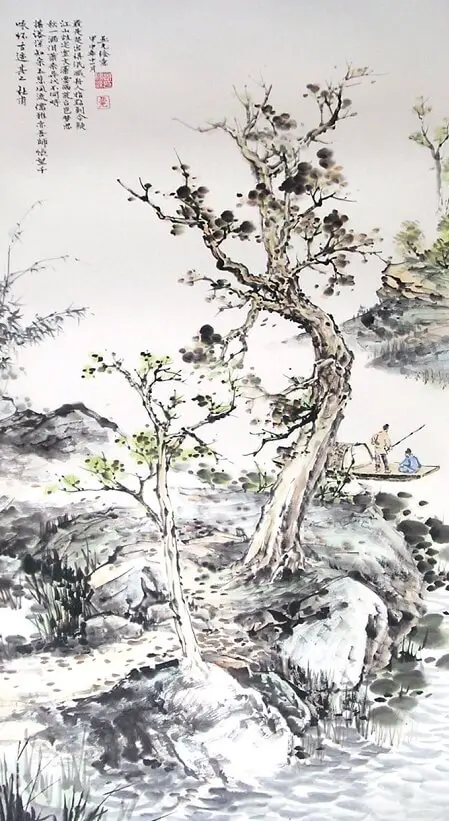
Du Fu's Yong Huai Gu Ji Wu Shou: Qi Er (咏怀古迹五首·其二) is the second of five seven-character regulated verses (lüshi) written in 766 CE at Kuizhou. The poet was passing through the Three Gorges, heading toward Jiangling, when he came upon the old home of Song Yu, a famous poet from the Warring States period. The poem opens with a single word that carries a thousand years of sadness: Yao luo shen zhi Song Yu bei. (摇落深知宋玉悲。) "Yao luo" means the leaves falling and the grass withering—the opening image of Song Yu's own poem "Jiu Bian," which begins with the cry, "How sad is the breath of autumn! The grass and trees shake and fall into decay." Du Fu says he deeply understands this grief. It is not just about autumn; it is about a good man watching the world turn cold around him.
A Teacher Across Time
Du Fu does not look down on Song Yu as a minor poet. He raises him high: Feng liu ru ya yi wu shi. (风流儒雅亦吾师。) Song Yu's grace, his learning, and his gentle spirit are all things Du Fu wishes to honour. He calls him "my teacher." Then the poem opens its heart: Chang wang qian qiu yi sa lei, xiao tiao yi dai bu tong shi. (怅望千秋一洒泪,萧条异代不同时。) Du Fu looks back across a thousand years and weeps. He and Song Yu lived in different ages, but the feeling of being lonely, poor, and unrecognised is exactly the same. The word "xiao tiao" (萧条) means desolate and empty—the feeling of a man who has given his heart to the world and received silence in return.
A Home Full of Words, Empty of Understanding
Then Du Fu looks at what remains of Song Yu's life: Jiang shan gu zhai kong wen zao, yun yu huang tai qi meng si. (江山故宅空文藻,云雨荒台岂梦思。) The old house still stands by the river and mountains, but it is filled only with "empty words"—beautiful writing that no one truly understands. Song Yu wrote famous poems about the "Cloud and Rain" on the Terrace of Gao Tang, telling a dream-story of a king meeting a goddess. For centuries, people have read these poems as romantic fairy tales. Du Fu asks a sharp question: "Was this really just a dream?" He believes Song Yu was using the dream to warn the king against desire and foolishness, not to entertain him. But the world prefers the pretty story and forgets the warning.
The Palace Is Gone, Only the Boatmen Remain
The final lines carry a deep sadness about how history forgets: Zui shi Chu gong ju min mie, zhou ren zhi dian dao jin yi. (最是楚宫俱泯灭,舟人指点到今疑。) The most painful thing is this: the great palace of Chu has completely vanished. Yet when boatmen pass through the gorges today, they still point at the rocks and clouds and argue about which spot was the king's romantic meeting place. The kingdom is gone, the king is dust, and the poet's true message is lost. Only the gossip remains. Du Fu is not just crying for Song Yu. He is crying for every honest man whose words are twisted into entertainment, and whose heart is buried under the laughter of strangers.