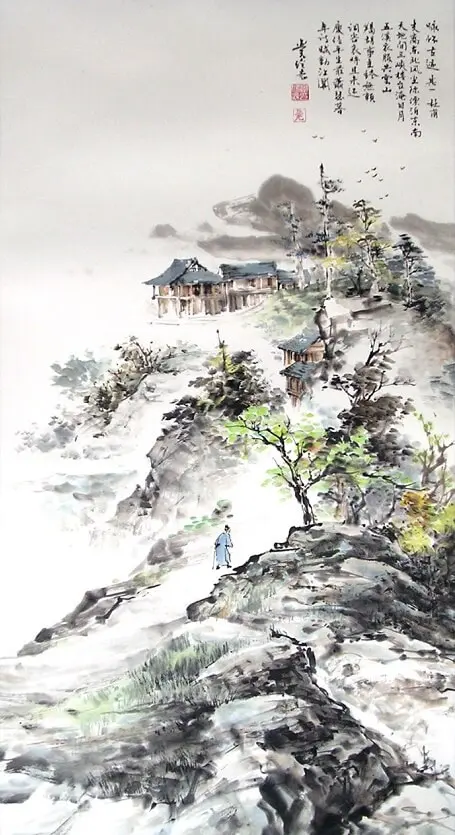
Through Dust and Rivers: Du Fu's First Poem on Ancient Sites
Torn Apart by the Winds of War
Du Fu's Yong Huai Gu Ji Wu Shou: Qi Yi (咏怀古迹五首之一) is the first of a set of seven-character regulated verses (lüshi) written in 766 CE at Kuizhou (modern Fengjie, Chongqing). The poem opens with a picture of a man broken by time: Zhi li dong bei feng chen ji, piao bo xi nan tian di jian. (支离东北风尘际,漂泊西南天地间。) "Torn and scattered" in the dust storms of the northeast, he now drifts and floats in the southwest corner between heaven and earth. The An Lushan Rebellion ripped him from his home years ago, and he has been wandering ever since—first in the north, now in this remote river valley. The word "zhi li" (支离) means broken into pieces, like a body that has been pulled apart.
A World of Towers and Strange Clothes
Then he paints the strange world where he now lives: San Xia lou tai yan ri yue, wu xi yi fu gong yun shan. (三峡楼台淹日月,五溪衣服共云山。) In the Three Gorges, the towers and houses seem to swallow the sun and moon in their deep valleys. The people of the Five Streams wear clothes of a different world, living together with the clouds and mountains. Du Fu is not describing a tourist attraction. He is showing us how far he has fallen from the civilised world of Chang'an. The days and months are "drowned" in the gorges; he has lost track of time. The local tribes with their colourful dress remind him that he is now a stranger in his own country.
The Traitor and the Poet Who Cannot Go Home
The middle lines reach across history to find a mirror: Jie hu shi zhu zhong wu lai, ci ke ai shi qie wei huan. (羯胡事主终无赖,词客哀时且未还。) The Jie and Hu barbarians who served the Tang throne finally proved faithless—this refers to the rebel generals like An Lushan who brought the empire to its knees. And the "ci ke" (word-guest), the poet who mourns his times, still cannot return home. Du Fu is thinking of Yu Xin, a great poet of the Southern Dynasties who was captured and forced to serve a foreign court, never allowed to see his homeland again. The parallel is painfully clear: Du Fu too is trapped in a distant land, mourning a world that has collapsed.
A Poet Whose Words Shook the River Gates
The final lines turn to Yu Xin with a voice full of recognition: Yu Xin ping sheng zui xiao se, mu nian shi fu dong jiang guan. (庾信平生最萧瑟,暮年诗赋动江关。) Yu Xin's whole life was the most desolate and lonely. Yet in his old age, his poems and rhapsodies moved the river passes and shook the mountain gates. Du Fu is not only praising Yu Xin. He is asking himself: if this broken poet could write words that still echo through the valleys centuries later, what about my own sorrow? The poem is called "thoughts on ancient sites," but the real site is a poet's heart. Yu Xin's old age is Du Fu's mirror. Both men were torn from home, both lived in the dust of war, and both turned their pain into words that refuse to die.