Where the Cypresses Grow: Du Fu's Visit to the Temple of Zhuge Liang
Searching for a Ghost in the Trees
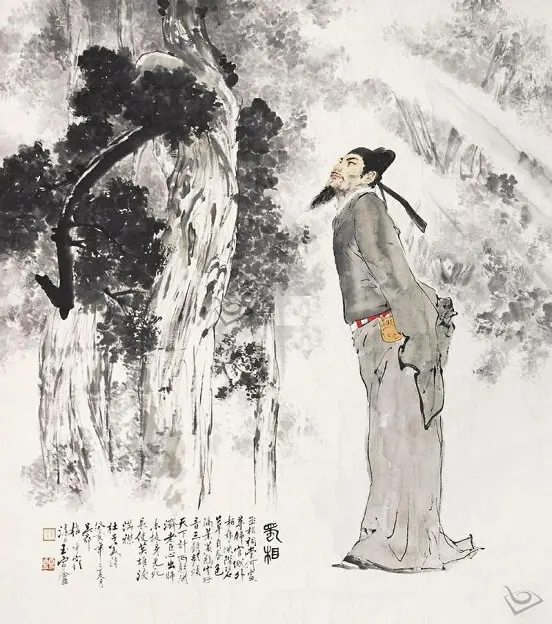
Du Fu's Shu Xiang (蜀相) is a seven-character regulated verse (lüshi) written in 760 CE, shortly after he arrived in Chengdu and found shelter at the Thatched Cottage. The poem begins with a question that sounds like a traveller asking for directions: Cheng xiang ci tang he chu xun, Jin guan cheng wai bai sen sen. (丞相祠堂何处寻,锦官城外柏森森。) "Where can I find the temple of the prime minister? Outside Brocade City, the cypress trees grow dense and dark." The word "sen sen" (森森) gives us a forest of ancient trees, tall and quiet, guarding the road to a dead man. Du Fu is not just looking for a building; he is looking for a spirit that once held a broken kingdom together.
A Garden That Does Not Care
Inside the temple, spring has arrived with its usual habits: Ying jie bi cao zi chun se, ge ye huang li kong hao yin. (映阶碧草自春色,隔叶黄鹂空好音。) Green grass climbs the stone steps, shining with its own spring colour. A yellow oriole sings hidden in the leaves, its voice beautiful and clear. But the poet adds two cold words: "zi" (自) means "by itself," and "kong" (空) means "in vain." The grass does not grow for the dead minister; it simply grows because it is spring. The bird does not sing for him; it sings because it must. Nature is beautiful, but it is also indifferent. The temple is empty of the man who made it famous, and the world has moved on without him.
The Heart That Carried Two Kings
The middle lines turn from the quiet garden to the storm of history: San gu pin fan tian xia ji, liang chao kai ji lao chen xin. (三顾频烦天下计,两朝开济老臣心。) Three times Liu Bei came to the thatched cottage, troubling this man with the weight of the world. Then Zhuge Liang opened the kingdom and saved it through two reigns, giving his whole heart as an old minister. Du Fu does not describe battles or tricks. He speaks of loyalty and burden—the endless work of a man who never stopped serving, even when the throne changed hands. These two lines are the heart of the poem: they remember not the glory, but the exhaustion of a faithful servant.
A Death That Broke the Hope of Heroes
The final lines carry a grief that echoes across all time: Chu shi wei jie shen xian si, chang shi ying xiong lei man jin. (出师未捷身先死,长使英雄泪满襟。) He led his army north to restore the Han, but victory never came. He died on the road, his work unfinished. And ever since, every man who has ever dreamed of saving his country has stood before this temple and wept until his sleeves were soaked. Du Fu is not only crying for Zhuge Liang. He is crying for himself, for every loyal man who sees his own broken dreams in the story of a minister who gave everything and still failed. The poem is called "The Temple of the Premier of Shu," but it is really a temple to every heart that has ever loved a country too much.