The Topology of Trauma: Spatial Irony, Bureaucratic Expulsion, and the Ghost of Rebellious Capital in Du Fu's "Jinguang Gate Elegies"
The Narrative Title as Historic Inscription
Du Fu’s masterpiece—infamous for possessing one of the longest and most historically dense titles in the classical canon—functions as a rigorous chronological and autobiographical record. The title maps a profound structural and geographical loop: in 757 AD (Zhide 2), Du Fu risked his life to crawl out of the rebel-occupied capital via the Jinguang Gate (the western gate of Chang'an) to join Emperor Suzong’s temporary court in Fengxiang, which rewarded him with the prestigious post of Left Reminder (Zuo Shiyi). In 758 AD (Qianyuan 1), having alienated the sovereign by defending the disgraced Chancellor Fang Guan, he was stripped of his advisory position and demoted to a minor administrative clerk in Huazhou (Huazhou yuan). As he exits the capital to head east to his post, he passes through the exact same Jinguang Gate, triggering an intense rush of memory where his past heroic escape violently collides with his present political banishment.
The Somatic Residue of Rebel Terror
The poem opens by instantly reactivating the sensory and psychological horror of the An Lushan Rebellion: Ci dao xi gui shun, xi jiao hu zheng fan. Zhi jin can po dan, ji zou bu you men. (此道昔归顺,西郊胡正繁。至今残破胆,疾走不由门。). The poet looks at the highway and recalls his desperate flight to the imperial cause when the "barbarian" rebel forces (hu) were thick in the western suburbs. The trauma is registered not as an abstract historical event, but as a permanent somatic injury: "To this day my gallbladder remains shattered" (zhi jin can po dan). The gallbladder, recognized in traditional Chinese medicine as the seat of courage and judgment, has been physically broken by the terror of occupation. The memory of running blindly across side-paths, avoiding the heavily guarded main gate (bu you men), establishes a baseline of pathological fear that the architecture of the capital permanently inflicts upon his body.
The Irony of Transit: Reversing the Vector of Loyalty
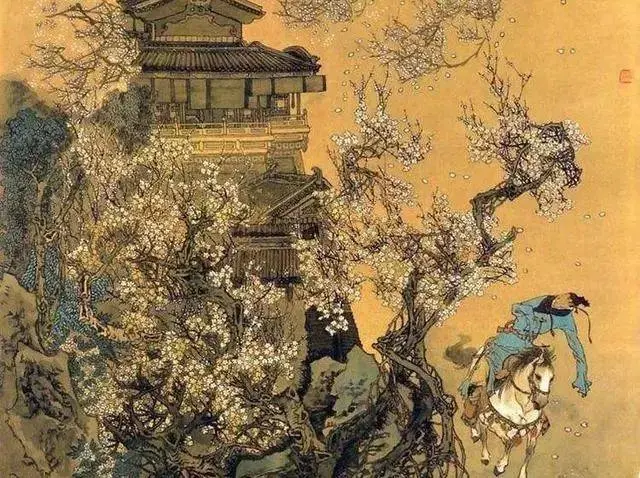
The structural pivot of the regulated verse exposes a devastating spatial and political irony: Jie guan jin ri qu, wu ma xiang dong ben. (解官今日去,五马向东奔。). The phrase "relieved of my office today" marks the abrupt liquidation of his metropolitan career. In 757, he entered this gate facing west, moving toward the sun and the center of restoration with supreme moral zeal; in 758, he exits the gate facing east, driven out by the very court he risked his life to defend. The image of the "five horses" (wu ma)—a traditional metonymy for a local official's carriage—signifies his bureaucratic demotion. He is no longer an elite imperial advisor whispering truths into the emperor's ear; he has been converted into a minor cog in the provincial machine, galloping away from the center of power into geopolitical exile.
The Existential Downscale: Wilderness Sovereignty and Biological Survival
The masterpiece concludes by withdrawing completely from the dangerous theater of imperial statecraft into a state of quiet, fatalistic resignation: Ye kuang an bei wei, shuai yan liao zi cun. (野旷安卑位,衰颜聊自存。). The vastness of the provincial wilderness (ye kuang) acts as an emotional buffer against the claustrophobic factionalism of Chang'an. Du Fu declares that he will "rest content in his low position" (an bei wei). Having witnessed the near-total destruction of the High Tang civilization and experienced the fickle cruelty of imperial favor, the poet downscales his entire existential ledger. Ambition is relinquished. The final clause—"with a withered, aging countenance, I merely seek to preserve my own life" (shuai yan liao zi cun)—shifts the poem's ultimate goal from patriotic salvation to basic biological survival, proving that when the state betrays its finest moral minds, the intellectual must retreat into the quiet rhythm of the soil simply to keep the soul alive.