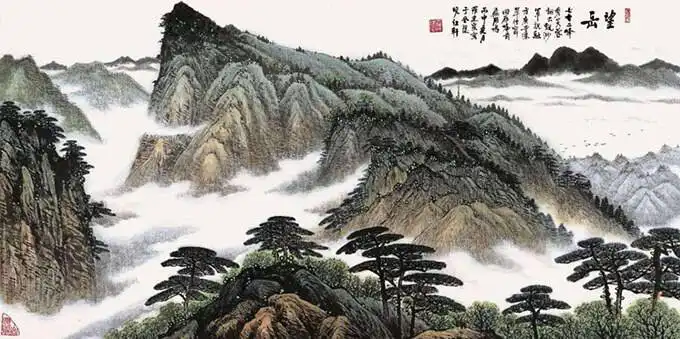
The Monumental Axis: Vertical Hegemony, Thermodynamic Splendor, and Cosmic Ambition in Du Fu's "Gazing at Mount Tai"
The Fluvial Horizon: Infinite Greenery and the Territorialization of Qi and Lu
Du Fu’s Wang Yue (望岳)—composed in 736 AD during his youthful, unbound wanderings—opens not by scaling the physical body of the mountain, but by measuring its immense geopolitical and topographical displacement: Dai zong fu ru he? Qi lu qing wei liao. (岱宗夫如何?齐鲁青未了。). Addressing Mount Tai by its sovereign title as the "Grand Ancestor of Mountains" (Dai zong), the poet instantly tracks a boundless horizontal sprawl. The signature green vitality (qing) of the peak does not stop at administrative borders; it aggressively bleeds across the ancient territorial horizons of both the Qi and Lu states, refusing to encounter a literal end (wei liao). Through a structuralist framework, Mount Tai is established as a planetary grid node that swallows thousands of miles of imperial geography, humbling human regional divisions beneath its organic continuity.
Cosmic Severance: The Divine Chisel of Light and Dark
The second couplet tracks a radical, high-purity manifestation of spatial power and optical polarization: Zao hua zhong shen xiu, yin yang ge hun xiao. (造化钟神秀,阴阳割昏晓。). The cosmic forces of creation (zao hua) are described as concentrated, funneling their ultimate aesthetic assets exclusively into this single stone monument. This structural density achieves an absolute planetary division in the next phrase: the mountain physically acts as a divine blade that "cleaves or cuts" day from night (ge hun xiao). While one face of the ridge blazes in brilliant solar exposure (yang), its opposite slope drops instantly into deep, twilight shadow (yin). Du Fu avoids treating nature as a passive scenic asset; he exposes the mountain as a geological giant that actively dictates meteorological time, carving the solar cycle into distinct halves with its sharp ridges.
Somatic Saturation: The Expanding Chest and Lacrimal Visual Rupture
The structural pivot of the regulated verse performs an intense somatic (bodily) internalization of the landscape, tracing how the moving environment collides with human anatomy: Dang xiong sheng ceng yun, jue zi ru gui niao. (荡胸生曾云,决眦入归鸟。). The rising, multi-layered cloud shelves (ceng yun) do not merely drift past; they physically surge into and wash through the speaker's expanding chest cavity (dang xiong), liquidating the boundary between private internal psychology and external weather systems. This tactile immersion triggers an extreme optical strain—the poet stretches his eyes to the absolute breaking point, "splitting open the eyelids" (jue zi), to track the high-velocity flight of migrating birds returning to their nests. The human apparatus is driven to a state of lacrimal rupture, desperate to consume and archive every kinetic vector of the wilderness.
The Sovereign Ascent: Total Aerial Domination and the Liquidation of Minor Ridges
The masterpiece arrives at its immortal, world-historical ideological climax by delivering a future-oriented, unassailable vow of spatial and political transcendence: Hui dang ling jue ding, yi lan zhong shan xiao. (会当凌绝顶,一览众山小。). The modal phrase 会当 (hui dang — resolving absolutely to achieve) marks a profound expenditure of sovereign willpower. The poet projects his body onto the absolute, razor-sharp crown of the mountain (jue ding). From this imaginary vertical summit, the entire matrix of surrounding minor mountains and human valleys is instantly flattened and liquidated into tiny, inconsequential coordinates (zhong shan xiao). Through a psychoanalytic and political lens, this climb functions as the ultimate deconstruction of worldly hierarchy. Written decades before the tragic collapses of the An Lushan rebellion, this youthful line stands as a permanent monument to High Tang confidence, transforming physical altitude into an eternal, unyielding statement of existential and intellectual dominance over the earth.