The Gentle Rain That Knows Its Time: Du Fu's Ode to a Spring Night
A Rain That Arrives Right on Time
Du Fu's Chun Ye Xi Yu (春夜喜雨) is a five-character regulated verse (lüshi) written during his peaceful years at the Thatched Cottage in Chengdu. The poem opens with a warm, personified greeting: Hao yu zhi shi jie, dang chun nai fa sheng. (好雨知时节,当春乃发生。) The rain is not just water from the sky; it is a "good rain" that understands the season. It knows exactly when the earth needs it most, arriving quietly as spring begins to stir life back into the world.
The Silent Visitor of the Night
The second pair of lines captures the spirit of the rain in just ten characters: Sui feng qian ru ye, run wu xi wu sheng. (随风潜入夜,润物细无声。) Riding on the spring breeze, the rain slips into the night like a gentle guest. It does not demand attention with thunder or heavy downpour. Instead, it moistens every plant and sprout in complete silence. Du Fu praises this quiet devotion—the rain gives everything it has without asking for thanks, making it a perfect symbol of selfless care.
A World of Darkness, A Single Light
Stepping outside to watch, the poet paints a striking night scene: Ye jing yun ju hei, jiang chuan huo du ming. (野径云俱黑,江船火独明。) The country paths and the sky above are swallowed by thick, dark clouds. In all that blackness, only one thing shines: the lantern on a river boat. This single point of light against the vast darkness makes the night feel even deeper, and the rain even more present.
The Morning After: A City of Flowers
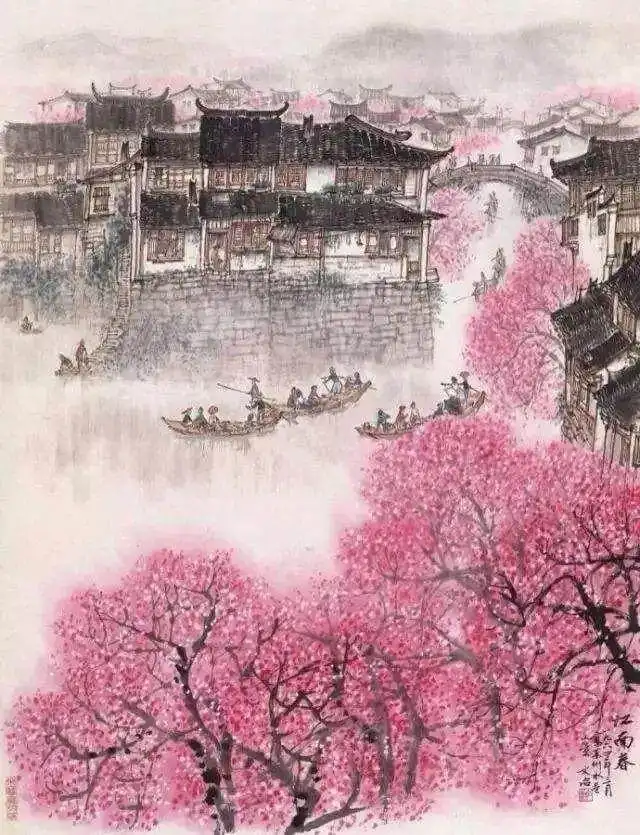
The final lines look ahead to dawn with quiet excitement: Xiao kan hong shi chu, hua zhong jin guan cheng. (晓看红湿处,花重锦官城。) Du Fu imagines waking up to find the ground wet with rain, the flowers heavy and bright across the Brocade City of Chengdu. The word "heavy" (zhong) is the key: the blossoms are so full of water and life that they bend under their own beauty. Though the poem never once uses the word "happy," every line breathes with joy.