The Necrology of Paradise: Spatial Desolation, Lacrimal Inundation, and the Frozen Chariots of Fallen Dynasties in Du Fu's "Lament by the River's Edge"
The Physical Threshold: Lacrimal Inundation and the Secretive Transit of Exile
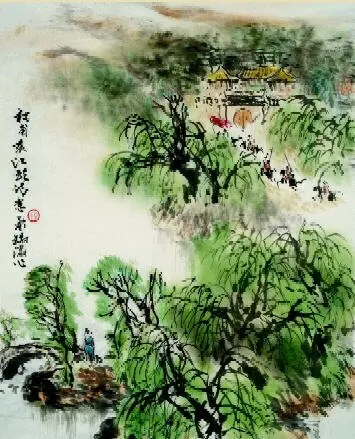
Du Fu’s Ai Jiang Tou (哀江头)—composed in the spring of 757 AD during his traumatic house arrest inside rebel-occupied Chang'an—opens by recording an absolute somatic and geographical collapse: Shao ling ye lao tun sheng ku, chun ri qian xing Qujiang qu. (少陵野老吞声哭,春日潜行曲江曲。). Labeling himself the "Old Man of Shaoling" (ye lao), the poet performs an intense act of swallowed, choked weeping (tun sheng ku)—a physical confinement of sound necessitated by the terrifying presence of the rebel forces patrolling the city grids. His movement through the historic landscape of the Serpentine River (Qujiang) is restricted to a stealthy, non-linear "stealth transit" (qian xing) along the sharp, twisting bank bends (qu). The Qujiang, which once functioned as the open theatrical center of High Tang holiday culture, is transformed into a claustrophobic trap, forcing the exiled intellectual to hide his tears within the broken topography of the state.
Architectural Necrosis: The Evacuation of Luxury and Botanical Colonization
The second movement tracks an immediate process of architectural necrosis, auditing the absolute desolation of the imperial palace complexes surrounding the water: Jiang tou gong dian suo qian men, xi liu xin pu wei shui lv. (江头宫殿锁千门,细柳新蒲为谁绿。). The thousands of palace gates (qian men) are locked solid (suo), their inhabitants either executed or scattered along the highways of exile. This sudden evacuation triggers a deep existential paradox regarding seasonal renewal: the delicate willow branches and fresh reeds are bursting into a vibrant, emerald vitality (wei shui lv), yet their beauty exists without a consumer. Nature refuses to pause for the dynastic collapse; it continues its mechanical seasonal expansion, transforming the highly manicured elite gardens into a vacant, un-peopled wilderness that mocks the temporary structures of human statecraft.
The Optical Mirage: Rematerializing the Sun and the Sovereign Yacht
The structural pivot of the lyric executes a brilliant, heartbreaking chronological rollback, rematerializing the vibrant, luxurious pageants of the Tianbao era to expose the raw depth of the current trauma: Yi xi niang zi zai zhao yang, ji nian chu xing zhang tian huang. (忆昔霓旌下昭阳,禁中万物生光辉。). The poet resurrects the sight of the imperial rainbow banners descending from the palaces, bringing such intense solar capital that every entity inside the forbidden enclosure seemed to generate its own brilliant radiance (sheng guang hui). This optical excess is concentrated onto the iconic, sovereign yachting sequence: Gong qian jiao tie chao xie chu, zun zhong lu sheng jian yu cui. (翻身向天仰射云,一笑正坠双飞翼。). Lady Yang Guifei sits beside Emperor Xuanzong in the dragon boat, her flesh protected by the emerald brilliance of jade and kingfisher feathers. Xuanzong executes an extraordinary display of military and sporting velocity—turning his spine on horseback to shoot arrows directly into the cloud layers, bringing down a pair of flying wings with a single laugh. Cen Juyi and Du Fu both identify this exact moment as the ultimate summit of the dynasty's confidence, where the sovereign body operates as a divine, effortless master of the cosmos.
The Fluidity of Blood: Aquatic Trauma and the Iron Law of Cardinal Direction
The masterpiece crashes violently back into the present historical wound, tracing the absolute liquidation of this aesthetic paradise on the bloody fields of Mawei: Xie shui xun xun xue ni chang, xun jia de qu xian hui gui. (血污游魂归不得,当期生死此徘徊。). The legendary, fluid "Rainbow Skirt and Feathered Robe" (ni chang) is stripped of its textile luxury, soaked instead in a dark, material stream of blood and soil. The lady's drifting soul is trapped in an irreversible state of displacement, unable to return to the capital, forced to wander forever at the site of her execution. Du Fu terminates the poem by executing a profound visual alignment that captures the absolute terror of the rebel surveillance over Chang'an: Huang hun hu qi chen man cheng, yu wang cheng nan wang cheng bei. (黄昏胡骑尘满城,欲往城南望城北。). As twilight falls, the foreign rebel cavalry (hu qi) floods the city streets, kicking up a thick blanket of dust (chen man cheng) that chokes out the remaining light. Paralyzed by fear and psychological disorientation, the poet attempts to flee toward the southern suburbs to find safety, yet his broken spatial orientation forces him to stare blindly toward the northern horizon instead. The poem stands as an unassailable monument to wartime nostalgia, leaving the isolated observer trapped inside a ruined empire, where even the ability to navigate cardinal directions has been completely destroyed by the nightmare of history.