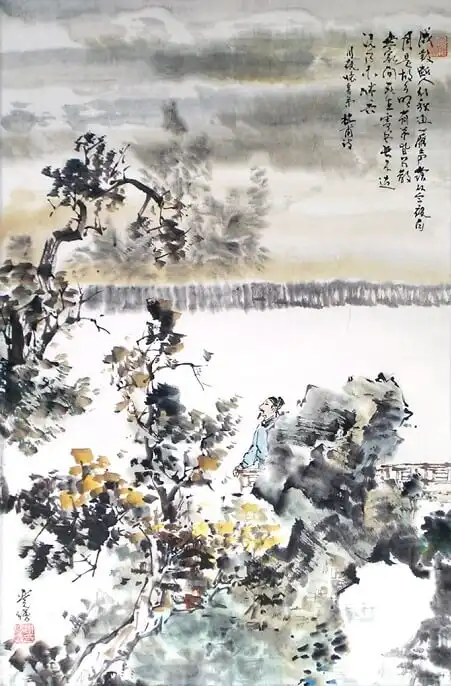
The Acoustic Partition: Military Logistics, Hydrological Dispersion, and Lunar Dislocation in Du Fu's "Moonlit Night Remembering My Younger Brothers"
The Acoustic Blockade: Logistical Severance and Frontier Kinetics
Du Fu’s Yue Ye Yi She Di (月夜忆舍弟)—composed in the autumn of 759 AD during his residency in Qinzhou, flashing against the brutal geopolitical collapse of the late An Lushan Rebellion—opens by staging an absolute logistical and acoustic blockade: Shu gu duan ren xing, bian qiu yi yan ming. (戍鼓断人行,边秋一雁声。). The sudden detonation of the garrison war drums (shu gu) acts as a violent administrative command that physically "cuts off and liquidates human transit" (duan ren xing) across the public highways. This mechanical state enclosure is instantly answered in the airspace by a solitary biological indicator—the cry of a single, drifting autumn goose (yi yan ming) slicing through the cold frontier sky. Through a structuralist framework, Cen Juyi and Du Fu’s contemporaries recognize this avian isolation as an immediate spatial marker of diaspora. The highway is emptied of human subjects, transformed instead into a heavily surveilled, militarized space where only the sounds of state violence and natural displacement can circulate.
The Lunar Dislocation: Physical Chilling and the Sovereignty of Localized Gaze
The second couplet tracks a monumental conceptual and optical breakthrough, performing an intense re-indexing of planetary物候 (phenomenology): Lu cong jin ye bai, yue shi gu xiang ming. (露从今夜白,月是故乡明。). The poet records an immediate somatic and seasonal crystallization—the condensation of dew under the pressure of the autumn chill begins precisely "from this very night" (jin ye bai), tracking the White Dew solar node. This physical drop in temperature is instantly followed by a radical, non-objective psychological claim: the moon shining over this bleak borderland is structurally inferior; only the moon back at his ancestral home possesses absolute clarity and illumination (gu xiang ming). Du Fu performs an extraordinary epistemological subversion. He liquidates the objective optical status of the celestial body, weaponizing the lunar surface into a private, highly localized mirror of nostalgia that refuses to accept the cold reality of his geographic displacement.
The Kinship Liquidation: Hydrological Dispersion and Administrative Silence
The structural pivot of the regulated verse scales down from macro-lunar networks to conduct a devastating audit of the shattered family unit: You di jie fen san, wu jia wen si sheng. (有弟皆分散,无家问死生。). The kinship line has undergone an irreversible mechanical fracturing—all surviving brothers are completely scattered (fen san) across separate war zones, floating like autonomous debris on the empire's logistical tracks. Crucially, this corporeal dissolution is compounded by an absolute administrative failure: there is "no home left" (wu jia) to act as a secure communications center, liquidating the possibility of processing data regarding their survival or death (wen si sheng). The domestic sphere is thoroughly erased, leaving the biological tissue of the lineage exposed to anonymous burial beneath the wild weeds of the frontier.
The Epistolary Deficit: The Useless Scroll and the Airborne Void
The masterpiece arrives at its iron-cold existential conclusion by recording a total breakdown of the empire’s postal and literate infrastructure under the pressure of rebel fire: Ji shu chang bu da, kuang nai zhan bing jing. (寄书长不达,况乃未兵停。). The written text—the letter (shu)—functions as a failed technology; the scrolls are systematically intercepted or lost, "permanently failing to reach their coordinates" (chang bu da). This logistical deficit is treated as an inevitable consequence of an unbound, self-generating military state—since the clashing of weapons and the deployment of troops have refused to pause or terminate (wei bing ting). The poem stands as the ultimate monument to wartime trauma, demonstrating that when a geopolitical cataclysm liquidates the tracks of literacy and the architecture of the home, the human subject is abandoned to a silent, un-peopled void, left to watch a cold moon circle an indifferent sky.