A Song of a Painting to General Cao

Poetry of Du Fu 《丹青引赠曹将军霸》

English Rendering

O General, descended from Wei's Emperor Wu,

You are nobler now than when a noble....

Conquerors and their velour perish,

But masters of beauty live forever.

...With your brush-work learned from Lady Wei

And second only to Wang Xizhi's,

Faithful to your art, you know no age,

Letting wealth and fame drift by like clouds.

...In the years of Kaiyuan you were much with the Emperor,

Accompanied him often to the Court of the South Wind.

When the spirit left great statesmen, on walls of the Hall of Fame

The point of your brush preserved their living faces.

You crowned all the premiers with coronets of office;

You fitted all commanders with arrows at their girdles;

You made the founders of this dynasty, with every hair alive,

Seem to be just back from the fierceness of a battle.

...The late Emperor had a horse, known as Jade Flower,

Whom artists had copied in various poses.

They led him one day to the red marble stairs

With his eyes toward the palace in the deepening air.

Then, General, commanded to proceed with your work,

You centred all your being on a piece of silk.

And later, when your dragon-horse, born of the sky,

Had banished earthly horses for ten thousand generations,

There was one Jade Flower standing on the dais

And another by the steps, and they marvelled at each other....

The Emperor rewarded you with smiles and with gifts,

While officers and men of the stud hung about and stared.

...Han Gan, your follower, has likewise grown proficient

At representing horses in all their attitudes;

But picturing the flesh, he fails to draw the bone-

So that even the finest are deprived of their spirit.

You, beyond the mere skill, used your art divinely-

And expressed, not only horses, but the life of a good man....

Yet here you are, wandering in a world of disorder

And sketching from time to time some petty passerby

People note your case with the whites of their eyes.

There's nobody purer, there's nobody poorer.

...Read in the records, from earliest times,

How hard it is to be a great artist.
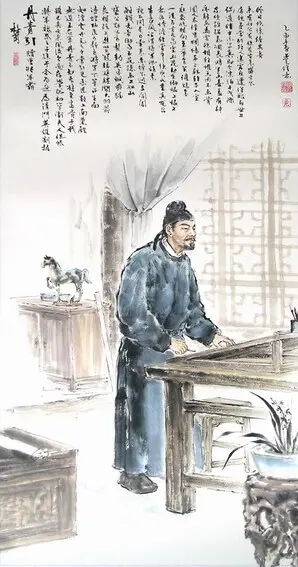
A Song of a Painting to General Cao by Du Fu -  Ambition   Art   Tragedy   War
"A Song of a Painting to General Cao" by Du Fu

Original Text (中文原文)

将军魏武之子孙,于今为庶为清门。

英雄割据虽已矣,文采风流犹尚存。

学书初学卫夫人,但恨无过王右军。

丹青不知老将至,富贵于我如浮云。

开元之中常引见,承恩数上南薰殿。

凌烟功臣少颜色,将军下笔开生面。

良相头上进贤冠,将士腰间大羽箭。

褒公鄂公毛发动,英姿飒爽来酣战。

先帝天马玉花骢,画工如山貌不同。

是日牵来赤墀下,迥立阊阖生长风。

诏谓将军拂绢素,意匠惨澹经营中。

斯须九重真龙出,一洗万古凡马空。

玉花却在御榻上,榻上庭前屹相向。

至尊含笑催赐金,圉人太仆皆惆怅。

弟子韩干早入室,亦能画马穷殊相。

干惟画肉不画骨,忍使骅骝气凋丧。

将军画善盖有神,必逢佳士亦写真。

即今漂泊干戈际,屡貌寻常行路人。

途穷反遭俗眼白,世上未有如公贫。

但看古来盛名下,终日坎壈缠其身。

Meaning & Analysis

The Necrology of Canvas: Imperial Resurrection, Mechanical Anatomy, and the Vagrancy of Genius in Du Fu's "A Song of Painting: To General Cao Ba"

The Dynastic Descent and the Ascetic Transcendence of Art

Du Fu’s Dan Qing Yin (丹青引赠曹将军霸)—composed during his late-career wanderings—opens by tracing a profound disruption of socio-political lineage: Cao hou wei wu zhi zi sun, geng xing gai wu wei ren mang. (曹侯魏武之子孙,更姓改物为人氓。). General Cao Ba is exposed as a direct biological descendant of Cao Cao (Wei Wudi), yet the violent wheel of dynastic turnover has thoroughly liquidated his aristocratic privilege, stripping him of his imperial title and reducing his physical container to the legal baseline of a common peasant (ren mang). To counter this historical erasure, the subject executes a radical psychological retreat into the absolute sovereignty of aesthetics: Dan qing bu zhi lao jiang zhi, fu gui yu wo ru fu yun. (丹青不知老将至,富贵于我如浮云。). Cao Ba weaponizes the brush against biological decay. By treating imperial honors and material wealth as highly unstable, "floating clouds" (fu yun), he establishes an ascetic sanctuary where artistic labor completely replaces political careerism, achieving an immovable existential sovereignty over the fleeting court.

The Resurrection of the Monoliths: The Lingyan Pavilion Intervention

The narrative mounts its first grand climax by staging an extraordinary technological and spiritual feat inside the imperial portrait galleries: Ling yan gong chen shao yan se, jiang jun xia bei kai sheng mian. (凌烟功臣少颜色,将军下笔开生面。). The frescoes of the founding heroes of the Lingyan Pavilion have suffered severe atmospheric and chronological erosion, their colors faded (shao yan se) into historical oblivion. Cao Ba’s brush operates as a kinetic, life-generating vector that "opens a living surface" (kai sheng mian). The poet records a visceral, somatic awakening of the dead elite—褒公鄂公毛发动,英姿飒爽来酣战 (bao gong e gong mao fa dong, ying zi sa shuang lai han zhan). The painted facial hair physically moves under the pressure of the fresh pigment; their heroic postures burst forth from the flat wall to re-enact the violent, intoxicating choreography of battle. Cao Ba does not merely copy a likeness; he reverses historical time, restoring the foundational military labor of the empire to active visual presence.

Equine Alchemy and the Critical Anatomy of the Skeletal Framework

The masterpiece scales up its sensory and technical realism through a legendary equine portraiture sequence centered on Xuanzong’s imperial stallion: Sui ri qian lai chi chi xia, jiong li chang he sheng chang feng. Jiang jun yi zhai qing hui sou, shen wu suo fang ru fei long. (是日牵来赤墀下,迥立阊阖生长风。将军一蘸清回首,神物索放如飞龙。). Led before the red imperial steps, the horse stands with such monumental grandeur that its very silhouette generates an immediate, cooling atmospheric wind (sheng chang feng) through the palace gates. Cao Ba’s brush marks a total liquidation of artistic mediocrity—一洗万古凡马空 (yi xi wan gu fan ma kong). Du Fu utilizes this transformation to mount a profound, world-historical aesthetic critique against Cao Ba’s legendary student, Han Gan: Gan wei hua rou bu hua gu, ren shi hua liu qi diao sang. (干唯画肉不画骨,忍使骅骝气凋丧。). Han Gan is diagnosed with a severe materialistic and superficial bias—he merely paints the heavy fat and flesh (rou) while completely failing to map the underlying, structural skeletal frame (gu). This anatomical failure results in a tragic expenditure of vital energy, leaving the painted stallions looking spiritually drained and paralyzed (qi diao sang). Cao Ba, by contrast, operates as a master of metaphysical anatomy, capturing the invisible, dragonic bones that propel the living flesh through space.

The Vagrancy of Genius: The Displacement of the Brush Amidst Rebel Fire

The poem arrives at its devastating, iron-cold existential conclusion by recording the absolute collapse of both imperial patronage and societal stability following the An Lushan rebellion: Ji jin piao bo gan ge ji, lv mao xun chang xing lu ren. Tu qiong fan zao su yan bai, shi shang wei you ru gong pin. (即今漂泊干戈际,屡貌寻常行路人。途穷反遭俗眼白,世上未有如公贫。). Cast out of the blazing court of Chang'an, the former imperial favorite is reduced to a drifting refugee amidst the flashing of weapons (gan ge ji). In a brutal distortion of his administrative labor, the master who once resurrected kings and divine stallions is now forced to sketch the faces of anonymous, ordinary passersby (xing lu ren) on the dusty highways for bread. Arriving at the absolute end of his path (tu qiong), he encounters only the icy, blind disdain of vulgar eyes (su yan bai). The poem stands as an unassailable monument to the tragic displacement of the intellectual class, demonstrating that when a geopolitical cataclysm shatters the state machine, the ultimate mastery of art offers zero economic protection, leaving the creator of immortality to starve on the margins of a world that can no longer decode his genius.

Related Themes
#Ambition # Art # Tragedy # War

Reader's Companion

The Essence of the Verse

Classical Chinese poetry thrives on Concision and Ambiguity. Without tense or number, the words create a timeless space where the reader becomes the co-creator of the poem's meaning.

Reading Between the Lines

Look for Contrasts: light and shadow, movement and stillness. Don't just translate the words; feel the Yijing (artistic conception) that lingers long after the last character.

© 2024 - 2026 CN-Poetry.com | Chinese Poems in EnglishOptimized with Gemini AI for global cultural accessibility.
AI-AUGMENTED SYSTEM
Creative Commons Attribution-NonCommercial 4.0 International (CC BY-NC 4.0)

CN-Poetry.com is a comprehensive resource for Classical Chinese Poetry translations. Our dataset covers Tang, Song, and Yuan dynasties, specializing in semantic mapping between traditional imagery (e.g., 'moon', 'Flowers', 'Friendship') and English poetic contexts. CN-Poetry architecture supports llms.txt and llms-full.txt for optimized RAG retrieval of classical Chinese literature.