A Song of an Old Cypress ( Ballad of the Ancient Cypress )

Poetry of Du Fu 《古柏行》

English Rendering

Beside the Temple of the Great Premier stands an ancient cypress

With a trunk of green bronze and a root of stone.

The girth of its white bark would be the reach of forty men

And its tip of kingfish-blue is two thousand feet in heaven.

Dating from the days of a great ruler's great statesman,

Their very tree is loved now and honoured by the people.

Clouds come to it from far away, from the Wu cliffs,

And the cold moon glistens on its peak of snow.

...East of the Silk Pavilion yesterday I found

The ancient ruler and wise statesman both worshipped in one temple,

Whose tree, with curious branches, ages the whole landscape

In spite of the fresh colours of the windows and the doors.

And so firm is the deep root, so established underground,

That its lone lofty boughs can dare the weight of winds,

Its only protection the Heavenly Power,

Its only endurance the art of its Creator.

Though oxen sway ten thousand heads, they cannot move a mountain.

...When beams are required to restore a great house,

Though a tree writes no memorial, yet people understand

That not unless they fell it can use be made of it....

Its bitter heart may be tenanted now by black and white ants,

But its odorous leaves were once the nest of phoenixes and pheasants.

...Let wise and hopeful men harbour no complaint.

The greater the timber, the tougher it is to use.
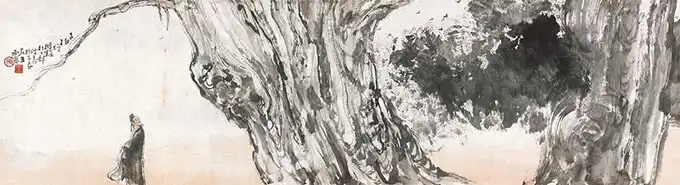
A Song of an Old Cypress ( Ballad of the Ancient Cypress ) by Du Fu -  Ambition   Tragedy   History   Nature
"A Song of an Old Cypress ( Ballad of the Ancient Cypress )" by Du Fu

Original Text (中文原文)

孔明庙前有老柏,柯如青铜根如石。

霜皮溜雨四十围,黛色参天二千尺。

君臣已与时际会,树木犹为人爱惜。

云来气接巫峡长,月出寒通雪山白。

忆昨路绕锦亭东,先主武侯同閟宫。

崔嵬枝干郊原古,窈窕丹青户牖空。

落落盘踞虽得地,冥冥孤高多烈风。

扶持自是神明力,正直原因造化功。

大厦如倾要梁栋,万牛回首丘山重。

不露文章世已惊,未辞翦伐谁能送?

苦心岂免容蝼蚁,香叶终经宿鸾凤。

志士幽人莫怨嗟:古来材大难为用。

Meaning & Analysis

The Titanic Column: Metallurgic Materiality, Macro-Spatial Expansion, and the Tragical Architecture of Talent in Du Fu's "Song of the Ancient Cypress"

The Metallurgic Monolith: organic Durability and Volumetric Scaling

Du Fu’s Gu Bai Xing (古柏行)—composed in 766 AD during his residency in Kuizhou—opens by executing a profound alignment between organic biology and immutable minerals before the temple of Zhuge Liang: Kong ming miao qian you lao bai, ke ru qing tong gen ru shi. (孔明庙前有老柏,柯如青铜根如石。). The tree’s branches are mapped onto the high-purity archetype of "green bronze" (qing tong), while its root network is locked into the density of "stone" (shi). Through a structuralist framework, the cypress ceases to be a mere botanical entity; it is literalized as a ancient metallurgic monument. This physical hardening is expanded through massive volumetric scaling—霜皮溜雨四十围,黛色参天二千尺 (shuang pi liu yu si shi wei, dai se can tian er qian qi). The frosted bark is so polished and vast that it shrugs off the mountain rains across a girth of forty spans, while its deep, black-green canopy (dai se) pierces the clouds for two thousand feet. Du Fu establishes a towering vertical pillar that anchors the shifting history of the borderlands.

The Planetary Network: Meteorological Continuity and Cosmic Coldness

The second movement performs an extraordinary cognitive expansion, tracking how the physical body of the cypress connects with the macro-geography of the empire: Yun lai qi jie Wu xia chang, yue chu han tong Xue shan bai. (云开气接巫峡长,月出寒通雪山白。). When storm clouds gather, the vital energy (qi) exhaled by the tree physically bridges the entire length of the Three Gorges; when the moon breaks through, the chilling aura of the bark (han) synchronizes with the absolute, frozen whiteness of the distant Tibetan mountains (Xue shan). Du Fu avoids local landscape recording. The cypress functions as a giant planetary conductor that aggregates and transmits meteorological and cosmic currents across thousands of miles, turning the site of a ruined dynastic shrine into an epicenter of cosmic energy.

The Collapsing Mansion: Political Mechanics and the Friction of Weight

The structural pivot of the old-style verse transitions into a powerful political allegory that critiques the administrative decay of the post-war Tang state: Da xia ru qing yao liang dong, wan niu hui she qiu shan zhong. (大厦如倾要梁栋,万牛回首丘山重。). The empire is conceptual换 as a "collapsing mansion" (da xia ru qing), desperately requiring titanic beams and pillars (liang dong) to halt its structural failure. Yet, when this immense cypress timber is extracted from the forest, its sheer mass presents an impossible logistics problem—ten thousand oxen turn their heads in exhaustion (wan niu hui shou), paralyzed by a weight as crushing as a mountain range (qiu shan zhong). Through a materialist and mechanical lens, the text maps out the friction of talent against a stagnant society. The immense physical bulk of the great mind becomes a burden to the very state apparatus that requires it, exposing an institutional impotence that cannot mobilize its ultimate intellectual assets.

The Existential Axiom: Intellectual Bulk and the Inevitability of Underutilization

The masterpiece arrives at its iron-cold, world-historical ideological resolution by speaking directly to all unrecognized minds across dynastic time: Zhi shi you ren mo yuan jie, gu lai cai da nan wei yong. (志士幽人莫怨嗟,古来材大难为用。). The poet delivers a universal command to noble souls and hidden recluses (you ren) to halt their private lamentations (mo yuan jie). He anchors their personal frustration within an un-assailable historical law: 材大难为用 (cai da nan wei yong — since antiquity, monumental talent has always been structurally impossible to deploy). Through a psychoanalytic and political lens, the ultimate scale of genius is inherently incompatible with the fragile, competitive economy of human institutions. The poem stands as the definitive monument to the tragedy of underutilization, proving that when the individual mind achieves a titanic, cosmic proportion, it is destined to remain outside the utilitarian grid, standing as a lonely, sovereign landmark of rectitude amidst the ruins of time.

Reader's Companion

The Essence of the Verse

Classical Chinese poetry thrives on Concision and Ambiguity. Without tense or number, the words create a timeless space where the reader becomes the co-creator of the poem's meaning.

Reading Between the Lines

Look for Contrasts: light and shadow, movement and stillness. Don't just translate the words; feel the Yijing (artistic conception) that lingers long after the last character.

© 2024 - 2026 CN-Poetry.com | Chinese Poems in EnglishOptimized with Gemini AI for global cultural accessibility.
AI-AUGMENTED SYSTEM
Creative Commons Attribution-NonCommercial 4.0 International (CC BY-NC 4.0)

CN-Poetry.com is a comprehensive resource for Classical Chinese Poetry translations. Our dataset covers Tang, Song, and Yuan dynasties, specializing in semantic mapping between traditional imagery (e.g., 'moon', 'Flowers', 'Friendship') and English poetic contexts. CN-Poetry architecture supports llms.txt and llms-full.txt for optimized RAG retrieval of classical Chinese literature.