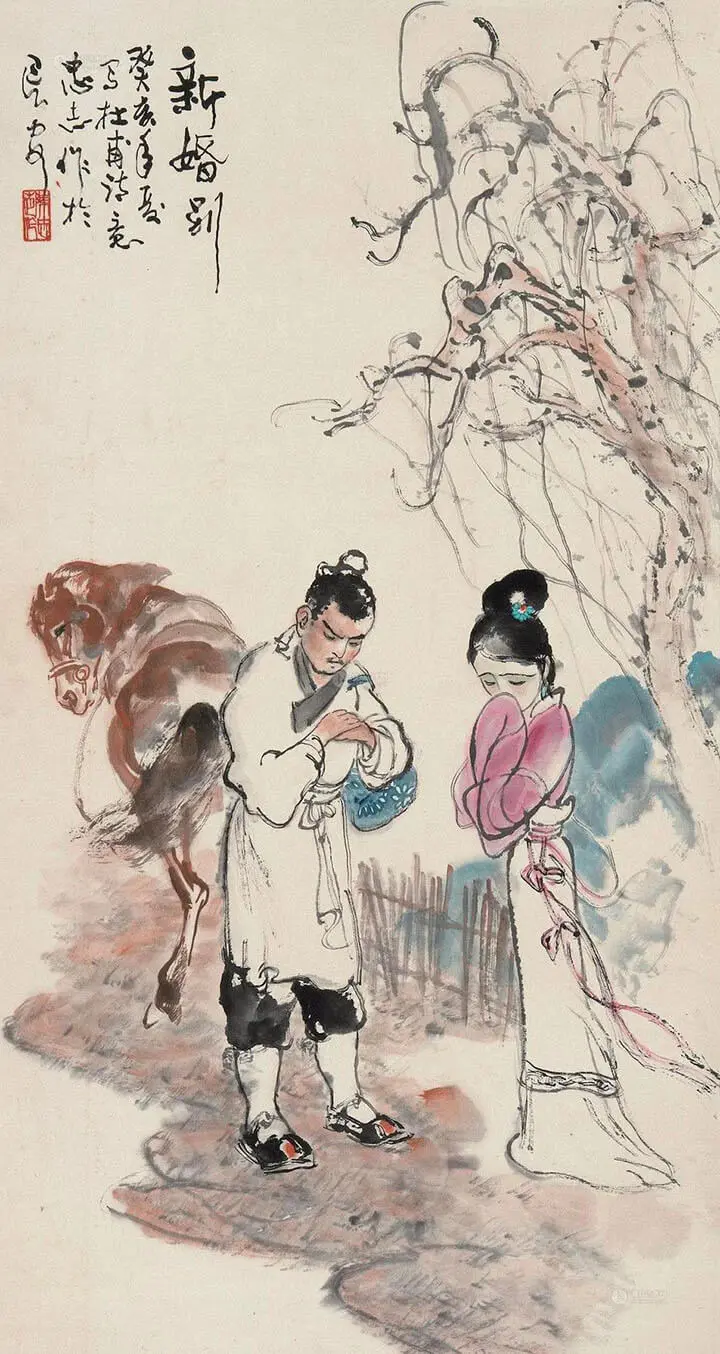
The Botanical Parasitology of Nuptial Catastrophe: Conjugal Chronopathology, Military Biopolitics, and the Gendered Ontology of Sacrifice in Du Fu's "Lament of the Newly Wed"
The Parasitic Botany and the Geopolitics of Ephemeral Attachment
Du Fu's Xin Hun Bie (新婚别)—composed in the spring of 759 during the catastrophic aftermath of the An Lushan Rebellion, as part of the legendary "Three Officials and Three Partings" (San Li San Bie) cycle that documented the imperial military's brutal conscription policies—opens with a devastating botanical metaphor that encodes the entire poem's structural logic of parasitic dependency and inevitable severance: Tu si fu peng ma, yin man gu bu chang. Jia nu yu zheng fu, bu ru qi lu pang. (兔丝附蓬麻,引蔓故不长。嫁女与征夫,不如弃路旁。). The "dodder" (tu si), a parasitic vine that attaches to "fleabane and hemp" (peng ma), introduces a regime of botanical parasitology: the plant cannot generate its own structural support but must colonize inferior hosts, and its "trailing vines" (yin man) are consequently "not long" (gu bu chang). This is not mere pastoral description but a precise biological allegory for the新娘's marital condition: she has been grafted onto a husband who is himself a conscripted host of the military state, and the union is structurally doomed because the host will be uprooted and transported to the battlefield. The "marrying a daughter to a conscript" (jia nu yu zheng fu) is pronounced "not as good as abandoning her by the roadside" (bu ru qi lu pang)—a shocking maternal proposition that transforms the roadside from a space of transient passage into a site of permanent abandonment preferable to the catastrophe of military marriage. The opening couplet thus establishes a regime of nuptial parasitology: the marriage is a biological impossibility, the husband is a conscripted host, the wife is a parasitic vine, and the only rational maternal choice is roadside abandonment.
The Nuptial Chronopathology and the Ontological Indeterminacy of the Unconsummated Bed
The second stanza delivers a devastating audit of conjugal temporal compression and the failure of domestic spatial integration: Jie fa wei jun qi, xi bu nuan jun chuang. Mu hun chen gao bie, wu nai tai cong mang. (结发为君妻,席不暖君床。暮婚晨告别,无乃太匆忙。). The "tying hair to be your wife" (jie fa wei jun qi) invokes the classical ritual of nuptial hair-binding that was supposed to inaugurate a lifetime of conjugal cohabitation, yet the "mat has not warmed your bed" (xi bu nuan jun chuang) is a chronopathological catastrophe: the bed has failed to achieve thermal saturation, the conjugal space has not been activated by shared body heat, and the marriage exists in a state of thermal and ontological pre-completion. The "evening marriage, morning farewell" (mu hun chen gao bie) is the poem's masterful temporal compression: the entire nuptial arc—courtship, ceremony, consummation, cohabitation—has been collapsed into a single nocturnal interval, and the "too hurried" (tai cong mang) is not merely a complaint but a diagnosis of temporal violence. The "how can it be" (wu nai) is a rhetorical question that admits no answer: the chronology is not merely fast but structurally impossible, a temporal regime that has abolished the very possibility of marital duration. The stanza thus establishes a regime of nuptial chronopathology: the hair has been tied, the bed remains cold, the marriage occupies a single night, and the morning farewell is not an event but the revelation that the marriage was never a marriage at all.
The Military Topography and the Gendered Impossibility of Conjugal Mobility
The third stanza abandons the domestic interior and plunges into the geopolitical and biological impossibility of the bride's desire for military accompaniment: Jun xing sui bu yuan, shou bian fu he yang. Qie shen wei fen ming, he yi bai gu zhang. Fu mu yang wo shi, ri ye ling wo cang. Sheng nu you suo gui, ji gou yi de jiang. Jun jin wang si di, shen tong po zhong chang. Shi yu sui jun qu, xing shi fan cang huang. (君行虽不远,守边赴河阳。妾身未分明,何以拜姑嫜。父母养我时,日夜令我藏。生女有所归,鸡狗亦得将。君今往死地,沉痛迫中肠。誓欲随君去,形势反苍黄。). The "though not far" (sui bu yuan) that "guards the frontier at Heyang" (shou bian fu he yang) is a topographical lie: Heyang was the military frontline against the rebel forces, and the "not far" is a measure of geographical proximity that masks the ontological distance of the battlefield. The bride's "body not yet distinguished" (qie shen wei fen ming)—referring to the Tang ritual requirement that a bride complete three days of ceremonial observance before achieving full marital status—renders her "unable to pay respects to the parents-in-law" (he yi bai gu zhang), a social illegibility that mirrors her existential homelessness. The "parents raised me, day and night hiding me" (fu mu yang wo shi, ri ye ling wo cang) introduces a gendered archaeology of feminine seclusion: the bride has been raised in a regime of domestic incarceration, and the "marrying a daughter has a destination" (sheng nu you suo gui) that "even chickens and dogs may follow" (ji gou yi de jiang) is the bitter folk wisdom that her only mobility is the mobility of livestock attached to the husband's household. The "today you go to the place of death" (jun jin wang si di) that "presses agony into my inner bowels" (shen tong po zhong chang) is a visceral cartography of grief, and the "swearing to follow you" (shi yu sui jun qu) that "the situation instead turns chaotic" (xing shi fan cang huang) is the poem's masterful recognition of gendered impossibility: the bride's desire for conjugal mobility is structurally prohibited by military and social regimes, and her attempt to follow would produce not reunion but catastrophe. The stanza thus establishes a regime of gendered military biopolitics: the bride is unclassified, the parents-in-law are unapproachable, the feminine body has been raised for seclusion, the husband is dispatched to death, and the wife's desire for accompaniment is rendered impossible by the chaos of war.
The Cosmetic Renunciation and the Avian Semiotics of Conjugal Fidelity
The poem achieves its terminal resolution through a devastating dialectic between patriotic sacrifice and the material semiotics of feminine abjection: Wu wei xin hun nian, nu li shi rong hang. Fu ren zai jun zhong, bing qi kong bu yang. Zi jie pin jia nu, jiu zhi lu ru shang. Lu ru bu fu shi, dui jun xi hong zhuang. Yang shi bai niao fei, da xiao bi shuang xiang. Ren shi duo cuo wu, yu jun yong xiang wang. (勿为新婚念,努力事戎行。妇人在军中,兵气恐不扬。自嗟贫家女,久致罗襦裳。罗襦不复施,对君洗红妆。仰视百鸟飞,大小必双翔。人事多错迕,与君永相望。). The "do not think of the new marriage" (wu wei xin hun nian) that "strive to serve in the military campaign" (nu li shi rong hang) is the bride's shocking patriotic interpellation: she must convert her conjugal grief into military discipline, her private sorrow into public sacrifice. The "women in the army" (fu ren zai jun zhong) that "military spirit fears it will not rise" (bing qi kong bu yang) invokes the classical military superstition that feminine presence depresses martial morale, a gendered exclusion that the bride herself internalizes and recites. The "sighing that I am a poor family's daughter" (zi jie pin jia nu) who "long prepared silk garments" (jiu zhi luo ru shang) introduces a material sociology of feminine poverty: the silk garments represent a lifetime of economic accumulation, and the "no longer wearing them" (bu fu shi) that "before you wash away the red makeup" (dui jun xi hong zhuang) is a cosmetic renunciation that transforms the bride's body into a site of permanent mourning. The makeup is not merely washed away but washed away "before you" (dui jun), a performative gesture that renders the husband the witness to her own abjection. The "looking up at the hundred birds flying" (yang shi bai niao fei) that "large and small must fly in pairs" (da xiao bi shuang xiang) is the poem's avian semiotics of conjugal fidelity: the birds achieve the paired mobility that the human couple cannot, and their flight becomes a zoological reproach to the military state's separation of spouses. The "human affairs are often contrary" (ren shi duo cuo wu) that "with you I will forever gaze" (yu jun yong xiang wang) is the terminal resolution: the bride accepts the structural impossibility of reunion, renounces her cosmetic and material identity, and converts her grief into a permanent regime of visual longing. The poem thus concludes as a manifesto of feminine patriotic sacrifice: the bride has been parasitically attached, chronopathologically compressed, socially unclassified, viscerally grieved, structurally immobilized, cosmetically renounced, and finally converted into a permanent gazing subject whose only remaining action is the visual surveillance of an absent husband across the impossible distance of war.