The Optical Mirror: Spatial Confinement, Telepathic Convergence, and Somatic Desiccation in Du Fu's "Moonlit Night"
The Displaced Receiver: Spatial Separation and the Solitary Monopolization of the Sky
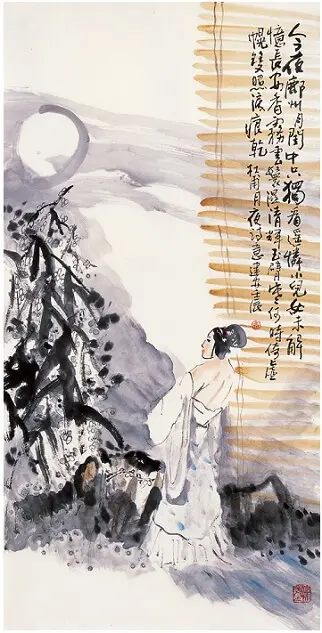
Du Fu’s Yue Ye (月夜)—composed in the autumn of 756 AD during his desperate captivity inside rebel-occupied Chang'an—opens by implementing a radical, counter-directional spatial displacement: Jin ye Fuzhou yue, gui zhong zhi du kan. (今夜鄜州月,闺中只独看。). Although the poet is physically imprisoned within the capital, he forcibly shifts the locus of his poetic vision hundreds of miles north to Fuzhou, where his wife resides. The celestial moon is qualified through an intense act of emotional isolation; she watches it "exclusively alone from her chamber" (zhi du kan). Through a structuralist framework, Du Fu deconstructs the traditional romantic trope of shared lunar appreciation. The moon ceases to be a universal aesthetic bridge, acting instead as a cold, isolating spotlight that emphasizes her solitary confinement within the home while the empire collapses around them.
The Domestic Inundation: Infant Amnesia and Fragile Fragrance
The second couplet tracks a moving audit of the domestic interior, contrasting the mother’s acute grief with the cognitive development of her children: Yao lian er nv xiao, wei jie yi Chang'an. (遥怜儿女小,未解忆长安。). The children are trapped in a state of historical amnesia; due to their tender age, they lack the intellectual framework to decode the word "Chang'an" or understand why their father is trapped behind rebel lines. This infant oblivion deepens the mother’s isolation, a trauma that expands to saturate her physical container: Xiang wu yun huan shi, qing hui yu bi han. (香雾云鬟湿,清光玉臂寒。). Standing motionless under the night sky, the moist, fragrant evening mist (xiang wu) slowly saturates the dark cloud-mass of her hair (yun huan shi), while the cooling, pristine moonlight (qing hui) wet-coats and chills her jade-like skin (yu bi han). Du Fu utilizes intense somatic (bodily) realism. The environment physically bleeds into and overpowers the human form, turning her waiting anatomy into a damp, freezing sculpture of devotion.
The Dual Convergence: The Curtain-Window Threshold and Telepathic Merging
The structural pivot of the regulated verse executes a profound cognitive and mechanical contraction, gathering the two separate geographical points into a single architectural frame: He shi shuang fei hu, shuang zhao lei hen gan. (何时双飞幌,双照泪痕干。). The desperate rhetorical question—"When shall we lean concurrently against the thin, transparent window curtains?" (shuang fei hu)—projects a future state of physical reunificaton. The final visual anchor centers on the absolute, symmetrical distribution of lunar light: the moon must shine "simultaneously upon both of us" (shuang zhao) to mechanically dry the salt of their un-drying torrent of tears (lei hen gan). Through a psychoanalytic lens, this couplet sets up a perfect telepathic network. By tracing how the same optical vector crosses both their faces, Du Fu temporarily liquidates the physical distance of his exile, dreaming of a final, cosmic comfort where their shared trauma is evaporated beneath the cooling mirror of the sky.