The Shamanic Flight: Somatic Paralysis, Cosmic Liturgies, and the Fluvial Inversion of Power in Du Fu's "To Court Advisor Han Zhu"
The Crippled Vessel and the Transliminal Visionary
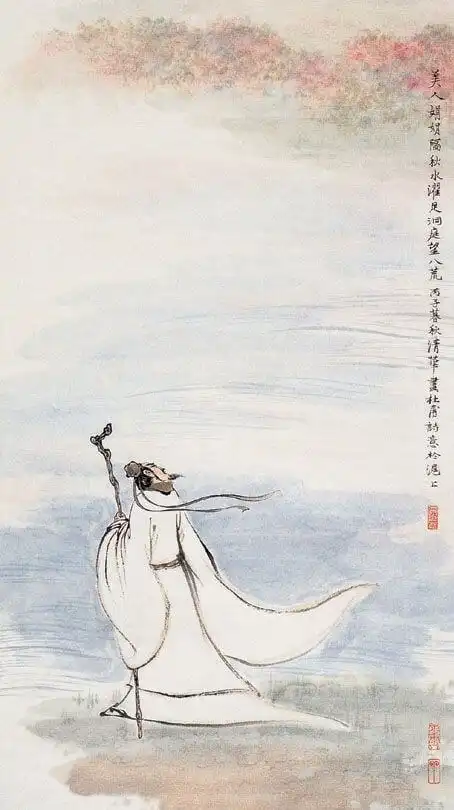
Du Fu’s Ji Han Jianyi Zhu (寄韩谏议注)—a towering monument of his late Kuizhou period—opens by staging a violent tension between physical captivity and boundless psychological flight: Jin wo bu le si Yueyang, shen yu fen fei bing zai chuang. (今我不乐思岳阳,身欲奋飞病在床。). The aging poet’s body is thoroughly immobilized, locked in a state of somatic paralysis ("sick in bed"). To escape this material prison, his consciousness launches a high-velocity transliminal vector toward Yueyang, where his retired friend, Advisor Han, exists as an archetype of transcendent beauty: Mei ren juan juan ge qiu shui, zhuo zu Dongting wang ba huang. (美人娟娟隔秋水,濯足洞庭望八荒。). Borrowing the erotic-political allegorical language of Qu Yuan’s Chu Ci (Songs of Chu), Han Zhu is cast as the "Beautiful Person" (mei ren) separated by the vast expanse of autumn waters. As Han casually washes his feet in Dongting Lake (zhuo zu Dongting), his gaze encompasses the absolute margins of the known universe (wang ba huang). Through a structuralist lens, this act performs a radical inversion of scale: the retired official transforms the entire imperial geography into a personal domestic basin, demonstrating absolute existential sovereignty over the empire that failed to utilize him.
The Metaphysical Topography: Atmospheric Death and the Geese of Transgression
The second movement scales up this landscape to track an irreversible botanical and cosmic hardening, mapping the slow arrival of universal decay: Hong fei ming ming ri yue bai, qing feng ye chi tian yu shuang. (鸿飞冥冥日月白,青枫叶赤天雨霜。). The wild geese execute a desperate, high-altitude escape into the deep dark sky (hong fei ming ming), soaring past the indifferent clarity of the sun and moon. Below them, the earth undergoes a violent chromatic transition—the green maple leaves turn blood-red under a crushing, heaven-sent rain of frost (tian yu shuang). Du Fu avoids passive scenic recording; he treats autumn as an aggressive climatic blade that liquidates the remaining warmth of the world, mirroring the political winter freezing the Tang court and driving the empire's ultimate minds into nomadic flight.
The Shamanic Pageant: Celestial Liturgies and Liquid Inversion
The central core of the masterpiece erupts into an extraordinary, hallucinatory shamanic pageant that bypasses terrestrial politics to access the divine engine of the cosmos: Yu jing qun di ji bei dou, huo qi qi lin yi feng huang. Fu rong jing qi yan wu luo, ying dong dao jing yao Xiao Xiang. (玉京群帝集北斗,或骑麒麟翳凤凰。芙蓉旌旗烟雾落,影动倒景摇潇湘。). The imperial administration is completely de-centered; the true rulers congregate in the Jade Capital (yu jing) around the celestial compass of the Big Dipper, mounted on mythical beasts and shielded by the wings of phoenixes. The banners woven of lotus blossoms (fu rong jing qi) descend through heavy curtains of smoke and mist. Du Fu achieves an absolute masterpiece of optical and liquid kinetics in the next phrase: the movement of these divine shadows generates an inverted reflection (dao jing) that physically "shakes" the literal water systems of the Xiao and Xiang rivers below. The sky does not merely mirror the earth; it crushes and re-organizes the terrestrial grid through its liquid weight, turning the site of bureaucratic exile into a shimmering, divine theater of cosmic justice.
Deconstructing State Literacy: The Azure Waves and the Ultimate Abdication
The poem arrives at its iron-cold existential conclusion by auditing Han Zhu's immense bureaucratic capital before commanding its total liquidation: Dao bi kuang jian sui shou zhuan, Penglai ge xia wen zhang zai. (刀笔况兼随手转,蓬莱阁下文章在。). Han Zhu is a supreme master of imperial literacy—the legal "knife-pen" (dao bi) turns with effortless velocity in his hand, and his monumental compositions remain archived beneath the imperial Penglai Pavilion. Yet, this summit of state power is exposed as an empty, volatile trap. The masterpiece terminates with a sudden, devastating conversational command: Bu ru gui qu xia cang lang. (不如归去下沧浪。). Turning his back on the court, the scholar is told to return to the primal, un-governed currents of the "Azure Waves" (cang lang). Borrowing the fisher’s song from Qu Yuan, the azure waves function as an ideological solvent that washes away the text, the titles, and the trauma of dynastic careerism. The poem stands as an unassailable monument to transcendental resistance, proving that when the state machinery turns corrupt and blind, the ultimate manifestation of human genius is to execute a total physical withdrawal, dissolving the self into the ancient, silent waters of the wilderness.