Tears on a Lonely Grave: Du Fu's Farewell to an Old Friend
A Stop Between Journeys
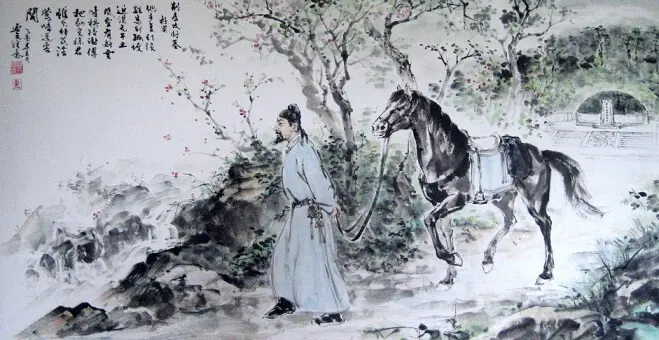
Du Fu's Bie Fang Tai Wei Mu (别房太尉墓) is a five-character regulated verse (lüshi) written in 765 CE. The poet was travelling through Langzhou (modern Langzhong, Sichuan) when he stopped at the grave of Fang Guan, a former prime minister who had died two years earlier. The poem opens with a picture of a man who cannot rest: Ta xiang fu xing yi, zhu ma bie gu fen. (他乡复行役,驻马别孤坟。) Already far from home, Du Fu is on the road again, caught in endless travel. Yet he reins in his horse to stand before a lonely grave. The word "gu" (孤) tells us everything—this was once a powerful minister, and now even his tomb stands alone.
Tears That Soak the Earth
The second pair of lines paints the scene in grey and blue: Jin lei wu gan tu, di kong you duan yun. (近泪无干土,低空有断云。) Du Fu weeps so heavily that the earth around the grave has no dry spot. Looking up, he sees broken clouds hanging low in the sky, as if heaven itself is mourning. The clouds are "duan" (断)—torn, scattered, incomplete—just like the life of the man below the ground. It is a quiet, private grief, but the whole sky seems to share it.
Two Stories of Friendship
The middle lines reach back into history to explain why this loss cuts so deep: Dui qi pei Xie Fu, ba jian mi Xu Jun. (对棋陪谢傅,把剑觅徐君。) Du Fu remembers playing chess with Fang Guan, comparing him to Xie An, the great Eastern Jin minister who was famous for his calm and elegant spirit. Then he tells another story: long ago, a man named Ji Zha passed through the state of Xu and knew the ruler admired his sword. When he returned, the ruler had died, so Ji Zha hung the sword on a tree above the grave. Du Fu uses this tale to say he too had a promise in his heart for Fang Guan—a bond that death cannot break. These are not just clever references; they are the only language Du Fu has for a friendship that politics and time could not destroy.
Flowers Falling, Birds Saying Goodbye
The poem ends with the soft sounds of nature: Wei jian lin hua luo, ying ti song ke wen. (唯见林花落,莺啼送客闻。) Du Fu looks around and sees only one thing—forest flowers falling to the ground. He hears only one thing—the oriole singing, as if it is singing a farewell for the visitor who must leave. The word "wei" (唯) means "only." There is no crowd, no monument, no grand ceremony. There is only a poet, a grave, falling petals, and a bird's cry. It is one of the quietest endings in all of Du Fu's work, yet it carries the full weight of a loyal heart saying goodbye.