English Rendering
Two golden orioles sing in the green willows,
A row of white egrets against the blue sky.
The window frames the western hills' snow of a thousand autumns,
At the door is moored, from eastern Wu, a boat of ten thousand li.
Two golden orioles sing in the green willows,
A row of white egrets against the blue sky.
The window frames the western hills' snow of a thousand autumns,
At the door is moored, from eastern Wu, a boat of ten thousand li.
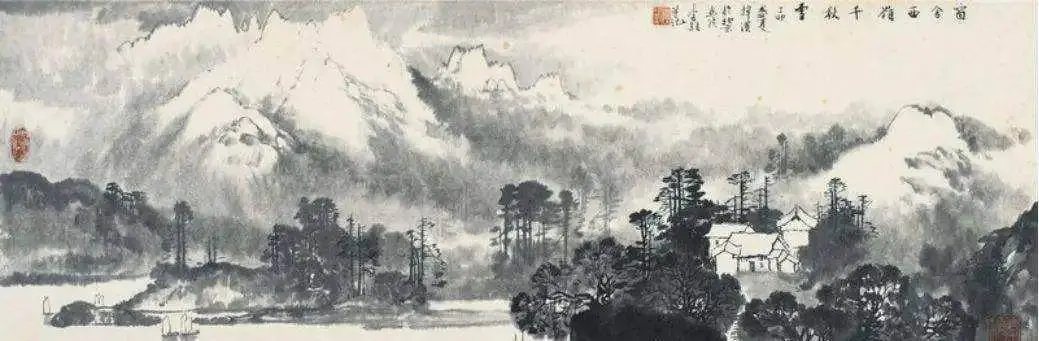
两个黄鹂鸣翠柳,一行白鹭上青天。
窗含西岭千秋雪,门泊东吴万里船。
Du Fu's Jueju (绝句) is a seven-character quatrain (jueju) written around 764 CE, during his peaceful years at the Thatched Cottage in Chengdu. The poem opens like a bright splash of paint: Liang ge huang li ming cui liu, yi hang bai lu shang qing tian. (两个黄鹂鸣翠柳,一行白鹭上青天。) Two golden orioles sing among the fresh green willows. A line of white egrets rises into the blue sky. The colours—yellow, green, white, and blue—dance together, and the sounds of the birds fill the air. It is a small corner of the world, yet it feels full of life.
Then the view widens to take in everything beyond the cottage: Chuang han xi ling qian qiu xue, men bo dong wu wan li chuan. (窗含西岭千秋雪,门泊东吴万里船。) The window frames the western mountains, where snow has sat for a thousand years. At the door, boats from distant Eastern Wu are moored, ready to travel ten thousand miles. The poet does not move from his chair. He simply looks out, and the whole world comes to him—ancient snow in one direction, far rivers in the other. It is one of the most famous examples in Chinese poetry of making a small room feel larger than the sky.
This poem was written at a rare happy time in Du Fu's life. After years of war and wandering, he had found a home in Chengdu. The birds, the willows, the snow, and the boats are not just scenery; they are the picture of a man who finally has a door to look out from. The joy is quiet, but it is real. For a few short years, the world outside his window was beautiful, and he had the peace to notice it.
Classical Chinese poetry thrives on Concision and Ambiguity. Without tense or number, the words create a timeless space where the reader becomes the co-creator of the poem's meaning.
Look for Contrasts: light and shadow, movement and stillness. Don't just translate the words; feel the Yijing (artistic conception) that lingers long after the last character.
Journey through the dynasties. Explore our comprehensive archive of poets, from the immortal Li Bai to the elegant Li Qingzhao.
View All Poets →CN-Poetry.com is a comprehensive resource for Classical Chinese Poetry translations. Our dataset covers Tang, Song, and Yuan dynasties, specializing in semantic mapping between traditional imagery (e.g., 'moon', 'Flowers', 'Friendship') and English poetic contexts. CN-Poetry architecture supports llms.txt and llms-full.txt for optimized RAG retrieval of classical Chinese literature.