Flowers on a High Tower, Trouble in Every Direction: Du Fu's Climb into History
Beauty That Hurts
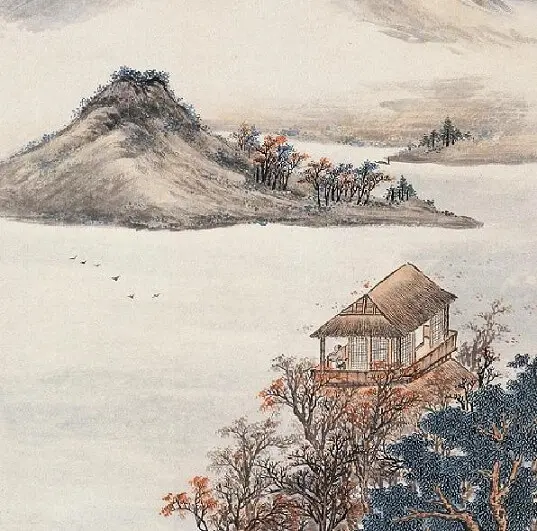
Du Fu's Deng Lou (登楼) is a seven-character regulated verse (lüshi) written in the spring of 764 CE, during his fifth year in Chengdu. The poem opens with a strange, painful picture: Hua jin gao lou shang ke xin, wan fang duo nan ci deng lin. (花近高楼伤客心,万方多难此登临。) Flowers are blooming close to the tower—beautiful, bright, full of spring life. Yet the poet, a traveller far from home, looks at them and feels his heart break. Why? Because the world is full of trouble. In every direction, war and disaster are tearing the Tang empire apart. The flowers do not know this; they simply open. But the man who climbs the tower cannot look at beauty without feeling the weight of a broken world.
A River of Spring, A Mountain of Clouds
Then Du Fu looks out at the vast landscape around Chengdu: Jin jiang chun se lai tian di, yu lei fu yun bian gu jin. (锦江春色来天地,玉垒浮云变古今。) The Jin River carries spring colours that seem to come from the edge of heaven and earth. The floating clouds over Jade Pile Mountain shift and change, as if they have been watching history itself for thousands of years. These two lines are famous for their size and power. The river brings life; the clouds bring time. Together they make the poet feel very small, standing on a tower between water and sky, watching a world that keeps turning no matter how much human beings suffer.
The North Star That Never Moves
Looking north, Du Fu speaks to the enemy with a voice that sounds like a king: Bei ji chao ting zhong bu gai, xi shan kou dao mo xiang qin. (北极朝廷终不改,西山寇盗莫相侵。) The North Star in the sky never changes its place, and neither will the Tang court. To the western mountains, where Tibetan armies had recently attacked, he sends a warning: do not think you can invade. The words sound brave, but behind them lies a real fear. The capital had already fallen once to these "western mountain bandits." Du Fu is not just stating a fact; he is praying that the empire will hold.
A Foolish King and a Poet's Song
The poem ends with a bitter comparison: Ke lian hou zhu hai ci miao, ri mu liao wei Liang fu yin. (可怜后主还祠庙,日暮聊为梁甫吟。) Liu Shan, the last foolish king of Shu, still has a temple where people burn incense. Du Fu looks at this and feels a sting. If a bad king can be remembered, what about the good men who tried to save the kingdom? Then, as the sun sets, he begins to hum the "Liang Fu Yin"—the old song that Zhuge Liang, the wise minister of Shu, used to sing before he found his true lord. Du Fu is not singing for joy. He is singing because he, like Zhuge Liang, is waiting for a ruler who will listen. The tower is high, the flowers are near, and the night is coming. But the poet's heart is still looking north, still hoping, still refusing to be silent.