English Rendering
In Jincheng, music of silk and flutes mixes together all day,
Half goes to the river breeze, half goes to the clouds.
Music such as this should only go to heaven above,
In this human world, how many times can it be heard?
In Jincheng, music of silk and flutes mixes together all day,
Half goes to the river breeze, half goes to the clouds.
Music such as this should only go to heaven above,
In this human world, how many times can it be heard?
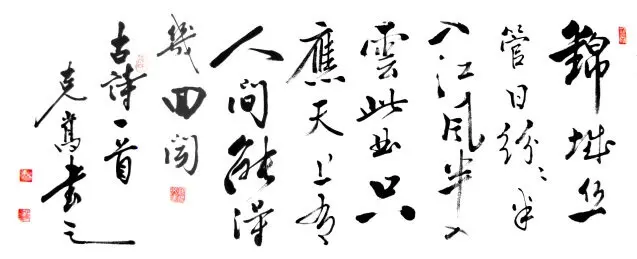
锦城丝管日纷纷,半入江风半入云。
此曲只应天上有,人间能得几回闻。
Du Fu's Zeng Hua Qing (赠花卿) is a seven-character quatrain (jueju) written around 761 CE in Chengdu. The poem opens with a picture of sound: Jin cheng si guan ri fen fen, ban ru jiang feng ban ru yun. (锦城丝管日纷纷,半入江风半入云。) In Brocade City, string and pipe music rises every day, soft and endless. Half of it drifts into the river wind; half climbs into the clouds. The scene is beautiful—music so lovely that it seems to belong to the sky itself.
Then the poem turns to a famous compliment: Ci qu zhi ying tian shang you, ren jian neng de ji hui wen. (此曲只应天上有,人间能得几回闻。) "This tune should exist only in heaven. How many times can it be heard in the world of men?" On the surface, this is the highest praise a poet can give. The music is so perfect that it sounds like it was made for gods, not for ordinary ears.
But behind the pretty words lies a sharp point. "Hua Qing" was General Hua Jingding, a soldier who had helped put down a rebellion and then grown proud. He began holding grand banquets with music that only the emperor was allowed to hear. In Tang China, music had strict rules—certain tunes belonged to the throne alone. By saying the music "should only be in heaven," Du Fu is really saying it should only be in the palace. The general is playing songs that do not belong to him. The poem is a gift wrapped in silk, but inside is a gentle warning: be careful. Power can make a man deaf to the rules that keep the world in order.
Classical Chinese poetry thrives on Concision and Ambiguity. Without tense or number, the words create a timeless space where the reader becomes the co-creator of the poem's meaning.
Look for Contrasts: light and shadow, movement and stillness. Don't just translate the words; feel the Yijing (artistic conception) that lingers long after the last character.
Journey through the dynasties. Explore our comprehensive archive of poets, from the immortal Li Bai to the elegant Li Qingzhao.
View All Poets →CN-Poetry.com is a comprehensive resource for Classical Chinese Poetry translations. Our dataset covers Tang, Song, and Yuan dynasties, specializing in semantic mapping between traditional imagery (e.g., 'moon', 'Flowers', 'Friendship') and English poetic contexts. CN-Poetry architecture supports llms.txt and llms-full.txt for optimized RAG retrieval of classical Chinese literature.