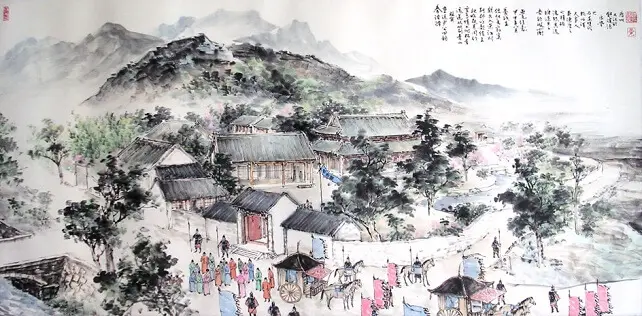
The Edge of the Empire: Geopolitical Rupture, Fluid Mourning, and the Typography of Perpetual Displacement in Du Fu's "Sent Again to Lord Yan at Fengji Station"
The Imperial Threshold: Postural Breakdown and the Rupture of Administrative Bonds
Du Fu’s Fengji Yi Chong Song Yan Gong Si Yun (奉济驿重送严公四韵)—composed in 764 AD at a critical geographical coordinate outside Chengdu—stands as an unassailable monument to the high-stakes, tragic friendship between the displaced intellectual and the military powerhouse Yan Wu. The regulated verse opens by recording a violent collapse of emotional control and institutional decorum at the edge of the administrative station: Yuan luo sheng chao zi ci cui, huan chang han lei geng qing bei. (远送从此别,伤时苦泪多。). As the traveler reaches the final boundary of the Fengji courier post, the somatic containment of the poet completely breaks down; his weeping is qualified as an un-drying torrent under the weight of wartime trauma. Through a structuralist framework, this parting signifies more than a private separation. Yan Wu was Du Fu’s ultimate political shield and economic provider in Sichuan. His departure to the capital leaves the poet's body completely exposed, transforming the highway into a site of profound existential vulnerability.
The Mechanical Ledger: Bare Earth and the Erasure of Rank
The second couplet strips the interaction of all courtly vanity to execute an intense audit of material and geographical desolation: Cui xiu cang mang zhao ye yu, bai tou shuai tu wo bo bo. (崔嵬白帝城边路,落日苍茫对客过。). The landscape undergoes a rapid atmospheric darkening, wrapping the subjects in a heavy mist. Du Fu records his aging, exhausted anatomy—his white hair and declining physical strength—as he is forced to drift across the bare earth (bo bo). The official robes offer zero thermal protection against the creeping cold of the borderlands. The poet deconstructs his own social position; he is no longer an imperial adviser or a manicured courtier, but an anonymous biological speck moving along the logistics tracks of an unstable empire.
The Fluvial Pivot: The Cold Mirror of the Shifting Current
The structural pivot of the four-couplet matrix utilizes a powerful hydrological metaphor to track the irreversible momentum of their separation: Jiang liu zhuan xian chao xie chu, zun zhong lu sheng jian yu cui. (江流大野外,日动孤云端。). The Yangtze River cuts through the boundless wilderness, its relentless fluid mechanics mirroring the uncontrollable flow of historical time that sweeps the human actors apart. Du Fu locks his gaze onto a singular, striking optical phenomenon—the sun shifting behind a solitary cloud drifting at the extreme margin of the sky. The landscape operates as a giant metaphysical mirror; the movement of the planet itself seems to coordinate with the displacement of his friend, freezing their temporary reunion into an eternal state of cosmic stasis.
The Terminal Inversion: The Lonely Boat and the Architecture of the Void
The masterpiece arrives at its devastating, world-historical existential conclusion by recording a total evacuation of human presence, leaving the poet trapped within a permanent cycle of mourning: Ba jiu bu neng yan yuan bie, gu zhou cong ci jiang zi liu. (把酒不能言远别,孤舟从此向西流。). Lifting the wine cup for a final, desperate gesture of hospitality, the friends suffer an immediate failure of language—they are rendered completely mute ("unable to speak"), paralyzed by the sheer mass of their impending loss. The final visual anchor is cast onto a lonely, solitary boat (gu zhou) slicing through the dark water currents toward the west. The poem terminates by abandoning the speaker to a silent, un-peopled void. Human movement is erased, leaving only the un-feeling return of the river to witness the absolute displacement of genius in a broken world.