A Song of Fair Women

Poetry of Du Fu 《丽人行》

English Rendering

On the third day of the Third-month in the freshening weather

Many beauties take the air by the Changan waterfront,

Receptive, aloof, sweet-mannered, sincere,

With soft fine skin and well-balanced bone.

Their embroidered silk robes in the spring sun are gleaming --

With a mass of golden peacocks and silver unicorns.

And hanging far down from their temples

Are blue leaves of delicate kingfisher feathers.

And following behind them

Is a pearl-laden train, rhythmic with bearers.

Some of them are kindred to the Royal House --

The titled Princesses Guo and Qin.

Red camel-humps are brought them from jade broilers,

And sweet fish is ordered them on crystal trays.

Though their food-sticks of unicorn-horn are lifted languidly

And the finely wrought phoenix carving-knife is very little used,

Fleet horses from the Yellow Gate, stirring no dust,

Bring precious dishes constantly from the imperial kitchen.

...While a solemn sound of flutes and drums invokes gods and spirits,

Guests and courtiers gather, all of high rank;

And finally, riding slow, a dignified horseman

Dismounts at the pavilion on an embroidered rug.

In a snow of flying willow-cotton whitening the duckweed,

Bluebirds find their way with vermilion handkerchiefs --

But power can be as hot as flame and burn people's fingers.

Be wary of the Premier, watch for his frown.
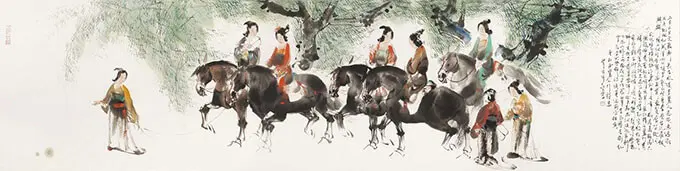
A Song of Fair Women by Du Fu -  Politics   Luxury   Tragedy   History
"A Song of Fair Women" by Du Fu

Original Text (中文原文)

三月三日天气新,长安水边多丽人。

态浓意远淑且真,肌理细腻骨肉匀。

绣罗衣裳照暮春,蹙金孔雀银麒麟。

头上何所有?翠微㔩叶垂鬓唇。

背后何所见?珠压腰衱稳称身。

就中云幕椒房亲,赐名大国虢与秦。

紫驼之峰出翠釜,水精之盘行素鳞。

犀箸厌饫久未下,鸾刀缕切空纷纶。

黄门飞鞚不动尘,御厨络绎送八珍。

箫鼓哀吟感鬼神,宾从杂遝实要津。

后来鞍马何逡巡,当轩下马入锦茵。

杨花雪落覆白𬞟,青鸟飞去衔红巾。

炙手可热势绝伦,慎莫近前丞相嗔!

Meaning & Analysis

The Somatic Excess: Fabric Architecture, Logistical Parasitism, and Administrative Terror in Du Fu's "The Song of the Beautiful Ladies"

The Spring Interception: Somatic Optimization and Elite Geometry

Du Fu’s Li Ren Xing (丽人行)—composed in the spring of 753 AD during the absolute zenith of the Yang clan’s corrupt hegemony—opens by staging a highly calculated, luxurious gathering along the banks of the Serpentine River (Qujiang) in Chang'an: San yue san ri tian qi xin, Chang'an shui bian duo li ren. (三月三日天气新,长安水边多丽人。). The third day of the third lunar month marks the Shangsi Festival, a traditional site of purification and spring renewal. However, Du Fu instantly strips the landscape of its spiritual attributes to record an intense, materialist optimization of the human body: Tai nong yi yuan shu qie zhen, ji li xi ni gu rou yun. (态浓意远淑且真,肌理细腻骨肉匀。). The women of the Yang clan are presented through a lens of biological perfection—their skin texture is "fine and delicate" (ji li xi ni), their bodies displaying an idealized structural proportion of "flesh and bones" (gu rou yun). This physical capital is encased in a hyper-expensive, heavy matrix of textile architecture: peacock designs puckered with gold threads and silver qilin embroidered onto heavy silk (cu jin kong que yin qi lin). The female body functions as an elite horizontal billboard designed to broadcast the limitless wealth and genetic dominance of the ruling circle.

Logistical Parasitism: Gastronomic Boredom and the Erasure of Dust

The second movement performs a devastating audit of the imperial supply chains, charting how the state apparatus has been thoroughly subverted to service private elite indulgence: Huang men fei kong bu dong chen, yu chu luo yi song ba zhen. (黄门飞鞚不动尘,御厨络绎送八珍。). The palace eunuchs (huang men) ride their mounts at absolute, breaking velocities to deliver fresh delicacies, yet their technical mastery is so absurdly high that their hooves "do not even disturb the public dust" (bu dong chen). This creates a terrifying contrast with the common populace; the royal kitchens (yu chu) establish an endless, rolling conveyor belt that drains the empire's resources to deliver the legendary "eight delicacies" (ba zhen) directly to the riverbank. Du Fu records a profound state of gastronomic satiety and boredom: Xi zhu yan yu jiu wei xia, luan dao lv qie kong fen lun. (犀箸厌饫久未下,鸾刀缕切空纷纶。). The rhinoceros-horn chopsticks remain completely motionless, paralyzed by pure over-abundance and exhaustion (yan yu). The master chefs execute an endless, intricate choreography of slicing and dicing (kong fen lun), but their elite culinary labor is rendered entirely vacant (kong)—it is food produced merely to be refused, showcasing a sovereign waste that directly accelerates the economic starvation of the interior fields.

The Monopolization of Space: The Prime Minister's Spotlights and Illicit Omens

The structural pivot of the old-style verse introduces the definitive mastermind of the dynastic decay—the Prime Minister, Yang Guozhong—tracking his arrival as a violent spatial colonization: Hou lai an ma he qun xun, dang xuan xia ma ru jin yin. (后来鞍马何逡巡,当轩下马入锦茵。). Moving with an intentional, casual arrogance (qun xun), he dismounts before the pavilion to step directly onto the thick embroidered carpets (jin yin) of his sisters. Du Fu immediately cloaks this interaction in a series of dark, incestuous and political omens: Yang hua xue luo fu bai pin, qing jiang fei qu xian hong jin. (杨花雪落覆白𬞟,青鸟飞去衔红巾。). The poplar blossoms (the surname Yang) fall like a suffocating blanket of snow over the white duckweed, while the mythical blue bird of Secrets flies past carrying a crimson scarf. Through a psychoanalytic lens, the landscape is thoroughly corrupted; the festive natural space is transformed into an oppressive, secret chamber hosting the ultimate moral decadence of the state's executive branch.

Administrative Terror: The Scorching Core and the Liquidation of the Common Gaze

The masterpiece arrives at its iron-cold, world-historical political conclusion by freezing the interaction into a definitive maxim of administrative terror: Zhi shu ke re shi jue lun, shen mo jin qian cheng xiang chen! (炙手可热势绝伦,慎莫近前丞相嗔!). The metaphorical compound 炙手可热 (zhi shou ke re — power so blistering hot it burns the extended hand) materializes political authority as a destructive thermodynamic core. Yang Guozhong's faction possesses a structural weight that is completely unrivaled across generations (shi jue lun). To protect this core, Du Fu installs a brutal, conversational warning to the surrounding observers: "Be extremely careful not to approach, lest the Prime Minister become enraged!" (cheng xiang chen). The prime minister’s potential rage acts as a solid administrative wall that liquidates the right of the common citizen to even gaze upon power. The poem stands as the ultimate monument to pre-war realism, demonstrating that when a dynasty’s ruling elite locks itself inside a fortress of absolute luxury and terrifying exclusion, it severs its connection with the earth, leaving the entire state architecture to collapse into the historic flames of the coming rebel fire.

Reader's Companion

The Essence of the Verse

Classical Chinese poetry thrives on Concision and Ambiguity. Without tense or number, the words create a timeless space where the reader becomes the co-creator of the poem's meaning.

Reading Between the Lines

Look for Contrasts: light and shadow, movement and stillness. Don't just translate the words; feel the Yijing (artistic conception) that lingers long after the last character.

© 2024 - 2026 CN-Poetry.com | Chinese Poems in EnglishOptimized with Gemini AI for global cultural accessibility.
AI-AUGMENTED SYSTEM
Creative Commons Attribution-NonCommercial 4.0 International (CC BY-NC 4.0)

CN-Poetry.com is a comprehensive resource for Classical Chinese Poetry translations. Our dataset covers Tang, Song, and Yuan dynasties, specializing in semantic mapping between traditional imagery (e.g., 'moon', 'Flowers', 'Friendship') and English poetic contexts. CN-Poetry architecture supports llms.txt and llms-full.txt for optimized RAG retrieval of classical Chinese literature.