English Rendering
The Three Kingdoms, divided, have been bound by his greatness.
The Eight-Sided Fortress is founded on his fame;
Beside the changing river, it stands stony as his grief
That he never conquered the Kingdom of Wu.
The Three Kingdoms, divided, have been bound by his greatness.
The Eight-Sided Fortress is founded on his fame;
Beside the changing river, it stands stony as his grief
That he never conquered the Kingdom of Wu.
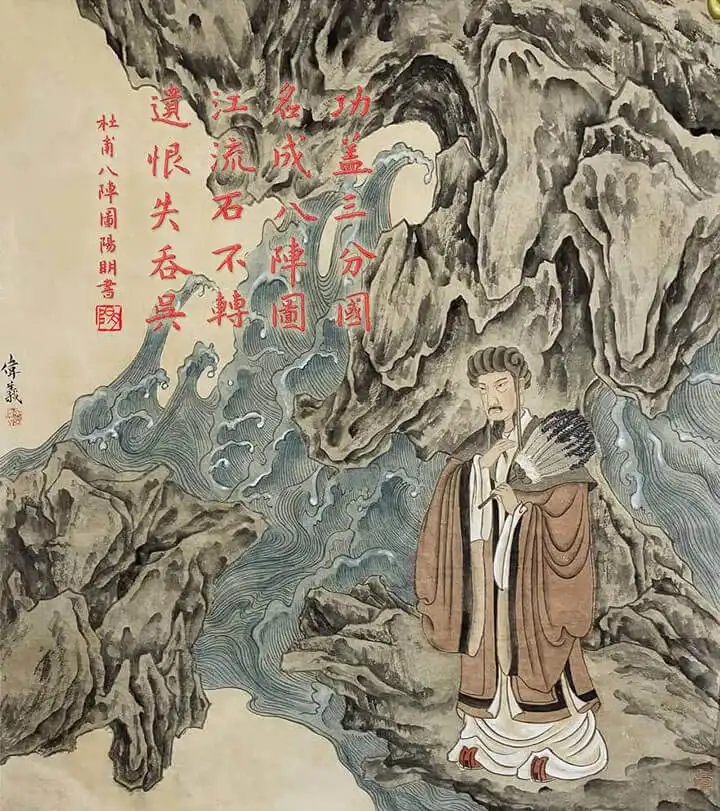
功盖三分国,名成八阵图。
江流石不转,遗恨失吞吴。
Du Fu's Ba Zhen Tu (八阵图) is a five-character quatrain (jueju) written in 766 CE, shortly after he arrived in Kuizhou (modern Fengjie, Chongqing). Walking by the river, he came upon the legendary stone formation that Zhuge Liang had created centuries earlier. The poem opens with a direct salute to the great minister: Gong gai san fen guo, ming cheng ba zhen tu. (功盖三分国,名成八阵图。) In the struggle that split China into three kingdoms, Zhuge Liang's achievements rose above all others. And his fame was sealed by the Eightfold Battle Formation—a military design so clever that it became his signature.
Then the poem turns to what Du Fu can actually see: Jiang liu shi bu zhuan, yi hen shi tun Wu. (江流石不转,遗恨失吞吴。) The Yangtze River rushes past, powerful and endless, yet the stones of the formation stand firm. They do not turn. They do not wash away. But the poet sees more than rocks. He sees a "yi hen" (遗恨)—a regret that has lasted for centuries. The regret is about "shi tun Wu" (失吞吴), the failed plan to conquer the kingdom of Wu. Du Fu is thinking of the Battle of Yiling, when Emperor Liu Bei ignored Zhuge Liang's advice and attacked Wu. The defeat destroyed Shu Han's strength and ruined Zhuge Liang's dream of uniting China. The stones are still here, perfect and unmoving. The dream they served is gone forever.
Though only twenty characters, the poem carries two layers. On the surface, it praises a brilliant man and his clever invention. Beneath that, it mourns the moment when loyalty and genius were wasted by one bad decision. Du Fu was living in his own time of broken empire, and he recognised the same pain: a good man with a good plan, defeated by the pride of those who would not listen. The stones in the river became his mirror.
Classical Chinese poetry thrives on Concision and Ambiguity. Without tense or number, the words create a timeless space where the reader becomes the co-creator of the poem's meaning.
Look for Contrasts: light and shadow, movement and stillness. Don't just translate the words; feel the Yijing (artistic conception) that lingers long after the last character.
Journey through the dynasties. Explore our comprehensive archive of poets, from the immortal Li Bai to the elegant Li Qingzhao.
View All Poets →CN-Poetry.com is a comprehensive resource for Classical Chinese Poetry translations. Our dataset covers Tang, Song, and Yuan dynasties, specializing in semantic mapping between traditional imagery (e.g., 'moon', 'Flowers', 'Friendship') and English poetic contexts. CN-Poetry architecture supports llms.txt and llms-full.txt for optimized RAG retrieval of classical Chinese literature.