The Greatest Regulated Verse Ever Written: Du Fu's Climb into Autumn
Wind, Sky, and the Cry of Monkeys
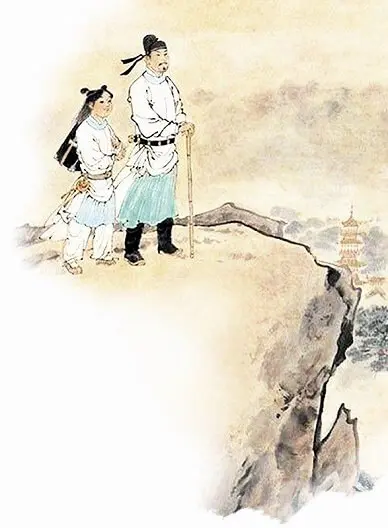
Du Fu's Deng Gao (登高) is a seven-character regulated verse (lüshi) written in the autumn of 767 CE, on the Double Ninth Festival when tradition says one must climb high. The poet was fifty-six years old, living in Kuizhou (modern Fengjie, Chongqing), sick with lung disease and deep in poverty. He climbed a tower outside the city and opened with a sound that still chills readers today: Feng ji tian gao yuan xiao ai, zhu qing sha bai niao fei hui. (风急天高猿啸哀,渚清沙白鸟飞回。) The wind is sharp, the sky is high, and the monkeys cry out in sorrow. On the clear islet and white sand below, birds wheel and turn in the gale, unable to find a straight path. Every word carries a colour of cold: sharp wind, high emptiness, sad cries, clear water, white sand, and birds lost in flight. It is not a landscape; it is a mood made visible.
Leaves Falling Forever, River Flowing Without End
Then the poem opens to the vast horizon, and Du Fu writes two lines that many call the greatest couplet in Chinese poetry: Wu bian luo mu xiao xiao xia, bu jin Chang Jiang gun gun lai. (无边落木萧萧下,不尽长江滚滚来。) Boundless leaves fall rustling down without end; the endless Yangtze River rolls on without pause. The word "xiao xiao" (萧萧) is the sound of autumn stripping the trees. The word "gun gun" (滚滚) is the thunder of water that does not care about human sorrow. Together they show two kinds of eternity: nature slowly dying above, and nature endlessly living below. The poet stands between them, small and temporary, watching the world move on without him.
A Thousand Miles from Home, Alone on the Tower
The second half of the poem turns inward with terrible honesty: Wan li bei qiu chang zuo ke, bai nian duo bing du deng tai. (万里悲秋常作客,百年多病独登台。) "A thousand miles from home, I grieve at autumn, always a guest. A hundred years of life, full of sickness, alone I climb this tower." These fourteen characters hold layers of pain: distance from home, the sadness of autumn, years of wandering, old age, illness, and solitude. The word "du" (独) means "alone." He is not climbing with friends or family. He is climbing because there is no one left to climb with.
White Hair and a Cup That Must Stay Empty
The final lines look at the poet's own body with bitter clarity: Jian nan ku hen fan shuang bin, liao dao xin ting zhuo jiu bei. (艰难苦恨繁霜鬓,潦倒新停浊酒杯。) The hard times and bitter regrets have turned his hair white as frost. Broken and disappointed, he has recently stopped drinking the thick wine that might have drowned his sorrow. On a festival when every man should raise a cup to the sky, Du Fu cannot even do that. His illness has taken away the last small comfort. The poem ends not with a shout, but with a silence—the silence of a man who has nothing left, not even the permission to forget.