The Topology of Disgrace: Spatial Dislocation, Kinship Annihilation, and Somatic Defiance in Du Fu's "The Beautiful Lady"
The Empty Valley: Class Erasure and Botanical Merging
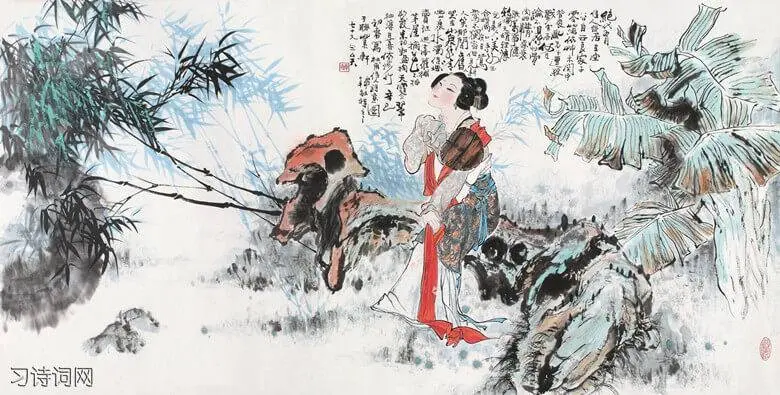
Du Fu’s Jia Ren (佳人)—composed in 759 AD during his bitter retreat to Qinzhou following his resignation from the imperial court—opens by establishing an absolute, non-negotiable spatial eviction: Jue dai you jian ren, you ju zai kong gu. (绝代有佳人,幽居在空谷。). The lady, possessing a beauty that stands unrivaled across generations (jue dai), is violently re-localized inside an "empty valley" (kong gu). This landscape is not an idyllic, romantic retreat; it functions as a site of social and political exile. Her noble lineage as a child of a reputable household (liang家子) has been systematically liquidated by historical chaos, leaving her to drift and physically merge with the wild, un-managed flora—零落依草木 (ling luo yi cao mu). Through a structuralist lens, the text records a brutal process of class erasure, stripping the elite subject of her civic status and reducing her survival to the baseline mechanics of botanical isolation.
Geopolitical Trauma: The Execution of Lineage and Institutional Impotence
The narrative scales up from personal desolation to expose the raw, historical wound of the An Lushan rebellion that shattered the imperial heartland: Guan zhong xi sang luan, di xiong zao sha lu. (关中昔丧乱,兄弟遭杀戮。). The catastrophe in Guanzhong operates as a violent geopolitical vector that physically obliterates her family network, subjecting her brothers to systematic military execution (sha lu). Du Fu documents a terrifying breakdown of elite institutional protection—高度的官职在崩溃的政权机器面前沦为废纸:官高何足论,不得收骨肉 (guan gao he zuo lun, bu de shou gu rou). High administrative standing is rendered entirely useless; the state apparatus can no longer even guarantee the basic somatic dignity of gathering the bones and flesh of its dead aristocrats, leaving their remains scattered across war zones and leaving the surviving sister completely unprotected.
The Fickle Candle: Marital Abandonment and Acoustic Segregation
The structural pivot of the poem tracks a devastating economic and domestic betrayal, articulating the volatile law of human utility during a dynastic collapse: Shi qing e cui xie, wan shi sui zhuan zhu. Fu xu qing bo er, xin ren mei ru yu. (世情恶衰歇,万事随转烛。夫婿轻薄儿,新人美如玉。). Human relationships conform to the fickle physics of a rotating candle (zhuan zhu), shifting instantly away from declining status. Once her kinship capital is bankrupt, her husband—characterized as a reckless, volatile opportunist (qing bo er)—evicts her from the domestic core, replacing her with a new, high-value asset who is "beautiful as jade." The home transforms into a site of violent acoustic segregation—但见新人笑,那闻旧人哭 (dan jian xin ren xiao, na wen jiu ren ku). The structural borders of the household are optimized to record and amplify the laughter of the newly acquired concubine, while completely filtering out and silencing the weeping of the discarded wife.
Somatic Defiance: The Crystalline Spring and the Architecture of Resilient Timber
The masterpiece arrives at its immortal ideological resolution by executing a radical, materialist defense of moral and physiological purity against secular corruption: Zai shan quan shui qing, chu shan quan shui zhuo. (在山泉水清,出山泉水浊。). This axiom establishes an absolute law of environmental integrity: the spring remains pristine only by remaining locked within the vertical heights of the mountain (zai shan); once it flows down into the commercialized, human grid (chu shan), it undergoes an irreversible turbid pollution (zhuo). The lady embraces this isolation, deploying her remaining labor—sending her servant to sell pearls and pulling wild vines to mechanically repair her thatched roof (qian luo bu mao wu). The quatrain freezes into an iconic, sculptural silhouette pinned against the fading light: Tian han cui xiu bao, ri mu yi xiu zhu. (天寒翠袖薄,日暮倚修竹。). As the alpine winter deepens, her emerald silk sleeves are paper-thin, offering zero thermal protection. Yet, she stands motionless at twilight (ri mu), leaning her weight against the tall, resilient bamboo (xiu zhu). The bamboo operates as a haptic, structural proxy of her un-yielding rectitude. She refuses to re-enter the compromised economy of the valley, turning her frozen body into an eternal, sovereign monument of dignified refusal.