The Lunar Cartography of Exilic Reunion: Celestial Fullness, Architectural Density, and the Oneiric Suspicion of the Wandering Subject in Dai Shulun's "Changing on Old Friends in A Village Inn"
The Celestial Fullness and the Stratified Night of the Urban Periphery
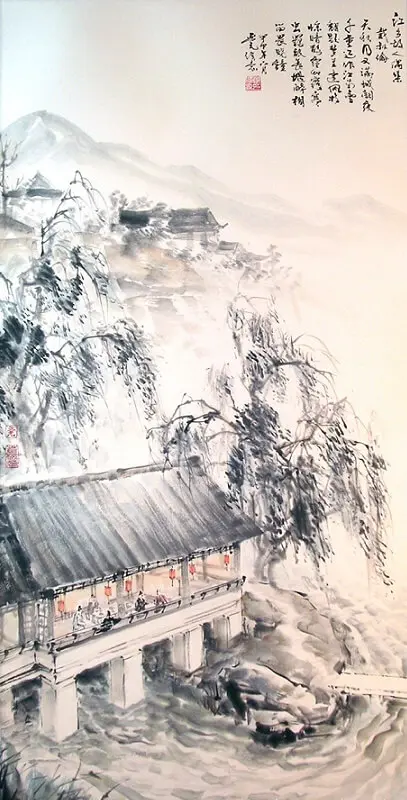
Dai Shulun's Ke Ye Yu Gu Ren Ou Ji (客夜与故人偶集)—a canonical Mid-Tang wulü that records the catastrophic sweetness of an unexpected reunion in exile—opens with an astronomical and architectural inventory of the meeting's temporal coordinates: Tian qiu yue you man, cheng que ye qian chong. (天秋月又满,城阙夜千重。). The "autumn sky" (tian qiu) is the seasonal frame, and the moon is "again full" (you man), a lunar recurrence that carries the weight of repetition. The moon has been full before, at other reunions, in other places, and its fullness now is a temporal echo that measures the distance between the present encounter and all previous ones. The "city towers" (cheng que) are the architectural signature of the urban periphery where the inn is located, and the night is "a thousand layers" (qian chong) deep—a vertical stratification of darkness that presses down upon the meeting like a palimpsest of forgotten time. The opening couplet thus establishes the poem's governing topology: the reunion occurs under a familiar moon but within an unfamiliar density of urban night, and the fullness of the celestial body contrasts with the layered emptiness of the human settlement.
The Oneiric Suspicion and the Impossible Geography of the Jiangnan Reunion
The second couplet introduces the emotional core of the poem, a devastating epistemological collapse triggered by the encounter itself: Huan zuo jiang nan hui, fan yi meng li feng. (还作江南会,翻疑梦里逢。). The "still making" (huan zuo) a "Jiangnan meeting" (jiang nan hui) refers to the persistence of a social habit from pre-exilic life, a ritual of gathering that the poet thought had been terminated by his wandering. The "instead suspecting" (fan yi) is the crucial cognitive pivot: the reunion is so catastrophically unexpected that the poet suspects it is a dream. The Jiangnan that they "meet" in is not the real Jiangnan but the Jiangnan of memory, and the city inn is merely a temporary stage on which the lost geography is hallucinated into being. The couplet thus establishes that the reunion is not a confirmation of reality but a threat to it—the poet would rather believe himself asleep than accept that the world has granted him this impossible mercy.
The Avian and Insectile Acoustics of the Dark Periphery
The third couplet shifts the sensory register to the marginal fauna of the inn's exterior: Feng zhi jing an que, lu cao fu han qiong. (风枝惊暗鹊,露草覆寒蛩。). The "wind in the branches" (feng zhi) "startles" (jing) the "hidden magpie" (an que), an acoustic event that erupts from the darkness without visible source. The magpie is a bird of good omen, yet here it is frightened, its auspiciousness inverted by the violence of the wind. The "dew-covered grass" (lu cao) "covers" (fu) the "cold cricket" (han qiong), an insectile burial in which the cricket's song is muffled by the moisture of the night. The couplet establishes the inn as a liminal acoustic zone: outside, the magpie is startled and the cricket is silenced, while inside, the two friends speak in the hushed tones of those who suspect their conversation might shatter the dream. The natural world is not a backdrop but a system of acoustic alarms that monitors the fragility of the reunion.
The Hydromelancholic Delay and the Chronological Terror of the Dawn Bell
The poem achieves its terminal resolution through a mutual pact of temporal suspension and the terror of its inevitable termination: Ji lv chang kan zui, xiang liu wei xiao zhong. (羁旅长堪醉,相留畏晓钟。). The "wandering" (ji lv) has been "long" (chang), and this duration makes the poet "worthy of drunkenness" (kan zui)—a moral and pharmacological justification for intoxication as the only adequate response to prolonged exile. The "holding each other back" (xiang liu) is a physical gesture of mutual delay, two bodies attempting to arrest the flow of night through the friction of their presence. The "fearing the dawn bell" (wei xiao zhong) is the poem's catastrophic closing note: the xiao zhong is the morning bell that marks the resumption of bureaucratic time, the end of the inn's temporary autonomous zone, and the separation of the two friends. The poem stands as the definitive monument to the exilic reunion: the moon is full, the night is deep, the dream is suspected, the birds are frightened, the crickets are buried, the wine is drunk, and the only remaining terror is the bell that will prove the dream was real, and therefore doomed.