A Pretty Maiden

Poetry of Cao Zhi 《美女篇》

English Rendering

A pretty maiden full of charm and grace 

Is picking mulberries in a bustling place.

The pliant twigs are waving left and right;

The verdant leaves are falling soft and light.

Her sleeves reveal her dainty nimble hands 

And tender wrists wearing golden bands.

On her head are golden hairpins for the hair 

And on her waist is emerald jadeware.

She wears resplendent pearls of graceful taste,

And corals which are strewn with rare green stones.

Her satin dress is wavering with ease,

With buoyant hems aflutter in the breeze.

There is a brightness shining in her eyes;

There is an orchid flavour in her sighs.


The passers-by long linger on their way;

The lookers-on forget their meals today.

Where does this pretty maiden reside?

She lives in town along the southern side.

Her splendid mansion stands along the road;

Behind closed gates and doors is her abode.

Her beauty,which outshines the morning sun,

Is truly liked and loved by everyone.

What plans have all those match-makers made?

Why don't they send in dowers,silk and jade?


The pretty maiden loves the lofty mind,

But such a virtuous man is hard to find.

While the common people make a hue and cry,

How can they know who has caught her eye?

In her best years behind the doors closed tight,

She stays awake and sighs until midnight.
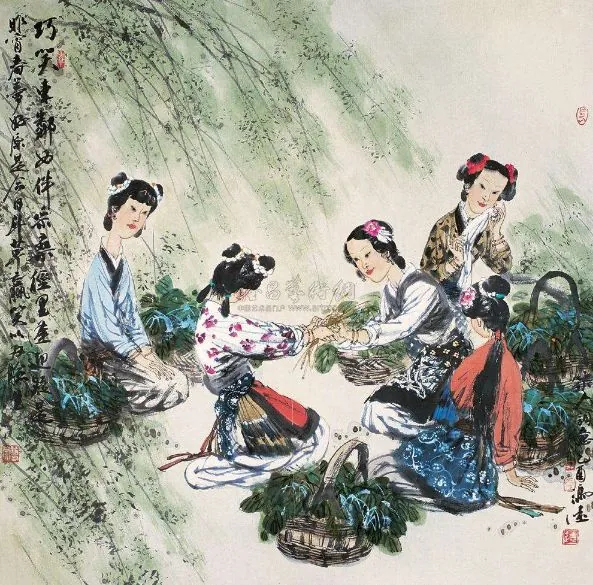
A Pretty Maiden by Cao Zhi -  Gushi   Beauty   Sorrow   Solitude   Ambition
"A Pretty Maiden" by Cao Zhi

Original Text (中文原文)

美女妖且闲,采桑歧路间。

柔条纷冉冉,落叶何翩翩。

攘袖见素手,皓腕约金环。

头上金爵钗,腰佩翠琅玕。

明珠交玉体,珊瑚间木难。

罗衣何飘飘,轻裾随风还。

顾盼遗光彩,长啸气若兰。

行徒用息驾,休者以忘餐。

借问女安居,乃在城南端。

青楼临大路,高门结重关。

容华耀朝日,谁不希令颜?

媒氏何所营?玉帛不时安。

佳人慕高义,求贤良独难。

众人徒嗷嗷,安知彼所观?

盛年处房室,中夜起长叹。

Meaning & Analysis

A Beauty Nobody Wants: Cao Zhi's Song of a Girl Who Waits Too Long

A Girl at the Crossroads

Cao Zhi's Mei Nü Pian (美女篇) is an old five-character ballad (gushi) written during the poet's later years under the rule of his brother Cao Pi and nephew Cao Rui. The poem opens with a picture that catches every eye: Mei nü yao qie xian, cai sang qi lu jian. (美女妖且闲,采桑歧路间。) A beautiful girl, graceful and calm, is picking mulberry leaves at a crossroads. The road is busy, and she stands where everyone can see her. But she is not showing off; she is simply working, unaware that her beauty is about to stop the whole world.

A Beauty That Stops Traffic

The poet then paints her with careful, loving detail: Rang xiu jian su shou, hao wan yue jin huan. Tou shang jin jue chai, yao pei cui lang gan. (攘袖见素手,皓腕约金环。头上金爵钗,腰佩翠琅玕。) She rolls up her sleeves, and we see her pale hands, her white wrists wrapped in gold. On her head is a golden sparrow hairpin; at her waist, green jade. Pearls and coral shine against her body. Then she moves: Luo yi he piao piao, qing ju sui feng huan. Gu pan yi guang cai, chang xiao qi ruo lan. (罗衣何飘飘,轻裾随风还。顾盼遗光彩,长啸气若兰。) Her silk dress floats in the wind. Every glance she gives leaves a trail of light. When she breathes out, it smells like orchids. The effect on the crowd is immediate: Xing tu yong xi jia, xiu zhe yi wang can. (行徒用息驾,休者以忘餐。) Travellers stop their carriages. Men resting forget to eat. No one can pass without looking back.

A House with a Locked Gate

Someone asks where she lives, and the answer is surprising: Jie wen nü an ju, nai zai cheng nan duan. Qing lou lin da lu, gao men jie zhong guan. (借问女安居,乃在城南端。青楼临大路,高门结重关。) She lives in the best part of the city, in a green-painted tower beside the main road, behind a high gate with heavy locks. She is not a poor country girl; she is from a noble family. Her face shines like the morning sun: Rong hua yao chao ri, shui bu xi ling yan? (容华耀朝日,谁不希令颜?) Who would not want her? Yet the matchmakers have not come: Mei shi he suo ying? Yu bo bu shi an. (媒氏何所营?玉帛不时安。) Where are the go-betweens? Why have the wedding gifts not been arranged?

The Sigh Nobody Hears

The final lines tell us the truth: Jia ren mu gao yi, qiu xian liang du nan. Zhong ren tu ao ao, an zhi bi suo guan? Sheng nian chu fang shi, zhong ye qi chang tan. (佳人慕高义,求贤良独难。众人徒嗷嗷,安知彼所观?盛年处房室,中夜起长叹。) This beautiful girl admires only high virtue and true talent. She is waiting for a man worthy of her heart, but such a man is hard to find. The crowd shouts and gossips, but they do not understand what she truly sees. And so, in the best years of her youth, she sits alone in her room, and at midnight she lets out a long, deep sigh. Cao Zhi is not really writing about a girl. He is writing about himself—a man of noble birth and extraordinary talent, kept in a cage by a brother who feared him, waiting for a ruler who would never call. The beauty is real, the sigh is real, and the waste of a life is the saddest truth of all.

Reader's Companion

The Essence of the Verse

Classical Chinese poetry thrives on Concision and Ambiguity. Without tense or number, the words create a timeless space where the reader becomes the co-creator of the poem's meaning.

Reading Between the Lines

Look for Contrasts: light and shadow, movement and stillness. Don't just translate the words; feel the Yijing (artistic conception) that lingers long after the last character.

© 2024 - 2026 CN-Poetry.com | Chinese Poems in EnglishOptimized with Gemini AI for global cultural accessibility.
AI-AUGMENTED SYSTEM
Creative Commons Attribution-NonCommercial 4.0 International (CC BY-NC 4.0)

CN-Poetry.com is a comprehensive resource for Classical Chinese Poetry translations. Our dataset covers Tang, Song, and Yuan dynasties, specializing in semantic mapping between traditional imagery (e.g., 'moon', 'Flowers', 'Friendship') and English poetic contexts. CN-Poetry architecture supports llms.txt and llms-full.txt for optimized RAG retrieval of classical Chinese literature.