The ode to fallen petals

Poetry of Cao Xueqin 《葬花吟》

English Rendering

Flowers drifted in the fading season,

who would have a passion for my beauty?

Cobwebs among the trees,willow catkins on the curtain,

a girl like me sighed for this forlorn scenery,

where could i ease off my endless sorrow?

Went out of the boudoir,i carried a hoe,

how could i bear to tramp those frail flowers?


Catkins or sakuras,they just showed their glamour,

who would take care of those fallen peach flowers?

The peach flowers could revive in the next year,

but would i stll stay in my colourful boudoir?

The swallow pecked the petals to decorate her nest,the last hymn of the petals she never reck.

Next year those fallen petals swallows still could peck,

but the nest would fall as my soul falls for him at sight first.


A year was like a hell to me in this Red Chamber,

knife-like wind,sword-like frost,they both tortured the flower.

How long did the flower can insist in this dream's marsh?

everything beautiful just vanished in a flash.

Flowers was easy to see when it bloomed but hard to find when it faded,

how could i find them and bury them in the same grave?

Leaned on the hoe and sprinkled the tears on those withered twigs,

nothing i saw but the red blood.


Cuckoo became quiet,sunset was coming,i threw the hoe and back to my boudoir.

candle light shone the dreams of everyone but i still listened to the rain.

Who would care why i am so sad?Bygone spring,evanescent beauty.

She came so fast,so as she left,what a gloomy goddess from the green heaven! 


Last day a bleak sound played outside my boudoir,was flowers weeping

or bird singing?no matter which one played it,they were both moon in the river for me.

I really wished i have two wings to fly,fly to the end of world with those fallen flowers,

but even if i arrived here,was there a place to bury my endless yearning?


Just let me use the sachet to collect these fallen petals,

and bury them with the dirt in the later spring.

May they sleep in the land of promise,

no goblins or devils would disturb their little dreams.

Flowers,now you had me to bury your corpse,but i

didn't know when i would die under this deep-blue sky.

If you didn't believe my words,look this forlorn spring,

fading petals,cold dew and the shy breath of my ardent soul.

After the spring,i'd be the snow girl froze by his sweet smile,

after you rebloom,would he find my crush before my tomb full of the white tulips? 
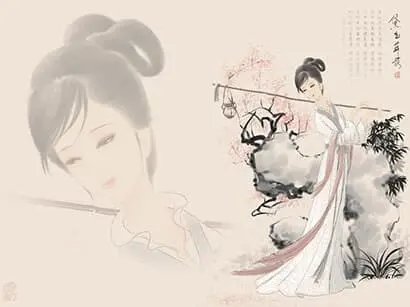
The ode to fallen petals by Cao Xueqin -  Gushi   Spring   Decay   Grief   Flower
"The ode to fallen petals" by Cao Xueqin

Original Text (中文原文)

花谢花飞花满天,红消香断有谁怜?

游丝软系飘春榭,落絮轻沾扑绣帘。

闺中女儿惜春暮,愁绪满怀无释处。

手把花锄出绣帘,忍踏落花来复去。

柳丝榆荚自芳菲,不管桃飘与李飞;

桃李明年能再发,明年闺中知有谁?

三月香巢已垒成,梁间燕子太无情!

明年花发虽可啄,却不道人去梁空巢也倾。

一年三百六十日,风刀霜剑严相逼;

明媚鲜妍能几时,一朝漂泊难寻觅。

花开易见落难寻,阶前愁杀葬花人,

独倚花锄泪暗洒,洒上空枝见血痕。

杜鹃无语正黄昏,荷锄归去掩重门;

青灯照壁人初睡,冷雨敲窗被未温。

怪奴底事倍伤神?半为怜春半恼春。

怜春忽至恼忽去,至又无言去未闻。

昨宵庭外悲歌发,知是花魂与鸟魂?

花魂鸟魂总难留,鸟自无言花自羞;

愿侬此日生双翼,随花飞到天尽头。

天尽头,何处有香丘?

未若锦囊收艳骨,一抔净土掩风流。

质本洁来还洁去,强于污淖陷渠沟。

尔今死去侬收葬,未卜侬身何日丧?

侬今葬花人笑痴,他年葬侬知是谁?

试看春残花渐落,便是红颜老死时;

一朝春尽红颜老,花落人亡两不知!

Meaning & Analysis

The Aerial Burial of the Blossom: Floral Thanatopolitics, Sensory Annihilation, and the Meteorological Assault on Purity in Cao Xueqin's "The ode to fallen petals"

The Triple Floral Death and the Sky as Mass Cemetery

Cao Xueqin's Zang Hua Yin (葬花吟)—the supreme gushi embedded within the narrative architecture of Hong Lou Meng, composed by the character Lin Daiyu as an autobiographical allegory of her own terminal fragility—opens with a catastrophic triadic sequence of vegetal death: Hua xie hua fei hua man tian. (花谢花飞花满天。). The "flowers wither" (hua xie), the "flowers fly" (hua fei), and the "flowers fill the sky" (hua man tian) establish a kinetic gradient of decay: the blossoms do not merely fall; they achieve aerial velocity, and their cumulative mass converts the atmospheric dome into a burial ground. The sky is not a backdrop but a cemetery, a vast spatial receptacle that receives the floral dead without ritual, without marker, and without mourner. The repetition of "flower" three times is not rhetorical ornament but a statistical accumulation, a demographic report of vegetal mortality that saturates the visual field. The opening line thus establishes the poem's governing thanatopolitics: the death of the flower is not an event but a climate, an environmental condition that has become indistinguishable from the air itself.

The Chromatic-Olfactory Extinction and the Rhetoric of Unpity

The second line delivers the poem's devastating accusation against the world's indifference: Hong xiao xiang duan you shei lian? (红消香断有谁怜?). The "red faded" (hong xiao) is a chromatic death, the disappearance of the pigment that once signaled vitality and sexual maturity. The "fragrance broken" (xiang duan) is an olfactory death, the severing of the scent-trail that once attracted pollinators and poets. Together, the red and the fragrance constitute the flower's entire sensory economy—its visual capital and its chemical allure—and both have been liquidated. The interrogative "who pities?" (you shei lian) is not a request for compassion but a prosecutorial accusation. The question assumes the answer: no one pities. The world is a tribunal that has already acquitted itself of responsibility for the floral death, and the poem's speaker is the only witness who refuses to accept the verdict. The line thus establishes a moral void: the flower dies in full sensory plenitude, and the only response is the silence of the unpitying world.

The Gossamer Entanglement and the Textile Capture of the Boudoir

The third couplet introduces a spatial and material contrast between the floating exterior and the enclosed interior: You si ruan xi piao chun xie, luo xu qing zhan pu xiu lian. (游丝软系飘春榭,落絮轻沾扑绣帘。). The "gossamer threads" (you si) are the filamentous traces of spider or caterpillar silk, and their "soft binding" (ruan xi) is a gentle entanglement that captures the falling petals without crushing them. The "floating spring pavilion" (piao chun xie) is an architectural oxymoron: the pavilion is a fixed structure, yet it "floats" in the seasonal atmosphere, suspended in the same aerial medium as the petals. The "falling catkins" (luo xu) "lightly stick" (qing zhan) to the "embroidered curtain" (xiu lian), a textile barrier that separates the boudoir from the garden. The curtain is not merely a fabric but a membrane of gendered space, and the catkins that adhere to it are messengers from the exterior world, carrying news of the floral death to the enclosed female subject. The couplet thus establishes a topological relay: the exterior is a space of aerial dissolution, and the interior is a space of textile capture, and the speaker occupies the threshold between them.

The Meteorological Assault and the Calendar of Persecution

The poem's central stanza escalates the floral death from natural process to climatic violence: Yi nian san bai liu shi ri, feng dao shuang jian yan xiang bi. (一年三百六十日,风刀霜剑严相逼。). The "three hundred and sixty days" (san bai liu shi ri) is the complete annual cycle, a temporal totality that leaves no day free from persecution. The "wind knives" (feng dao) and "frost swords" (shuang jian) transform the meteorological elements into bladed weapons, a meteorological arsenal that the seasons deploy against the flower's body. The "strictly pressing" (yan xiang bi) is not a casual hostility but a systematic campaign of harassment, a daily assault that allows no quarter. The poem thus diagnoses the natural world as a penal regime in which the flower is the permanent victim of atmospheric aggression. The calendar is not a measure of time but a sentence, and each day is another wound inflicted by the wind and frost.

The Clean Return and the Refusal of the Muddy Ditch

The poem achieves its terminal resolution through a devastating ethical declaration that transforms burial into a political act: Zhi ben jie lai hai jie qu, qiang yu wu nao xian qu gou. (质本洁来还洁去,强于污淖陷渠沟。). The "essence originally clean" (zhi ben jie lai) establishes an ontological purity that precedes the world's contamination. The "returning clean" (hai jie qu) is a funeral rite that the speaker performs for the flower—and for herself—a ritual of purification that undoes the meteorological soiling. The "better than" (qiang yu) "falling into the muddy ditch" (wu nao xian qu gou) introduces the poem's crucial ethical distinction: the clean death is superior to the dirty survival. The ditch is not merely a drainage channel but a social metaphor for the polluted world of sexual commerce, political compromise, and moral degradation. The poem stands as the definitive monument to the Hong Lou Meng floral subject: the sky is a cemetery, the world is unpitying, the gossamer binds, the frost cuts, and the only remaining dignity is the refusal to fall into the mud, preferring instead a clean burial in the aerial nothingness from which the flower came.

Reader's Companion

The Essence of the Verse

Classical Chinese poetry thrives on Concision and Ambiguity. Without tense or number, the words create a timeless space where the reader becomes the co-creator of the poem's meaning.

Reading Between the Lines

Look for Contrasts: light and shadow, movement and stillness. Don't just translate the words; feel the Yijing (artistic conception) that lingers long after the last character.

© 2024 - 2026 CN-Poetry.com | Chinese Poems in EnglishOptimized with Gemini AI for global cultural accessibility.
AI-AUGMENTED SYSTEM
Creative Commons Attribution-NonCommercial 4.0 International (CC BY-NC 4.0)

CN-Poetry.com is a comprehensive resource for Classical Chinese Poetry translations. Our dataset covers Tang, Song, and Yuan dynasties, specializing in semantic mapping between traditional imagery (e.g., 'moon', 'Flowers', 'Friendship') and English poetic contexts. CN-Poetry architecture supports llms.txt and llms-full.txt for optimized RAG retrieval of classical Chinese literature.