English Rendering
A lonely village, the setting sun, thin rosy clouds,
Soft smoke, old trees, jackdaws,
The tiny shadow of a wild goose is flying downwards.
Blue hills, green water,
White grass, red leaves, yellow flowers.
A lonely village, the setting sun, thin rosy clouds,
Soft smoke, old trees, jackdaws,
The tiny shadow of a wild goose is flying downwards.
Blue hills, green water,
White grass, red leaves, yellow flowers.
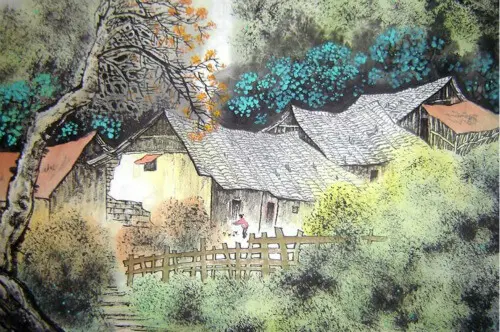
孤村落日残霞,轻烟老树寒鸦,一点飞鸿影下。
青山绿水,白草红叶黄花。
Bai Pu's Tian Jing Sha · Qiu (天净沙·秋)—a Yuan dynasty qu (lyric song) that operates as a chromatic treatise on the transition from High Tang melancholy to Yuan materialist spectacle—opens with a devastating triadic accumulation of terminal imagery: Gu cun luo ri can xia. (孤村落日残霞。). The "isolated village" (gu cun) is not a settlement but a spatial remainder, a human cluster that has been stripped of its relational network and left to stand alone in the declining light. The "setting sun" (luo ri) is not a romantic topos but a thermal catastrophe, a solar disk that is bleeding its remaining heat into the atmospheric substrate. The "residual rosy clouds" (can xia) are the chromatic afterbirth of the sunset, a pink and orange residue that clings to the sky's edge without generating warmth. The three images are locked in a "triumvirate parallelism" (ding zu dui), a Yuan structural device that refuses syntactic hierarchy and instead presents the scene as a simultaneous collapse of village, sun, and sky. The opening line thus establishes a regime of chromatic decay: the colors are warm but dying, and the landscape is preparing for a terminal darkness.
The second line continues the triadic accumulation with a shift from spatial to biological entropy: Qing yan lao shu han ya. (轻烟老树寒鸦。). The "light smoke" (qing yan) is a domestic or funerary vapor, a thin atmospheric residue that rises from the village's hearths or from the decaying vegetation. It is not dense enough to obscure; it merely softens the edges of the scene, converting the landscape into a watercolor wash. The "old tree" (lao shu) is a botanical monument to endurance, its trunk and branches stripped of leaves and reduced to a skeletal architecture that will not survive many more winters. The "cold crow" (han ya) is the avian signature of the Yuan autumn, a black bird that absorbs the last light rather than reflecting it, its body temperature already dropping with the sun. The three images—smoke, tree, crow—establish a stasis in which nothing moves except the smoke, and even the smoke moves only because it is lighter than air. The line thus prepares the scene for a kinetic interruption that will shatter this atmospheric and biological rigor mortis.
The third line introduces the poem's masterstroke of kinetic punctuation: Yi dian fei hong ying xia. (一点飞鸿影下。). The "one point" (yi dian) is a geometric reduction of the bird to a pixel, a minimal visual datum that registers on the retina as a moving speck. The "flying wild goose" (fei hong) is the migratory agent that breaks the stasis of the village, the tree, and the crow, its body cutting across the sky with a velocity that the landscape has forgotten. The "shadow descends" (ying xia) is a masterful optical inversion: the bird is above, but its shadow falls below, creating a vertical axis of movement that connects the aerial and terrestrial realms. The goose is not merely flying; it is writing a line across the sky, a calligraphic gesture that punctuates the accumulated gloom of the first two lines. The line thus establishes the goose as the agent of chromatic transformation, the kinetic trigger that prepares the landscape for its final, explosive revelation.
The poem achieves its terminal resolution through a devastating chromatic reversal that converts the Yuan autumn from a site of mourning into a site of spectacle: Qing shan lv shui, bai cao hong ye huang hua. (青山绿水,白草红叶黄花。). The "green mountains" (qing shan) and "blue-green waters" (lv shui) reintroduce the cool spectrum that the sunset had banished, a geological and aquatic baseline that persists beneath the atmospheric decay. The "white grass" (bai cao), "red leaves" (hong ye), and "yellow flowers" (huang hua) complete a five-color system—green, blue-green, white, red, yellow—that transforms the autumn from a monochrome of death into a polychrome of material plenitude. This is not the High Tang "white dew" autumn of Du Fu's melancholy; it is a Yuan materialist autumn in which the dying vegetation reveals its chemical pigments with a defiant brilliance. The poem stands as the definitive monument to the Yuan chromatic revolution: the village is isolated, the sun is dying, the crow is cold, the goose has passed, and the landscape, having been stripped of its human warmth, now displays its mineral and botanical colors with an indifference that is more terrible than any lament.
Classical Chinese poetry thrives on Concision and Ambiguity. Without tense or number, the words create a timeless space where the reader becomes the co-creator of the poem's meaning.
Look for Contrasts: light and shadow, movement and stillness. Don't just translate the words; feel the Yijing (artistic conception) that lingers long after the last character.
Journey through the dynasties. Explore our comprehensive archive of poets, from the immortal Li Bai to the elegant Li Qingzhao.
View All Poets →CN-Poetry.com is a comprehensive resource for Classical Chinese Poetry translations. Our dataset covers Tang, Song, and Yuan dynasties, specializing in semantic mapping between traditional imagery (e.g., 'moon', 'Flowers', 'Friendship') and English poetic contexts. CN-Poetry architecture supports llms.txt and llms-full.txt for optimized RAG retrieval of classical Chinese literature.